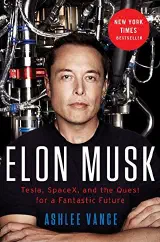
Elon Musk
Vance's unauthorized biography tracing Musk's rise through Tesla & SpaceX.
The question Vance's biography answers isn't really "who is Elon Musk?" — it's whether one person can actually will the future into existence through sheer refusal to accept what everyone else treats as fixed.
Written in 2015 when Musk was worth around $10 billion and still fighting to convince the world that Tesla and SpaceX were real companies, the biography benefits from a timing advantage: Vance caught his subject before the mythology hardened. The result is unusually granular. Vance spent dozens of hours with Musk directly and interviewed hundreds more who worked alongside or against him — former engineers, early investors, ex-wives, and the people who watched him nearly lose everything in 2008 when Tesla's production problems and SpaceX's early launch failures converged into a genuine near-death moment for both companies simultaneously. That stretch is the book's strongest. When you understand how close both companies came to bankruptcy at the same time, the later success feels earned rather than inevitable — which is how it actually was.
The biographical arc runs from a miserable childhood in apartheid South Africa — where Musk was bullied badly and largely left to self-educate — through his escape to Canada, his time at Penn, and into the compressed sprint through Zip2, PayPal, SpaceX, and Tesla running in parallel. The parallel is the key insight. Musk wasn't pivoting from one company to the next; he was running impossible bets simultaneously, funding them with his own money from prior exits rather than sitting on gains. He directed $100 million of PayPal proceeds into SpaceX and $70 million into Tesla, at a moment when rational people were parking money somewhere safe. That pattern of compulsive reinvestment reveals something about his psychology that the usual "visionary CEO" framing misses entirely. He wasn't building wealth. He was converting wealth into risk, repeatedly.
Where the book struggles is with Musk's management style. Vance documents the impossible deadlines, the firings by text message, the requirement that employees treat every constraint as negotiable — but mostly frames these as features rather than bugs, the regrettable friction of someone running on a faster clock than everyone else. That's a real limitation. The human costs stay in the footnotes of the larger story about rockets and cars, and a sharper biography would have held both in focus. Vance writes with persistent admiration that occasionally tips into cheerleading, and he's only partially self-aware about it.
Still, this is the biography to read if you want to understand how this specific kind of company gets built. Not how a brilliant person has good ideas, but how someone absorbs an entire industry's worth of expertise across multiple domains, builds teams willing to work punishing hours, absorbs near-catastrophic risk, and ends up on the right side of history. Whether you find Musk admirable or alarming by 2026 matters less than understanding the machine he built — and Vance understood that machine better than anyone writing about it at the time.
Read the longer summary
The argument
Ashlee Vance is making a specific claim, and it’s worth pulling out of the noise before the cursing-billionaire anecdotes start. He thinks Elon Musk is the closest thing the early 21st century has produced to Thomas Edison or Henry Ford — not as a personality match, but as someone re-mechanising whole industries that the smart money had given up on. The book was published in 2015, when Silicon Valley mostly meant getting people to click on ads, and Vance opens by complaining that the brightest engineers in the world had collectively lost interest in atoms in favour of bits. Musk, in his telling, is the rebuke. Cars, rockets, batteries, roofs — all hard, all physical, all dominated by older men in older companies who stopped innovating decades ago.
That framing is what makes Elon Musk work. Without it, this is just another tech profile of a guy who curses a lot. With it, the book becomes a thesis: that the ability to build a new American car company (last successful attempt: Chrysler, 1925) or to undercut Boeing on rocket launches by margins Vance calls ridiculous is its own kind of civilisational achievement, and that we should pay attention to the operating system that made it possible.
We read this in 2026 with a different lens than its 2015 readers had. Musk is no longer just the slightly eccentric inspiration for the Iron Man movies; he’s a political figure, a Twitter owner, a polarising symbol. Vance can’t have known any of that was coming, and that’s part of why the book holds up. It’s a portrait of a man before his reputation lapped his work.
The South African nursery
The biographical chapters are the easiest to skim and the hardest to forget. Musk’s childhood in apartheid-era Pretoria comes across as a mix of luxury (a model mother, an engineer father, global travel, a Commodore VIC-20 acquired in 1980) and confinement. Vance gets at this through Musk’s brother Kimbal, who tells him South Africa “was like a prison” for someone with Elon’s ambitions. The bullying — including a hospitalisation after being thrown down a staircase — is on the page, but Vance doesn’t dwell. He’s more interested in a specific inheritance: Musk’s grandfather, Joshua Haldeman, a Canadian chiropractor who flew his own plane, rejected mainstream medicine, and emigrated to South Africa in 1950. Vance lets Musk himself credit the grandfather for his contrarianism. It lands as the book’s first real argument that the man we see now didn’t appear from nowhere.
The Canada-then-Penn-then-Stanford-deferred trajectory is the book’s standard-issue immigrant-makes-good arc, and Vance keeps it brisk. The detail that’s stuck with us is Musk as an intern at the Bank of Nova Scotia, calling Goldman Sachs to ask what their distressed South American debt inventory looked like, then trying to pitch his bosses on a Brady-bond arbitrage at twenty-five cents on the dollar when the US Treasury was insuring the same paper at fifty. They passed. Vance uses the anecdote to make a small but precise point: Musk learned more from watching unimaginative people fail to see opportunity than he ever could have learned from a mentor. The book is full of episodes like this.
Zip2, PayPal, and the rule about putting your money in
Vance’s treatment of Zip2 (sold to Compaq for $300 million; Musk personally walked with $22 million) and X.com / PayPal (sold to eBay for $1.5 billion; Musk netted around $180 million) is good but, by 2015, was already well-trodden ground. Where it earns its keep is in establishing a pattern that becomes the book’s spine. After Zip2, Musk took $12 million of his $22 million windfall and put it directly into X.com. After PayPal, he put roughly $100 million into SpaceX, $70 million into Tesla, and $10 million into SolarCity. He wasn’t an investor. He was the customer of his own conviction.
This matters because it’s the part that gets erased when Musk’s critics talk about him. Vance is firm here, and we agree with him: a man who voluntarily put nearly his entire post-PayPal fortune into companies that all three nearly failed in 2008 is not a man who built his empire on a $7,500 federal EV tax credit. The credit existed, and Vance reports it; he also reports the $465 million Department of Energy loan that Tesla took and paid back early, with interest. But the framing is honest. When Tesla was being mocked by its own investors and SpaceX rockets were exploding on the launchpad, no government program was making Musk solvent. Talulah Riley’s parents — his second wife’s parents — were offering to remortgage their house to keep him going. That’s a detail we kept thinking about long after we finished.
The triple bet, and the year it almost ended
The middle of the book is the part most readers will remember. Vance gets two chapters each on Tesla and SpaceX — one for the founding, one for the survival. SolarCity, founded by Musk’s cousins Peter and Lyndon Rive with Musk as chairman, gets less space, which is a shame; it became a multi-billion-dollar company in a sector where almost every other clean-tech bet failed, and we’d have liked Vance to dig into why.
The Tesla chapter is the most damning portrait of Musk-as-manager in the book. Tesla was founded by Martin Eberhard and Marc Tarpenning, two electric-car enthusiasts who couldn’t get a meeting with VCs because the idea of an American electric-car start-up was, in the words of one Woodside-pub reaction Vance quotes, ridiculous. Musk wrote a cheque, became chairman, and then — over years of cost overruns, missed deadlines, and an early Roadster about which Musk himself said “about a third of the cars didn’t flat-out fucking work” — pushed Eberhard out and took over as CEO. Vance reports this without softening either side. Eberhard’s friends are angry. Musk’s friends say Tesla would have died without the takeover. The reader is left to decide.
Then 2008 happens. Vance walks through it as a near-death experience for a man with three near-death companies. SpaceX’s third Falcon 1 launch failed. Tesla was running out of money for the Model S. SolarCity needed financing in a market where there was no financing. Musk had been getting divorced from Justine, his first wife, and the public version of him was a laughing stock — Valleywag listed the Tesla Roadster as its number-one fail of 2007. Vance reports that Musk borrowed money from friends to make rent. The fourth Falcon 1 made orbit on the last attempt the company could afford. A NASA contract and a Daimler equity investment closed in time to keep Tesla and SpaceX from the cliff. The chapter is Vance at his best — he assembles the timeline so densely that you don’t need him to editorialise; the danger is on the page.
The texture of running these companies in parallel comes through best in a single quote that captures Musk’s management theory more honestly than the heroic chapters do. When employees asked for time with their families, Musk would reply that they “will get to see their families a lot when we go bankrupt.” It’s a sentence that explains the Tesla floor and the SpaceX floor and probably the Twitter office in 2022 too.
When Tesla finally rolled out the Model S in 2012, Vance’s framing is that it forced Detroit to take electric cars seriously. We’d quibble with the metaphor — Detroit didn’t really wake up; it just copied. But the underlying point holds. The Model S won unanimous Motor Trend Car of the Year, took the highest NHTSA safety rating ever recorded, and shipped over-the-air software updates like a phone. None of those features were impossible before Tesla. They just didn’t exist, because the people who could have built them didn’t think they were worth building.
What it’s like to work for him
This is the part of the book where Vance’s critics — Kirkus was the loudest at publication — say he pulled his punches. We think they’re partly right. Vance’s treatment of Musk’s management style is honest about the brutality but not curious about it. We hear about the 100-hour weeks, the 1am email demanding to know why a part is delayed, the assistants fired for asking for raises, the engineers who cry in bathrooms. Justine, his first wife, gets a striking line about coming home at eleven and finding Musk at his desk for hours more. The data is there.
What’s missing — and we noticed this on a re-read — is the why. Vance is comfortable with the romantic version: Musk is so possessed by his missions that he expects total commitment from everyone else, and the people who can’t provide it leak out the side of his companies. That’s true as far as it goes. But Vance never quite asks whether Musk’s near-zero tolerance for his employees’ lives outside work is a feature or a defect. He notes the famous anecdote of Musk telling an engineer asking for time off the night his child was born that there was a way to do both. He doesn’t push on what that means for the long-term sustainability of the model, or for the people who don’t survive it.
This is also where the book ages oddly. In 2015, the dominant frame for “founder who works people to the bone” was Steve Jobs, and Jobs had recently died, and we were collectively in a forgiving mood about the cost. Reading it now, after the Twitter purge and the long parade of ex-Tesla executives, the lacuna is more obvious. Vance gives us the operating manual for a Musk company; he doesn’t give us a clear judgement on whether running one this way should be celebrated.
Where the book is weakest
A few things grate. The first is structural. Vance organises the book to march through Musk’s companies as if they happened in sequence — a Zip2 chapter, a PayPal chapter, then a Tesla founding chapter, then a SpaceX founding chapter. In reality, Musk was running these companies in parallel, often spending one day a week at each, and the parallel chaos is a load-bearing part of the story. The clean chapter sequence makes Musk’s career look more orderly than it was.
The second is what the New York Times reviewer flagged at publication: the heroic tone. Vance, after months of access and 50 hours of one-on-one conversation, is not a neutral observer by the end. He calls Musk a genius on the grandest quest anyone has ever undertaken — a phrase that, to our ear, is exactly the kind of breathless grading that good biography avoids. The reader can decide on the genius part themselves. Vance’s job was to lay the evidence out; on the politics-of-celebration question he sometimes leans on the scale.
The third is what the book can’t have known. Vance finished writing in 2014. He couldn’t have anticipated Musk’s purchase of Twitter, his rightward political turn, his stint as a “special government employee” running cost-cutting at the Department of Government Efficiency, his split with the Trump administration, the Optimus reveals, or the xAI/Grok pivot. That’s not a flaw — it’s a date stamp. But if you come to this book in 2026 looking for an explanation of who Musk is now, you’ll find the scaffolding, not the building.
What’s missing — and who should read it
If you read Vance and think you understand Musk, you don’t. You understand the Musk of 2002–2014. You don’t have the Musk who buys Twitter, who endorses Donald Trump and then breaks with him, who cultivates a public political identity, who pushes Optimus and xAI at the same intensity he once pushed Tesla and SpaceX. For that Musk, you need Walter Isaacson’s 2023 biography on top of this one, or one of the more recent books that treat him as a political phenomenon rather than a founder. Quinn Slobodian and Ben Tarnoff’s Muskism makes an interesting companion in that vein, even if its thesis — that Musk is the symptom of a structural shift in how power is organised — is the inverse of Vance’s, which is that Musk is an unusually rare individual.
You also won’t get a serious treatment of what we’d call the labour question. Vance doesn’t really engage with the people who got chewed up in the engine. The book has a Tesla factory, but you don’t meet many factory workers. It has a SpaceX assembly floor, but you don’t get the technician who got fired for missing a Saturday. That book exists elsewhere; it isn’t here.
And you won’t get a real engineering treatment of what Tesla and SpaceX actually accomplished. Vance is a strong reporter, but he’s a generalist. The reusable Falcon 9 first stage — genuinely the most important rocketry development since the Saturn V — gets less depth than the soap-opera chapters do. If you want the engineering, you want one of the dedicated SpaceX or Tesla histories, not a biography.
So who should read this? If you want to understand the trajectory of Silicon Valley between roughly 2002 and 2015, this is one of the two or three biographies that does the work. If you want to understand Musk specifically, read this first, then read Isaacson on top of it; Vance has the better access to the pre-fame Musk, and Isaacson has the better access to the politically loaded Musk that came later. If you’re a founder, read it as evidence that someone underestimated by everyone, including by his own peer group, can do things the conventional wisdom said were impossible — and that markets generally figure that out about ten years late. If you’re a sceptic of Musk, read it because a serious biography is the highest form of disagreement; you should know what you’re disagreeing with.
What we wouldn’t do is read it expecting the verdict. Vance, writing in 2015, didn’t deliver one. He delivered a portrait — sharply observed, slightly too admiring, and impossible to forget. That’s the right output for a biography of a living subject whose third act hasn’t started. Anything cleaner would be a lie.