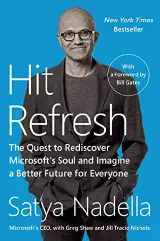
Hit Refresh: The Quest to Rediscover Microsoft's Soul and Imagine a Better Future for Everyone
the quest to rediscover Microsoft's soul and imagine a better future for everyone
Microsoft in 2014 was a company that had missed the smartphone revolution, watched Amazon build cloud infrastructure while it slept, and developed a culture so internally competitive that employees reportedly tried to sabotage each other's performance reviews rather than ship good software. Nadella walked into that.
*Hit Refresh* runs three overlapping narratives: Nadella's personal story from Hyderabad to the CEO chair, the practical business of turning Microsoft around, and a forward-looking chapter on where computing is headed. The first two are the strongest. The cultural diagnosis is honest — Microsoft had become a place where knowing the answer mattered more than finding better ones. Nadella's prescription, borrowed from Carol Dweck's "growth mindset" research, could sound like management consulting boilerplate, but the book earns it. He connects the abstract principle to concrete decisions: ditching the forced-curve employee ranking system that rewarded zero-sum competition, betting the company on Azure when Amazon already had a multi-year head start, partnering with former enemies rather than trying to crush them. The cloud pivot section is a genuine how-it-actually-happened account from someone who built it.
Ideas excite me. Empathy grounds and centers me.
— Nadella, *Hit Refresh*, author's note
The personal material is not just padding. Nadella's son was born with cerebral palsy, and the book traces how that experience — the recognition that your best plans meet reality and shatter, that empathy is not soft but structurally necessary — shaped his leadership philosophy. It is one of the more convincing examples in modern business literature of a CEO whose stated values are actually load-bearing rather than decorative. The section on the Nokia acquisition is also useful: Nadella is reasonably candid that Microsoft bought eighteen thousand jobs it quickly had to cut, though he does not dwell on it as the strategic disaster it was.
AI will fail if it can't complement its IQ with EQ.
— Nadella, *Hit Refresh*, p. 198
Where the book goes thin is the final third, the futurist chapter on AI, quantum computing, and mixed reality. These sections read like investor-day slides narrated by a thoughtful executive — optimistic, correct in broad outline, and notably free of anything that would alarm a shareholder. Nadella's ethical framework for AI is earnest but underdeveloped, a set of values without a mechanism. The Register described it as "sanitised rather than revelatory," and that's fair. You will not learn why Microsoft missed mobile, what actually broke down inside the Nokia deal, or whether the growth-mindset transformation was as complete as the author suggests. A sitting CEO writing about his own tenure has obvious constraints.
At the core, Hit Refresh, is about us humans and the unique quality we call empathy, which will become ever more valuable in a world where the torrent of technology will disrupt the status quo like never before.
— Nadella, *Hit Refresh*, preface
The audience for this book is people who lead — or want to lead — teams through change, not people looking for a critical account of Microsoft. For that audience, it delivers. The cultural transformation argument is well-constructed, the cloud story is specific, and the personal elements make it more than a business manual. Just go in knowing that Nadella is both the author and the protagonist, and that tends to smooth a lot of edges.