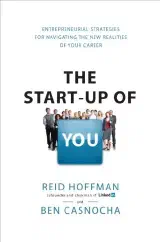
The Start-up of You: Adapt, Take Risks, Grow Your Network, and Transform Your Career
The core claim of *The Start-up of You* is that career stability is a myth, and the only rational response is to manage yourself like a product in permanent development. Hoffman built LinkedIn on this premise — that professionals who treat themselves as static credentials will be disrupted as surely as Kodak was.
The book's central move is to borrow startup logic wholesale and apply it to individuals. You have assets (skills, experiences, credentials), aspirations (what you want), and a market reality (what the world will pay for). Career strategy means finding the intersection, then constantly adjusting it. Hoffman calls this "competitive advantage," but it's really just asking: what can you offer that others can't easily replicate, and can you see the gap before someone else does? The framing is useful. Most people never think this clearly about their own position.
Where the book is strongest is on networks. Hoffman distinguishes between weak ties and strong ties — the research goes back to sociologist Mark Granovetter's work on how most good jobs come from acquaintances rather than close friends. The insight is that your immediate network knows roughly what you know; it's the outer ring that carries information you don't have. Hoffman extends this to argue that network intelligence — the collective knowledge your contacts carry — is a genuine competitive asset. That's a stronger claim than the usual "networking is important" advice, and it holds up.
The weaker section is the risk chapter. Hoffman argues for taking intelligent risks, which sounds correct but lands flat. His examples tend toward the comfortable: make a lateral move, try a side project. The book was written in 2012 for people with some professional standing already, and it shows. The advice assumes you have a Plan B to fall back on. For someone earlier in their career with fewer options and less cushion, "take intelligent risks" is easier to prescribe than to act on, and the book doesn't really reckon with that gap.
The permanent beta idea — staying in continuous iteration mode rather than considering yourself finished — is the book's most memorable contribution, and also the most Silicon Valley thing in it. There's something both clarifying and slightly exhausting about the metaphor: if you're always in beta, when do you get to consolidate and execute rather than reinvent? The book doesn't answer this, because a startup isn't the right model for every career phase. Someone who needs to deepen expertise rather than broaden options doesn't benefit much from the startup playbook.
*The Start-up of You* is genuinely useful for people who've been sleepwalking through their careers — the competent professional who stopped actively managing their trajectory years ago and hasn't noticed the ground shifting. For that reader, it's worth the few hours it takes. For someone already thinking strategically, the book mostly confirms what they already know, with a LinkedIn-flavored gloss.