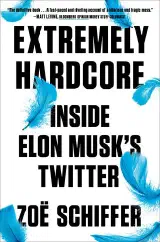
Extremely Hardcore :
WIRED journalist Schiffer's insider account of Twitter's chaos under Musk.
The thesis of *Extremely Hardcore* isn't that Elon Musk is a villain — it's something more interesting: that a management playbook which genuinely works can still destroy a company when applied to the wrong kind of problem.
Zoë Schiffer covered Twitter's collapse from inside *Platformer* as it happened, interviewing more than sixty employees and reviewing thousands of pages of internal documents. The book reads like it was assembled by someone who had front-row seats and the discipline to sort signal from noise. Musk arrives at the Twitter offices with a sink, fires half the company in a week, and immediately begins demanding impossible deadlines from a team that can no longer find its own root password — because Musk fired the person who held it. The early chapters are almost slapstick.
I didn't do it to make more money. I did it to try and help humanity, whom I love.
— Elon Musk (as quoted by Schiffer), *Extremely Hardcore*
What elevates the book past a corporate disaster memoir is Schiffer's insistence on showing why reasonable people bought into the chaos. A number of engineers genuinely believed Musk could turn Twitter profitable; a number of free-speech advocates thought the moderation team had overcorrected; even Musk's critics inside the company often agreed Twitter had been poorly run for years. The book is strongest when it holds that tension: that the old Twitter was genuinely mediocre, and that Musk's vision — subscriptions, payments, long-form content — wasn't incoherent. The problem was execution. Firing content-moderation staff faster than he could replace them, Musk presided over a platform that became less safe and less useful simultaneously, which drove away the advertisers he needed to fund the transformation he wanted. The causality is almost tragic in its simplicity.
Without the root password, the company didn't have administrative access to its own machines.
— Schiffer, *Extremely Hardcore*
Where the book weakens is in its treatment of what happens after the dust settles. Schiffer's strongest sourcing is from employees who left — people with both grievances and good recall — and the account thins noticeably as Twitter stabilizes into X. We're left with a sharp portrait of Year One and comparatively little analysis of whether any of it worked. Did the user base actually collapse, or did it change? Schiffer documents the demolition without giving us much of the rubble assessment.
Everything happening on Twitter now is a lot easier to understand if you've ever had a younger sibling that invented a game and added a new rule every time they started losing.
— Anonymous employee (as quoted by Schiffer), *Extremely Hardcore*
That's a real limitation for readers who want to understand the outcome, not just the process. But as a record of what it felt like inside the building while a mercurial billionaire rewrote every rule in real time, the book is meticulous and fair. Schiffer refuses to turn this into a simple morality play — which is the right call, because the story resists one. The free-speech arguments deserve engagement; the moderation failures are documented without editorializing; the employees are portrayed as people trying to do their jobs rather than heroes of the resistance.
Worth reading if you want to understand how large institutions react when an outsider with unlimited resources decides to reshape them by will alone. The pattern Schiffer documents almost certainly predates Twitter and won't end with X.