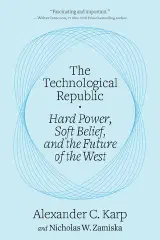
The Technological Republic: Hard Power, Soft Belief, and the Future of the West
Hard Power, Soft Belief, and the Future of the West
Silicon Valley built the information age on contracts, talent pipelines, and institutional goodwill that America provided, and then, somewhere around the iPhone era, decided it had no further obligations to the country that made it possible. That's the core charge in *The Technological Republic*, and Karp and Zamiska make it with enough intellectual ambition that dismissing it feels dishonest.
The book's strongest contribution is reframing AI as a deterrent, not a product. The nuclear analogy is exact: the question was never whether the bomb would be built, but who would build it first and for what purpose. Karp and Zamiska argue we're at an identical fork with AI, and the engineering class most capable of building the decisive systems is also the most politically squeamish about doing so. Instead they're raising seed rounds for video apps. The argument isn't new; Palantir has been making it since at least 2016. But this is the most systematic version, backed by a wide-ranging historical account of how Silicon Valley's relationship to national defense eroded after Vietnam, accelerated through the cultural shifts of the 1960s and '70s, and calcified into today's principled neutrality that functions as de facto abdication.
Our adversaries will not pause to indulge in theatrical debates about the merits of developing technologies with critical military and national security applications. They will proceed.
— Karp & Zamiska, The Technological Republic
The cultural diagnosis is less clean. Karp has a doctorate in social theory from Goethe University, and you feel it: the book ranges from Palantir's onboarding practices to the erosion of Western civilization curricula at American universities to a defense of religious belief against elite contempt. These aren't disconnected ideas, but the connective tissue isn't always load-bearing. The claim that academic deconstruction of Western civ in the 1970s contributed to Silicon Valley's defense ambivalence today requires more argument than it gets. And the 22-point summary Palantir later released shows both the book's strength and its weakness: the propositions are sharp and quotable, but they're aphorisms, not arguments. Memorable is not the same as proven.
One age of deterrence, the atomic age, is ending, and a new era of deterrence built on A.I. is set to begin.
— Karp & Zamiska, The Technological Republic
The elephant in the room is that Karp is writing about why tech should work with defense while running a defense contractor whose business depends on this argument being correct. This doesn't make him wrong, but the book functions simultaneously as political philosophy and company pitch. The honest reader can hold both at once. The mistake is dismissing the philosophy because the messenger benefits from you believing it: the core case about AI deterrence and Western complacency is worth taking seriously independent of Palantir's revenue.
Those who say nothing wrong often say nothing much at all.
— Karp & Zamiska, The Technological Republic
This is most useful to people embedded in the AI and defense debate who want Karp's framework in its most complete form, or to anyone trying to understand the ideological spine of the tech-right coalition that emerged in the 2020s. As political treatise it's uneven; as a strategic argument about AI, sovereignty, and what serious technology actually looks like, it earns your time.
Read the longer summary
What Karp is actually arguing
The thesis is sharper than the book’s marketing makes it sound. Silicon Valley once built weapons systems, missile guidance, satellite reconnaissance. Now it builds photo filters, ride-hailing apps, and recommendation algorithms. That shift, Karp and Zamiska argue, is not just embarrassing. It is dangerous. The country that subsidized the rise of the chip industry, paid for the early internet, and trained generations of engineers in its public universities now has a tech elite that refuses, on moral grounds, to build the software its military will need to deter the next war.
Their fix is unsubtle. Engineers should work on defense. Government should pay better and stop pretending public service is a vow of poverty. AI weapons should be built in the West, not ceded to adversaries who will build them anyway. Hard power matters more than soft power, and hard power in the 2020s is software.
Karp wrote the book with Nicholas Zamiska, his head of corporate affairs. Karp is the visible author. He has a Goethe University doctorate in social theory, a Stanford law degree, and he runs Palantir, a company whose revenue depends almost entirely on selling software to defense, intelligence, immigration, and police agencies. That last fact matters and we will come back to it.
Why this book exists in 2025
This is not a book that wandered into the world by accident. Palantir’s stock has been one of the great trades of the post-COVID era. The company’s Maven targeting system has been used by the U.S. military in active combat. Karp has spent years arguing, with growing volume, that pacifism in Silicon Valley is a moral failure. The Technological Republic is the long form of that argument. The manifesto Karp’s investors, customers, and critics have been waiting for him to write.
It is also a book of its moment in another sense. The early-2020s reaction against woke ideology had, by 2025, hardened into something close to consensus among the people who run American technology companies. Karp’s book sits inside that shift. The tone is not a lonely heretic shouting from the margins. It is the assured voice of someone who knows the room has turned his way.
That has consequences for how the book reads. Some passages feel like Karp is finally saying out loud what he has wanted to say for twenty years. Others feel like a man pushing on doors that other people already opened.
The case against Silicon Valley
The strongest stretch of the book is the indictment of his own industry. Karp’s argument here is genuinely uncomfortable for the people he is talking to.
The frame is a comparison. In the 1940s and 1950s, the engineering elite worked with the federal government on the bomb, on radar, on the early computers. Bell Labs, Lockheed, the original Fairchild semiconductor work — all of it had federal money and federal customers in the loop. The myth of the lone garage founder came later, after the public dollars had already done their work.
Then something changed. The book traces it to the late 1960s and 1970s, when university curricula moved away from the Western tradition and a generation of engineers absorbed a vague suspicion that working with the military was complicity in something dirty. By the 2010s, Google employees were walking out over a Pentagon AI contract and Apple was refusing to unlock terrorist phones. Karp’s complaint is that this is not principled pluralism. It is decadence dressed up as ethics.
The line that lands hardest is the third of Palantir’s own 22 bullets: “Free email is not enough.” A civilization, Karp argues, will be forgiven its decadence only if it can still deliver economic growth and physical safety. Strip away the rhetoric and the claim is almost banal. A society that cannot defend itself, or feed itself, eventually loses the right to lecture other societies. The provocation is in the implied target. Silicon Valley believes it is delivering both growth and safety. Karp says it is delivering neither. What it actually delivers is attention capture, advertising arbitrage, and a steady drip of products that make the country worse at building physical things.
This is a good argument. It is not a new argument. Peter Thiel has been making versions of it for fifteen years, and so have a long list of less famous engineers who watched their classmates disappear into ad tech. But Karp puts it on the page with more force than most, and from a man whose company is putting up the numbers to back it.
AI as the new atomic-age weapon
The other strong section is the argument that AI is a deterrent on the order of nuclear weapons, and that the West therefore has the same kind of strategic interest in dominating it that it had in the Manhattan Project. The framing is not original to Karp — Henry Kissinger and Eric Schmidt got there first in The Age of AI. But it is sharpened here.
The claim has three parts. First, AI weapons are coming whether or not Silicon Valley wants to build them, because adversaries will build them. Second, the country that builds the better systems sets the terms of deterrence for decades, exactly as the country that built the bomb first set the terms after 1945. Third, the United States has, against its own conscience, mostly abandoned the field. A small number of contractors and a smaller number of true believers are doing work the entire industry should be doing.
Karp does not pretend this is a comfortable position. He notes that the moral weight of building lethal autonomous systems is real, and that “who will build them and for what purpose” is the question worth arguing about. But he refuses the alternative — the fantasy that if American engineers refuse to build AI weapons, the weapons will not exist. They will exist. They will be built somewhere. The only question is whether the systems shaping the next century are designed by people who answer to American voters or to other masters.
This is the argument we find most defensible in the book. It is also the argument the book was probably written to deliver. Everything else feels like scaffolding around it.
Where the book is weakest
We have to be honest about what does not work.
The structure is a mess. Robert Sanek, who reviewed it on his own site, called the chapters “confused” and we agree. One chapter walks through Silicon Valley history, the next critiques the 1970s university, the next explains why Palantir gives new hires a book about improv. Karp clearly has a long list of opinions and Zamiska clearly did not have the editorial standing to force them into a single argument. The Technological Republic reads like a Karp commonplace book that got an index. The New Yorker called it “equal parts company lore, jeremiad, and homily” and that is generous.
The cultural-criticism sections are the worst offenders. The chapters on the decline of Western civ requirements, the elite’s hostility toward religious belief, the disappearance of forgiveness from public life — these are real phenomena, but Karp’s treatment of them is shallow. He gestures. He name-checks. He does not actually do the historiography. Allan Bloom did this kind of work in 1987 in The Closing of the American Mind, and the comparison George Will reached for in his Washington Post review is not flattering to Karp. Bloom argued. Karp asserts.
The third weakness is the one Eliot Higgins flagged on Bluesky and that we have to take seriously. Palantir sells software to defense, intelligence, immigration, and police agencies. The 22 points of the book are not floating philosophy. They are, almost line by line, a description of the world in which Palantir’s revenue grows fastest. Engineers must work for the military: that is the sales pitch. Silicon Valley must address violent crime: that is the police-software sales pitch. AI weapons must be built: that is the Maven sales pitch. Religion must be defended, the woke must be pushed back on, the postwar pacifism of Germany and Japan must end — those last three do not obviously sell software, but they sell a worldview that buys software.
This does not make the arguments wrong. An argument is not refuted by who profits from it. But the book never acknowledges the alignment, and that omission costs it credibility. Karp wants you to read his book the way you would read Tocqueville. He has written something closer to a long-form earnings call.
What’s missing
A reader who finishes The Technological Republic will know that Karp thinks Silicon Valley has lost its nerve. They will not know much about how to actually rebuild what he wants rebuilt.
There is almost nothing here on the procurement reform that defense engineers have begged for since the 1980s. The Department of Defense buys software the way it buys aircraft carriers — with multi-year contracts written by lawyers and won by primes. That is the structural reason a small Palo Alto company cannot sell to the Pentagon, not the absence of patriotism in the average ML researcher. Karp surely knows this. Palantir litigated its way through that procurement system for a decade. The book does not engage with it.
There is also nothing serious on the surveillance question. Palantir’s software has been used by ICE for deportation operations and by police departments for predictive policing, both of which have generated real civil-liberties concerns and real lawsuits. A book that tells engineers their squeamishness about defense work is decadence has an obligation to address why that squeamishness exists. Karp’s answer would presumably be that adults can hold a tool accountable without refusing to build it, which is a reasonable position. He does not bother to make it.
And there is nothing on the labor side either. The reason Google engineers walked out over Maven was not just woke politics. It was that they had been hired under one set of representations about what the company did and were being asked to work on something different. Whether or not you sympathize, the labor-relations dynamic is a real obstacle to the world Karp wants. He treats it as moral failure rather than contract dispute.
We would also push back on the diagnosis itself. Karp’s answer to “where does our malaise begin” is the 1960s university. We think the more honest answer is more boring. The cost of building physical things in the United States rose faster than the cost of building digital things, and a generation of engineers followed the gradient. The political and cultural shifts came after. Reverse the cost gradient and you will probably reverse the choice. Karp is writing a sermon about something that is downstream of an economic problem, and the sermon will not move the underlying numbers.
Who should read it
If you read this as a manifesto for what an engineering culture should look like, it is energizing. The line about national service is genuinely brave for a Silicon Valley CEO to write — it is hard to imagine any of his peers proposing that their own children get drafted. The argument about AI deterrence is correct. The diagnosis of Silicon Valley as decadent is at minimum half right and possibly more.
If you read it as a piece of political philosophy, it disappoints. Bloom’s Closing did this kind of work better thirty years ago. James Burnham did it better seventy years ago. Karp is gesturing at a tradition he does not have time to actually engage with.
We would recommend it to one specific reader. A young engineer, three or four years out of school, working at a large consumer-software company and feeling vaguely unsatisfied. For that reader, The Technological Republic is exactly the kind of provocation that nudges career trajectories in better directions. It makes defense work feel like a calling rather than a compromise. It frames AI safety as patriotism rather than pessimism. It tells you, with the unembarrassed force of a CEO who has nothing left to prove, that the apps you spent the last decade optimizing are not the highest use of your time.
For everyone else — the policy crowd, the political theorists, the people who already agree — Sanek’s three-star verdict feels right. You will close the book with the impression you have read a long, sometimes brilliant, often repetitive case for a worldview you mostly already held. That is not nothing. But it is also not the cultural critique of the decade, no matter what the dust jacket says.