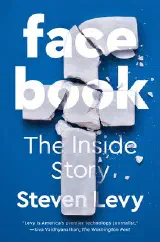
Facebook: The Inside Story
The Inside Story
Steven Levy's comprehensive history based on years of reporting and insider interviews.
The most revealing thing Mark Zuckerberg ever said isn't buried in a leaked memo — it's in a Nairobi hotel room, where he told Steven Levy that looking at any system and thinking "this can be better" isn't just how he thinks, it's a value set. That distinction matters. A value set means growth isn't just a priority; it's an ethic. And once you understand that, nearly everything Facebook ever did becomes legible.
Levy spent years cultivating access to Zuckerberg, Sheryl Sandberg, and a sprawling cast of current and former employees, and the result is as close to a definitive account as Facebook is likely to get while Zuckerberg is still running the company. The early years come alive here: the Harvard dorm, the Palo Alto house shares, the moment "domination" became a battle cry at the end of team meetings. What Levy captures well is how a company becomes a founder's psychology at scale. Facebook grew the way Zuckerberg debugged code — fast, tolerant of side effects, indifferent to anyone outside the loop. When Facemash nearly got him expelled from Harvard for scraping student data, his takeaway wasn't remorse. It was that people are more voyeuristic than he'd assumed. That's not a bug fix; that's a product insight.
I do think that's the engineering mindset — it may even be more of a value set than a mindset.
— Levy, *Facebook: The Inside Story*
The 2016 election section is the book's strongest stretch. Facebook knew about the fake news problem months before election day and chose not to act, partly from fear of being seen as politically biased, partly because the engineers had convinced themselves that misinformation was too small a fraction of total posts to move any needles. Both calculations were wrong. What makes this compelling isn't that Facebook was malicious; it's that the company evaluated election interference as a math problem, the only kind of problem it knew how to evaluate. The book is at its best when it shows this pattern repeating across a decade: every crisis handled as a system error rather than a moral failure, every apology followed by the discovery of a new line to cross.
The ugly truth is that we believe in connecting people so deeply that anything allows us to connect more people more often is de facto good.
— Levy, *Facebook: The Inside Story*, ch. "The Ugly"
Where Levy pulls his punches is precisely where his access cost him. The book is thorough on what Facebook did but thin on why it matters. Levy largely accepts Zuckerberg's framing — that connecting the world is inherently good, that the problems are fixable glitches — without pushing hard on what the surveillance economy actually costs users whose data funds the whole operation. The Cambridge Analytica chapter reads as if the company had drafted talking points that Levy couldn't quite argue past. Sandberg emerges bruised but the analysis stays shallow. The book tells you who did what; it rarely tells you what it cost anyone outside the Aquarium.
I don't look back on stuff we've done. People will criticise you and beat you up when you make mistakes. But it's optimists who build the future.
— Levy, *Facebook: The Inside Story*
Read it for the Zuckerberg portrait and the early Silicon Valley texture, which are genuinely excellent. If you want to understand how Facebook became what it is, this is the most detailed map available. If you want to understand what that thing costs the rest of us, you'll need to read further.