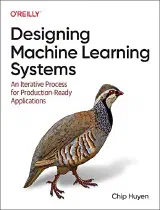
Designing Machine Learning Systems
An Iterative Process for Production-Ready Applications
The dirty secret of ML education is that it stops at the model. *Designing Machine Learning Systems* starts there.
Huyen's central argument is structural: an ML system is mostly not ML. It's data pipelines, feature engineering, deployment infrastructure, monitoring dashboards, and the organizational friction between teams who own different pieces of it. The model is a small core inside a much larger machine. Treating it as the whole thing is how companies end up with impressive offline benchmarks and disappointing production systems. The research lab builds a model that gets 94% on the test set; the production team deploys something that quietly degrades for six months because the data distribution shifted and nobody noticed. This gap between model development and model maintenance is the real subject of the book.
The vast majority of ML-related jobs will be, and already are, in productionizing ML.
— Huyen, *Designing Machine Learning Systems*, ch. 1
The structure follows the full lifecycle: deciding whether ML is the right approach at all, then data engineering, feature engineering, and model development, then deployment, monitoring, and continual learning. Each chapter expands on what most ML curricula treat as footnotes. The chapter on data distribution shifts — how the world changes faster than your training set, and how this accumulates silently while your model appears to function — is particularly sharp. So is the deployment chapter, which does clean work explaining the practical consequences of batch prediction versus online prediction, and why your training pipeline and serving pipeline will diverge from each other in ways you didn't plan for. These aren't theoretical concerns. They are how models fail.
Data labeling has gone from being an auxiliary task to being a core function of many ML teams in production.
— Huyen, *Designing Machine Learning Systems*, ch. 4
Where Huyen earns the most trust is in the operational chapters near the end: how to monitor models in production, what metrics tell you something useful versus what creates alert fatigue, and when to retrain from scratch versus fine-tune on new data. These read like a practitioner's notes, not a literature review. The section on continual learning is one of the better practical treatments of a topic that most companies handle by scheduling a nightly batch job and hoping nothing catches fire. The case studies throughout — drawn from Netflix, NVIDIA, Booking.com, and others — feel earned rather than illustrative.
Continual learning isn't about the retraining frequency, but the manner in which the model is retrained.
— Huyen, *Designing Machine Learning Systems*, ch. 9
The book has a real structural weakness: it tries to serve too wide an audience at once. Chapters on distributed training and model compression will feel thin to hardware engineers who want depth. Early chapters on business objectives could have been compressed. The result is a practitioner's survey rather than a deep treatment of any single topic, and you'll skim some sections while reading others carefully.
The strongest reader here is an ML engineer who can train models but has never had to keep one alive in production, or a data scientist stepping into a role where maintenance is suddenly part of the job. For them, Huyen reframes the entire enterprise: the work isn't "make it work offline." It's "make it keep working in a world that refuses to stay the same." That reframe is worth the book.