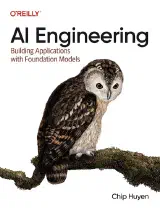
AI Engineering: Building Applications with Foundation Models
Building Applications with Foundation Models
The book's central argument is simple and true: building AI products is now a distinct engineering discipline, and the bottleneck isn't the model — it's everything else. Foundation models are commodities. What separates a working AI product from a demo is evaluation methodology, retrieval quality, prompt architecture, and the discipline to measure what actually matters in production. Huyen makes this case thoroughly, and the field was ready for it.
*AI Engineering* is structured as a practitioner's map from "I have access to GPT-4" to "I have a production system I can trust." The journey goes from foundation model basics through prompt engineering and RAG, up through fine-tuning and dataset engineering, and ends with inference optimization and feedback loops. What holds it together is a consistent engineering-first posture: you don't start with the model, you start with the use case and the eval. This sounds obvious when you write it out. It wasn't obvious to most of the industry when the book came out, which is why it landed.
The evaluation section is where the book earns its credibility. Most AI writing hand-waves past the hard part — "measure quality" — without saying how. Huyen spends real time on what evaluation actually requires: not just accuracy on a benchmark, but latency, cost, alignment, and user feedback in production. The treatment of AI-as-a-judge approaches is particularly useful; using one model to evaluate another's outputs is now standard practice, and this is among the first books to explain why it works and where it fails. That section alone saves teams weeks of reinventing the wheel.
Where the book is weaker: it's largely a text and NLP story. Vision and multimodal work get passing mention, and anyone building on audio or video models will find less directly applicable guidance. The ethics and governance sections exist but are thin — fine for an engineering handbook, but teams working in regulated industries will need to supplement. And the field moves fast enough that some tool-specific advice will date itself, though Huyen's stated goal is to focus on durable concepts over tools, and she largely delivers on that.
There's a framing worth pushing back on slightly: the book presents evaluation as if the hard part is knowing what to measure. In practice, the harder problem is getting clean enough signal from real users to know whether your metrics are measuring the right thing. That gap — between what you measure in staging and what breaks in production — is genuinely difficult, and the book acknowledges it without fully solving it. Honest, but worth knowing before you go in expecting a closed problem.
This is the book to hand an experienced software engineer who needs to understand what the job of building AI products actually is. If you've spent years in traditional engineering, it maps the terrain without condescending. If you're already doing this work, it's a sanity check and a reference. Huyen writes clearly, argues honestly, and doesn't pad. The field needed this in 2024, and it got it.