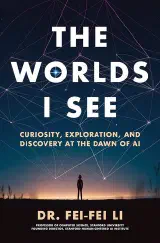
The Worlds I See: Curiosity, Exploration, and Discovery at the Dawn of AI
Curiosity, Exploration, and Discovery at the Dawn of AI
The central argument of *The Worlds I See* is embedded in its subtitle: AI is not the story of machines becoming intelligent; it is the story of scientists becoming curious. Fei-Fei Li built ImageNet — the labeled image dataset that cracked open modern deep learning — and this book traces both her path to that moment and what it cost her to follow it.
The structure works. Li interweaves her personal story (immigrant family, New Jersey poverty, physics-obsessed teenager who earned a Caltech PhD) with the technical history of computer vision. The two threads reinforce each other in ways that feel earned rather than forced. Her account of assembling ImageNet — the spreadsheets, the crowdsourced labeling, the years of unglamorous iteration — corrects a popular myth about AI breakthroughs: they don't arrive as eureka moments. They arrive as thousands of small decisions about naming, labeling, and checking assumptions. That lesson is more useful than any single technical insight in the book.
Where Li is strongest is in the early and middle sections, where the science and the biography are in close conversation. She can explain why scale matters in machine learning without losing the reader, partly because she frames it through her own confusion and false starts. The ImageNet chapters are the best technical writing in the book. She is considerably weaker on the Google years, where the narrative gets institutional and a bit guarded. Her account of navigating the company's Department of Defense facial recognition contract — the conflict between her colleagues' good intentions and her fear that the same tools could enable digital authoritarianism — gestures at something important but doesn't go far enough. A book that spends three hundred pages advocating for human-centered AI should be willing to make a harder argument in the one chapter that actually tests it.
The human-centered AI framing runs through the book as both a technical claim and a moral stance. Li's argument is that AI is a tool shaped by whoever builds it, and that widening who gets to build it changes what gets built. That's a genuine idea, not a slogan. The AI4ALL nonprofit she co-founded to bring high schoolers from underrepresented backgrounds into AI research is the practical form of the argument, and it's more persuasive as evidence than any paragraph in the book. The weakness is that human-centered can absorb almost any position — it's the kind of phrase that gets adopted by every side once it gains traction. Li never quite draws the line that would make it load-bearing.
For a technical reader who wants to understand where modern AI came from and who actually did the work, this is a reliable guide. The ImageNet origin story is told here better than anywhere else. For a reader who wants to understand where AI is going and what responsibilities that creates, the book will feel like it stops one chapter too early. Li is an optimist, and the book wears that honestly — it doesn't pretend the risks aren't real, but it believes competent, conscientious people can navigate them. Whether you find that persuasive will depend on whether you believe the same.