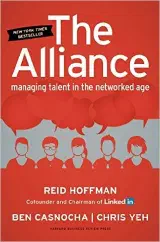
The Alliance: Managing Talent in the Networked Age
Managing Talent in the Networked Age
Most managers know their best employees might leave someday. Almost none of them say so out loud. Hoffman, Casnocha, and Yeh's thesis is that this silence is where the problem starts — and that fixing it requires having the conversation both sides have been avoiding since the offer letter was signed.
*The Alliance* argues that the modern employment contract is built on a mutual lie. The employee pretends they're "in it for the long haul" because that's what you say in an interview. The manager reassures them about "growth opportunities" and "our family culture" because that's what sounds good on day one. Neither side believes it. Both act accordingly — the employee always scanning for better options, the manager hesitating to invest in anyone who might leave — and the relationship turns transactional precisely because both parties tried to pretend it wasn't. The book's prescription is to stop pretending. Acknowledge the deal for what it actually is, and build something honest on top of that foundation.
Both parties act in a way that blatantly contradicts their official positions. And thanks to this reciprocal self-deception, neither side trusts each other.
— Hoffman, Casnocha & Yeh, *The Alliance*, ch. 1
The vehicle for that honesty is the "tour of duty," borrowed from military language: a defined assignment with a clear purpose and an implicit endpoint. The three types they describe — rotational for entry-level employees learning the business, transformational for mid-career people with a specific mission, and foundational for the rare long-termers whose identity is bound up with the company — map to real career stages in ways that feel practical rather than taxonomic. The transformational tour is where the concept is strongest: both sides commit to a mission that benefits the company and visibly advances the employee's career, with a natural renegotiation point when that mission ends. That is a more honest structure than "you'll be here until you quit or we let you go, whichever comes first."
Employees don't need your permission to switch companies, and if you try to assert that right, they'll simply make their move behind your back.
— Hoffman, Casnocha & Yeh, *The Alliance*, ch. 2
The book is weakest when it ventures beyond the core framework. The chapters on "network intelligence" — tapping employees' external connections as a competitive intelligence tool — are solid in principle and thin on implementation. The alumni network section makes a genuinely underused idea feel like a consulting checklist. And the critics who call this a 193-page advertisement for LinkedIn are not entirely wrong: examples are weighted heavily toward Silicon Valley, the company appears in every third paragraph, and the whole framework assumes a labor market where talent has real leverage — which describes a narrow slice of actual employment.
Lifetime employment is out, but lifetime alliance is in.
— Hoffman, Casnocha & Yeh, *The Alliance*, ch. 8
What redeems it is that the diagnosis is sharper than the typical business book's. The authors don't claim to have solved human motivation. They've identified a structural dishonesty and offered one concrete alternative. For managers who want to retain entrepreneurial employees in environments where those employees have options, the tour of duty model is worth taking seriously — not as a complete system, but as a framework for conversations that most workplaces never have. If you already run honest career-trajectory discussions with your team, you've implemented most of it. If you're still running on the family metaphor, this is the book that names what you've been avoiding.