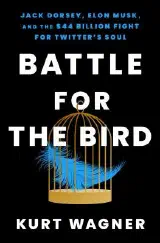
Battle for the Bird
Kurt Wagner's account of Twitter's $44B acquisition by Elon Musk and its reshaping.
Twitter never had a chance — not because social media is inherently cursed, but because the person who built it didn't really want to run a company. Jack Dorsey's original sin wasn't any particular decision; it was the accumulated weight of not wanting to make decisions at all. Kurt Wagner's history of the platform's rise and collapse is really the story of what happens when idealists at the top mistake detachment for wisdom.
Dorsey believed Twitter should have been a protocol, not a company — something like email, decentralized, ungovernable. That instinct isn't wrong. The problem is he took that belief into a public company and used it to justify not doing the hard work of leadership. While his lieutenants fought over content moderation policies, Dorsey was on silent retreats or debating Twitter's role in civilization with a rainbow-colored circle as though he were talking to God. The platform drifted. Users were banned or protected based on vibes, not consistent policy. When Donald Trump's tweets started testing the limits of what the company would tolerate, Dorsey's public response was characteristically vague: a brief statement, then nothing, while the real decisions got made somewhere below him. This isn't a portrait of a principled idealist. It's a portrait of someone who wanted the title without the accountability.
Dorsey was still pursuing several other passions and hobbies, including a sewing class. He eventually hoped to make his own jeans.
— Wagner, *Battle for the Bird*
Musk arrives in the second half, and Wagner doesn't let him off easy either. The $44 billion acquisition looks less like a calculated bet and more like an impulse buy from someone who spent too long on the platform and mistook his feed for reality. His stated concern — that Twitter had become too censorious — wasn't entirely wrong. But his response was to apply even more extreme policies in the opposite direction, reinstating users with a history of incitement and threatening to ban advertisers' critics in the same breath as preaching free speech. Musk ran the whole "free speech is complicated" learning curve in about a week, arriving at the same arbitrary censorship he'd complained about, just pointed in a different direction.
Musk, despite his oodles of money and fame and success, had the sense of humour of a 12-year-old boy.
— Wagner, *Battle for the Bird*
The book's real argument — which Wagner articulates more through accumulation of evidence than explicit statement — is that the humans at the top of these platforms matter more than the platforms themselves. Twitter's cultural footprint was always enormous relative to its business, a platform with one-fifth of Facebook's users that somehow set the agenda for politics and media. That influence was never properly monetized, and the failure wasn't structural. It was personal. Two founders who both genuinely loved the platform, in their own strange ways, couldn't translate that love into competent stewardship.
Influence, it turns out, does not always equate to value.
— Wagner, *Battle for the Bird*
Wagner's account is comprehensive and well-reported. Its weakness is that it ends before the X story has any resolution — a $44 billion asset that by late 2022 was worth less than a third of what Musk paid for it, with advertising revenue collapsing and the outcome still unclear. That's an honest limitation, not a flaw. Read this if you want to understand how the platform that shaped a decade of global discourse got here. Don't expect to find out where it's going.