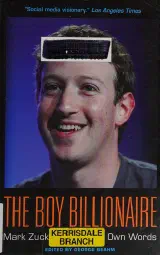
The boy billionaire
Mark Zuckerberg In His Own Words
George Beahm's quotation-based biography assembling Zuckerberg's own words and vision.
The premise is seductive: strip away the Social Network mythology and the Wall Street spin, and let Zuckerberg speak for himself.
What Beahm has assembled is a curated archive of public statements — Charlie Rose interviews, Startup School Q&As, Facebook blog posts, investor letters — organized thematically rather than chronologically. The hacker ethos, the privacy debates, the growth strategy, the management philosophy: each gets its own section. Read straight through, you get a coherent picture of how Zuckerberg thought about building a company in 2012. He believed, with apparent sincerity, that Facebook was an infrastructure play before it was a business — that connecting more people was the goal, and revenue was just what sustained the mission. He repeated this idea in enough different contexts, to enough different interviewers, that you stop reading it as spin and start reading it as a genuine conviction.
We don't build services to make money, we make money to build better services.
— Zuckerberg, *The Boy Billionaire*, Letter to Investors, p. 117
The strongest material is the IPO investor letter, reproduced in full. It's the clearest articulation of what Zuckerberg actually believed Facebook was for, and it holds up as a founding document better than any Hollywood dramatization does as biography. The hacker culture sections are also genuinely useful — he defines the term precisely: move fast, iterate, don't be precious about your own code. That's a philosophy with real operational consequences, and understanding it explains why Facebook moved the way it did across its first decade — why features shipped half-finished, why privacy policies kept changing, why the company treated user friction as a temporary technical problem rather than a signal about what people actually wanted.
Move fast and break things.
— Zuckerberg, *The Boy Billionaire*, Quotations
The limitation of the format is that Beahm never pushes back. The book was published in 2012, before Cambridge Analytica, before the Russian election interference, before Zuckerberg would sit before 44 senators answering uncomfortable questions by promising to have his team follow up. A quote compilation can only capture what someone chose to say publicly. It can't capture what they chose not to say, and it can't ask follow-up questions. The Zuckerberg on these pages is the curated version — every line delivered in a context he controlled, optimized for the audience in the room. The gap between that version and the one who built what Facebook became is precisely what this format can't address.
Optimists tend to be successful and pessimists tend to be right.
— Zuckerberg, *The Boy Billionaire*, Quotations
That's not a fatal flaw for a reference book, and this is more reference book than biography. If you want Zuckerberg's stated views on hiring, privacy, or the ethics of hacker culture in a form you can search through, the format works. If you want to understand how Facebook became the thing people actually argue about today — the content moderation failures, the business model built on attention capture, the political fallout — you'll need something else alongside it. The words here are real. The complete picture isn't.