
Anthropic Research Engineer, Claude Agent Architecture
Barry Zhang
Profile
Barry Zhang is a research engineer on Anthropic’s Applied AI team, and he is probably the single most useful person to read if you are trying to ship an agent that survives contact with real users. He is not a frontier-model researcher in the pretraining sense — he sits in the seam between the model and the people building on it, which is exactly the position from which the genuinely load-bearing engineering advice tends to come. Before Anthropic he was a tech lead on Meta’s Monetization genAI team, where he reportedly claimed the company’s inaugural “AI Engineer” title — a small detail that tells you something about how early he was to treating this as an engineering discipline rather than a research one.
His reputation rests on one document. In December 2024 he and Erik Schluntz published Building Effective Agents, which did something the agent discourse badly needed: it drew a hard line between workflows (LLMs orchestrated through predefined code paths) and agents (LLMs that dynamically direct their own tool use), catalogued the handful of composable patterns that actually work — prompt chaining, routing, parallelization, orchestrator-workers, evaluator-optimizer — and then told you, repeatedly, to use the simplest one that solves your problem. The post’s blunt thesis was that the teams shipping successful agents were not using complex frameworks; they were writing plain code against the model API. Simon Willison and much of the practitioner community treated it as the first honest writing on the subject. It also put Zhang in the middle of a live industry argument about whether agent frameworks earn their abstraction cost, a debate Harrison Chase of LangChain has pushed back on at length from the other side.
The follow-up is more interesting, and it is where his current work lives. In October 2025, Zhang co-authored Equipping agents for the real world with Agent Skills with Keith Lazuka and Mahesh Murag — the design document behind Claude’s Skills system. A Skill is a folder: a SKILL.md with YAML frontmatter, plus whatever scripts, references, and assets the task needs. The agent sees only the name and description until the task is relevant, then loads the rest. That progressive-disclosure trick is the whole point — it lets you hand an agent effectively unbounded procedural knowledge without paying for it in context on every turn. Skills now work across Claude.ai, Claude Code, the Agent SDK, and the Developer Platform, and the format is deliberately model-agnostic and boring: markdown and scripts, no runtime, no framework.
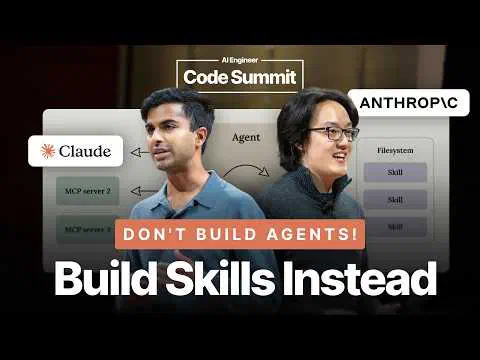
His current line is sharper than “build agents well” — it is stop building agents. In his talk with Murag he argues that the agent loop itself has turned out to be far more universal than anyone expected, so the differentiated work is no longer in the harness but in the packaged expertise you hand it. The framing is a genius mathematician who has never filed a tax return versus a fifteen-year tax professional: capability is not the bottleneck, domain procedure is. For a developer, this is a genuinely load-bearing reframe. It means your competitive asset is a directory of markdown and Python that encodes how your organisation actually does the work — portable, reviewable, diffable, and not locked to a vendor. The obvious caveat, which Anthropic’s own documentation flags, is that a Skill is executable content: install them only from sources you trust. Zhang has also said publicly he expects a lot more multi-agent collaboration in production through 2026, mostly for parallelization and for keeping a main agent’s context window clean.
Key Articles & Papers
Building Effective Agents Equipping Agents for the Real World with Agent SkillsVideos
YouTube