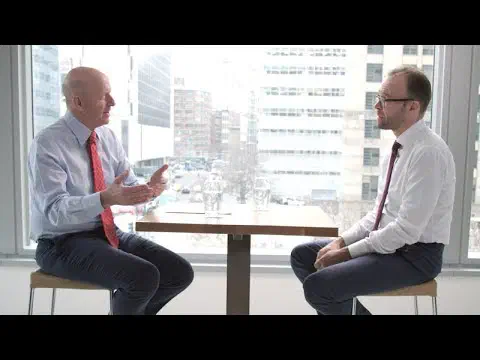

Goldman Sachs chief economist, AI labor market impacts
Jan Hatzius
Profile
Jan Hatzius isn’t a machine-learning researcher, and he doesn’t build models that generate text. He builds models that forecast economies — and for anyone trying to understand what AI actually does to jobs, wages, and growth, his are the numbers that move markets. As chief economist and head of Global Investment Research at Goldman Sachs, Hatzius runs the research shop whose estimates on AI-driven productivity and labor disruption get cited in boardrooms, central banks, and policy briefings. When Goldman publishes a figure on AI, institutional investors trade on it. That makes him one of the most consequential non-technical voices in the AI economy.
Born in Heidelberg in 1968, Hatzius earned a DPhil in economics from the University of Oxford and worked as a research officer at the London School of Economics before joining Goldman in Frankfurt in 1997. He moved to New York in 1999, made partner in 2008, and was named chief economist in 2011. His reputation was built on being right when it was unpopular: he flagged the subprime mortgage risk ahead of the 2008 crash, and later called the post-pandemic “soft landing” that most economists doubted. He’s a three-time winner of the Lawrence R. Klein Award for the most accurate U.S. forecast — a track record that’s precisely why his AI calls carry weight.
His most famous AI intervention is the March 2023 Goldman report estimating that generative AI could expose the equivalent of 300 million full-time jobs to automation while eventually lifting global GDP by roughly 7% (about $7 trillion) over a decade. That single headline shaped a huge share of the public conversation about AI and work — often stripped of its nuance, which was that most jobs are complemented, not replaced. For developers, the underlying framing is the useful part: Goldman’s method scores occupations by task exposure, and knowledge work heavy on routine cognition (drafting, coding boilerplate, summarizing) sits squarely in the crosshairs.
What makes Hatzius interesting in 2025–2026 is that he became the skeptic. As the market priced in an AI productivity boom, he argued the opposite about the near term: AI added “basically zero” to measured U.S. GDP growth in 2025, partly because much of the capex flows to imported chips and equipment — boosting Taiwanese and Korean output, not American. He simultaneously warns that AI is decoupling growth from jobs, producing the weakest labor market outside a recession in 50 years. That combination — long-run bull, short-run realist — is a more honest picture than either the hype or the doom, and it’s why developers building on this technology should know how he thinks.
Key Articles & Papers
Generative AI Could Raise Global GDP by 7% The Potentially Large Effects of Artificial Intelligence on Economic Growth What Will It Take for Companies to Capitalize on the Rise of AI? He Predicted the '08 Crash. Now He's Betting AI Will Turbocharge the US Economy The Global Economy Is Forecast to Post 'Sturdy' Growth of 2.8% in 2026Videos
Controversies
The 2023 “300 million jobs” figure remains Hatzius’s most contested contribution — not because it was fabricated, but because it was so widely detached from its own caveats. The report explicitly stressed that exposure to automation is not the same as job loss, and that most roles would be augmented rather than replaced, yet the number became shorthand for AI-driven mass unemployment across headlines worldwide. Critics questioned whether occupation-level “task exposure” scoring can meaningfully predict real labor outcomes at all.
His 2025 reversal drew its own pushback: telling markets that AI contributed “basically zero” to 2025 U.S. GDP growth put him at odds with a Wall Street consensus heavily invested in the AI-boom narrative, and some read it as downplaying gains that are simply hard to measure. Both episodes are less personal scandal than a fair illustration of how much interpretive weight rides on a single influential forecaster’s framing — worth keeping in mind whenever a Goldman AI number gets quoted as settled fact.
Spotify Podcasts








YouTube