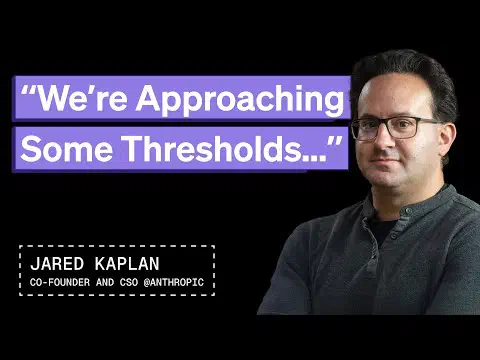

Anthropic Chief Science Officer, scaling laws pioneer
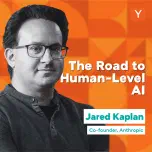
Jared Kaplan
Biographies


Profile
Jared Kaplan is the physicist who taught the AI industry to see the future in a straight line on a log-log plot. Before he was Chief Science Officer and co-founder of Anthropic, Kaplan spent roughly fifteen years as a theoretical physicist — a Stanford undergrad, a Harvard PhD in physics under Nima Arkani-Hamed, postdoctoral work at SLAC, and since 2012 a faculty position in the Department of Physics & Astronomy at Johns Hopkins University, where he worked on conformal field theory and cosmology. That background is not trivia. The reason his most famous contribution landed the way it did is that he approached neural networks the way a physicist approaches a new phenomenon: measure it across many orders of magnitude, and look for the power law hiding underneath.
He found one. The 2020 paper Scaling Laws for Neural Language Models, which Kaplan led at OpenAI, showed that a language model’s loss falls as a clean power-law function of three things — model size, dataset size, and compute — with trends holding across more than seven orders of magnitude. Kaplan and his collaborators trained over 200 transformers to establish it. The practical upshot was radical: model quality became predictable, which meant you could justify spending tens of millions of dollars on a single training run before you knew what the result would say. That insight is the intellectual engine behind GPT-3, Claude, and essentially every frontier model since. Kaplan was also a co-author on the GPT-3 paper itself and helped build Codex, the model that became GitHub Copilot.
In 2021 he left OpenAI alongside Dario Amodei, Daniela Amodei, Jack Clark, Chris Olah, and a handful of others to found Anthropic, betting that the same scaling curves that made powerful AI inevitable also made AI safety urgent. As Chief Science Officer he sits at the center of that bet, and his fingerprints are on the company’s most-cited safety work, including Constitutional AI, the technique that trains a model to critique and revise its own outputs against a written set of principles rather than relying entirely on human labelers. In October 2024 Anthropic also named him its Responsible Scaling Officer — the person who signs off on whether a model is safe enough to ship under the company’s Responsible Scaling Policy.
For a developer learning AI today, Kaplan is worth studying for two reasons. First, scaling laws are the closest thing the field has to a law of physics, and understanding them explains why the industry does what it does — why bigger, why more data, why the compute arms race. Second, he’s a living argument that outsiders with strong quantitative instincts can reshape a field: he came to deep learning late, brought a physicist’s obsession with clean empirical laws, and changed how everyone thinks about the trajectory of the technology. His 2019 lecture notes on machine learning for physicists remain a genuinely useful on-ramp for anyone with a math-heavy background trying to get up to speed.
Key Articles & Papers
Scaling Laws for Neural Language Models Language Models are Few-Shot Learners (GPT-3) Evaluating Large Language Models Trained on Code (Codex) Constitutional AI: Harmlessness from AI Feedback Training a Helpful and Harmless Assistant with RLHF A General Language Assistant as a Laboratory for Alignment Notes on Contemporary Machine Learning for PhysicistsVideos
Controversies
Kaplan’s role as Responsible Scaling Officer puts him at the friction point between Anthropic’s safety branding and its commercial reality, and both have drawn scrutiny. In Bartz v. Anthropic, authors sued over books used to train Claude; Judge William Alsup ruled that training on legally acquired books was “quintessentially transformative” fair use, but that downloading and retaining pirated copies was not — and in 2025 Anthropic agreed to a roughly $1.5 billion settlement, the largest copyright settlement in U.S. history. A separate suit from music publishers (including Universal Music) over song lyrics remains ongoing. Critics have also questioned whether Anthropic’s Responsible Scaling Policy — the framework Kaplan administers — has been quietly weakened over successive revisions, and whether a company that both sets and grades its own safety thresholds can be trusted to hold the line as commercial pressure mounts. None of this is unique to Kaplan or Anthropic; it’s the central tension of building frontier AI at a lab that markets itself on safety, and he is the executive most directly accountable for navigating it.
Spotify Podcasts





YouTube