
Co-founder of Adaption Labs, building efficient adaptive AI systems
Sara Hooker
Profile
Sara Hooker is one of the most articulate skeptics of the “bigger is better” orthodoxy that has defined the last decade of AI — and unlike most critics, she has the research record to make the argument land. Born in Dublin and raised across Lesotho, South Africa, Mozambique, Eswatini, and Kenya before heading to the U.S. for college, she brings a genuinely global vantage point to a field dominated by a handful of well-resourced labs. That perspective is not incidental to her work; it is the throughline. After a B.A. from Carleton College and a Ph.D. affiliated with Mila, she spent 2017–2022 as a research scientist at Google Brain, where she helped stand up Google’s first AI research lab in Accra, Ghana, and published the paper that made her name.
That paper, The Hardware Lottery (2020), is required reading for anyone who wants to understand why the field looks the way it does. Hooker’s thesis is deceptively simple: research ideas in AI often win not because they are better, but because they happen to fit the hardware and software we already have. GPUs made deep learning cheap to run, so deep learning won — and promising ideas that don’t map neatly onto matrix multiplication get orphaned. For a developer, this reframes the whole stack: the “state of the art” is partly an accident of what silicon was lying around. It’s a warning against mistaking convenience for truth.
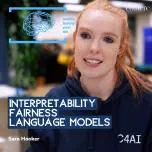
From 2022 to 2025 she led Cohere Labs (Cohere For AI), the research arm of Cohere, the company co-founded by Aidan Gomez. There she ran the Aya project — a 3,000-researcher open-science effort to build models that actually work in the world’s underrepresented languages, spanning 101 of them — and shipped the Aya Expanse family. Aya is the clearest expression of her politics of efficiency: advanced AI shouldn’t only serve English speakers with datacenter budgets. Her earlier work on model compression (“what do compressed networks forget?”) had already shown that shrinking a model quietly harms performance on the long tail — exactly the underrepresented cases that matter most for fairness.
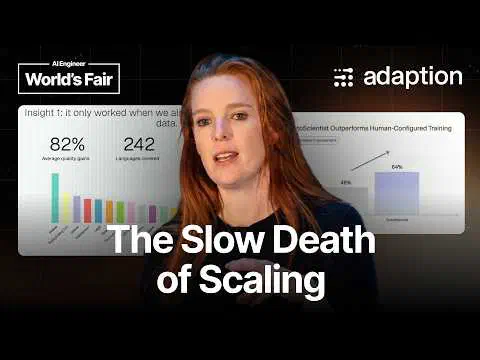
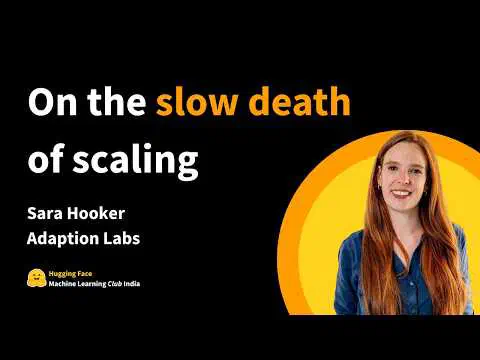
In February 2026 she went all-in on the thesis, co-founding Adaption Labs with Sudip Roy (formerly Cohere’s director of inference computing) and raising a $50M seed round. The bet: that models which continuously adapt from real-world experience — learning like a person who stubs their toe and then avoids the obstacle — can beat brute-force scaling on both cost and capability. Her essay On the Slow Death of Scaling (2025) lays out the case, and Adaption’s first product, AutoScientist, tries to automate the fine-tuning loop so models can teach themselves new capabilities. Whether or not adaptive learning dethrones scaling, Hooker is one of the sharpest voices telling developers that the frontier isn’t only about who has the most GPUs — and that matters if you’re building without a nine-figure compute budget.
Key Articles & Papers
The Hardware Lottery On the Slow Death of Scaling What Do Compressed Deep Neural Networks Forget? Aya Model: An Instruction Finetuned Open-Access Multilingual Language Model Aya Expanse: Combining Research Breakthroughs for a New Multilingual Frontier The Low-Resource Double Bind: An Empirical Study of Pruning for Low-Resource Machine TranslationVideos

Spotify Podcasts






YouTube