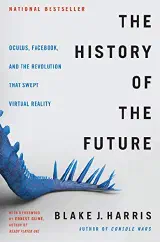
The History of the Future
Oculus, Facebook, and the Revolution That Swept Virtual Reality
Blake Harris chronicles Palmer Luckey's Oculus Rift and Facebook's $2B acquisition through 100+ interviews.
Palmer Luckey was nineteen, living alone in a camper trailer in Long Beach, and he was going to save virtual reality — a technology that had been promising to change everything for thirty years without actually doing it. That premise sounds like a punchline. *The History of the Future* makes it feel inevitable.
Blake Harris, who covered the Sega-Nintendo console wars in his previous book, brings the same eye for tech-industry drama to the founding of Oculus. The formula is familiar — scrappy outsider, visionary product, Silicon Valley money — but Harris has done the work. Over a hundred interviews with key players give the narrative its texture, and the result reads less like business history than a thriller where you already know the outcome and still can't stop turning pages.
The central character is genuinely compelling. Luckey wasn't a product manager or a Stanford dropout with a pitch deck; he was a self-taught hardware obsessive who had accumulated more vintage VR equipment than most research labs by the time he was a teenager. He knew exactly why every previous attempt at consumer VR had failed — the latency, the screens, the prices — and he had a clear theory about how to fix each problem. The Oculus Rift Kickstarter in 2012 proved he was right: gamers who had long written off VR suddenly believed again. Within two years, Mark Zuckerberg was writing a check for more than two billion dollars.
Harris is good on the acquisition and what it revealed. Facebook bought Oculus not because it wanted to sell gaming headsets but because it saw spatial computing as the next major computing platform — the thing that would make smartphones look like a transitional phase. Whether that bet was correct is still unresolved. But the decision scrambled everything. The VR community felt sold out. Engineers started leaving. And Luckey, who had been the public face of a countercultural tech revolution, found himself inside one of the most surveilled corporate environments in the world.
Where the book earns its keep is in the third act, which Harris apparently didn't know he was writing when he started. The story that seemed to end with a triumphant acquisition turns out to involve billion-dollar lawsuits, accusations of illegal practices, connections to the 2016 Trump campaign, and Luckey's eventual ouster from the company he founded. Harris presents all of this without sanctimony, which is the right call: these aren't simple morality tales about Silicon Valley hubris, they're the consequences of a particular kind of founder collision with a particular kind of corporate machinery.
The weakness is that Harris is better at accumulating detail than at stepping back to analyze it. He trusts the story to carry the meaning, and sometimes it does. Other times you want a sentence that states plainly what we should make of all this. The access that makes the book so good — those hundred-plus interviews — also creates an obligation to the subjects that occasionally dulls the edge. For anyone interested in how VR went from science fiction to a multi-billion-dollar industry in roughly thirty-six months, this is the definitive account. Just don't expect Harris to name the villain.