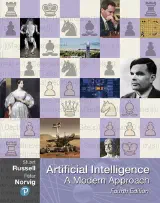
Artificial Intelligence: A Modern Approach (4th Edition)
A Modern Approach
The premise of *Artificial Intelligence: A Modern Approach* is deceptively simple: intelligence is what rational agents do, and rational agents are systems that take actions to maximize expected outcomes. Everything else — 1,100 pages of search algorithms, probability theory, machine learning, robotics, and natural language processing — follows from unpacking what that actually requires.
Russell and Norvig built something rare: a textbook that is also a coherent argument. The organizing concept of the rational agent threads through every chapter, keeping the book from dissolving into a catalog of unrelated techniques. When you hit Bayesian networks in Chapter 13 or reinforcement learning in Chapter 23, you always know *why* the machinery exists — it's another piece of the architecture for building something that can act well under uncertainty. That intellectual coherence is the book's real achievement, and it's why the book has held its position as the standard graduate text for three decades.
The fourth edition reflects where AI actually went between 2010 and 2020: less hand-crafted knowledge engineering, more learning from data. Deep learning gets its own chapter, probabilistic programming gets its own chapter, and the coverage of computer vision and NLP is substantially rewritten to account for what neural networks actually changed. These updates are necessary and mostly executed well. The danger with survey textbooks is that they age asymmetrically — the foundational material stays sharp while the "current methods" sections date out. Here, the deep learning treatment is solid without overclaiming, which is harder to do than it looks.
Where the book shows its age is in the final chapters on philosophy, ethics, and the future of AI. The discussion of the value alignment problem — what Russell calls the problem of "beneficial machines" — is genuinely important and underweighted relative to the search algorithms that open the book. Russell's argument is that the standard model of AI (give the agent an objective, let it maximize) is fundamentally incomplete, because we can't specify human values precisely enough to make it safe. That insight belongs earlier in the book, not buried in the conclusion. The ethical coverage on bias, surveillance, and autonomous weapons reads like a dutiful addition rather than something the authors have thought through as deeply as A* search.
For someone learning AI from scratch with a serious technical background, there is still no better single volume. The search chapters remain among the clearest treatments of the subject anywhere. The probability and decision theory sections are careful without being pedantic. And the breadth is genuine — you come away understanding how computer vision, NLP, and robotics actually connect to the same underlying problem of building agents that can act in the world. The book will not make you competent in any specific framework; it will give you the conceptual vocabulary to understand what any specific framework is actually doing, which matters more. If you're using it as a graduate student, read it cover to cover. If you're a working engineer who needs to understand what ML is actually doing under the hood, start with the probability chapters and work outward from there.