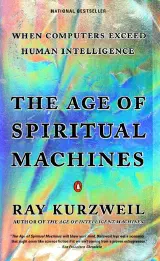
The Age of Spiritual Machines: When Computers Exceed Human Intelligence
when computers exceed human intelligence
Kurzweil's central claim, stated bluntly in 1999, was that machines would exceed human intelligence within decades — not as science fiction but as the inevitable continuation of a process that has been accelerating since the Big Bang.
That claim rests on a single idea he calls the Law of Accelerating Returns. As order increases in a system, significant events happen faster. Evolution built on itself until it produced intelligence; intelligence is now building on itself through technology; and technology, specifically computation, has been doubling in power at a consistent exponential rate for over a century. Moore's Law isn't a quirk of the semiconductor industry — it's a local expression of something universal. When silicon hits its limits, something else will carry the curve: optical computing, quantum computing, three-dimensional chips. The curve doesn't care what substrate it runs on.
a feeling of transcending one's everyday physical and mortal bounds to sense a deeper reality
— Kurzweil, The Age of Spiritual Machines, p. 151
The book's second half translates this into dated-chapter predictions: 2009, 2019, 2029, 2099. Reading these now is genuinely interesting. Kurzweil got the shape of things right — ubiquitous wireless devices, voice interfaces, machine translation, automated diagnostics — and badly misjudged the speed and form. By 2019, he expected computers to routinely pass the Turing test and paper documents to be nearly extinct. Neither happened. He predicted keyboards would be obsolete; we're still typing. What he missed wasn't the direction of travel, it was how uneven and messy the actual path would be. Innovation doesn't march; it lurches. But here in 2026, with large language models talking their way past most casual Turing tests and AI diagnostics genuinely outperforming radiologists in some domains, the gap between his timeline and ours has narrowed considerably. He was off by a decade or two, not by a century.
just being—experiencing, being conscious—is spiritual, and reflects the essence of spirituality
— Kurzweil, The Age of Spiritual Machines, p. 151
Where the book is weakest is on consciousness. Kurzweil argues that once machines have sufficient computational complexity, they will become conscious — and eventually spiritual. This is the least defended claim in the book. John Searle's Chinese Room argument gets a response (a machine's neurons don't understand what the machine understands either), but Kurzweil never fully grapples with the hard problem: why would any amount of computation produce subjective experience? He asserts it will, and moves on. That's not a refutation; it's a shrug dressed up in confidence. The consciousness chapters read more like Kurzweil's own religion than his engineering.
we will be software, not hardware
— Kurzweil, The Age of Spiritual Machines, pp. 119–129
None of that makes the book less worth reading. Published in 1999, it remains one of the clearest articulations of the pro-AI optimist position: technology is not something happening to us, it is what we are, and it has always been accelerating. For anyone trying to understand why serious people believe machine superintelligence is coming within their lifetimes, this is the foundational text. Kurzweil gets the timelines wrong and the philosophy shaky, but the core intuition — that exponential curves eventually produce outcomes that look impossible until they happen — has aged better than most of his critics.