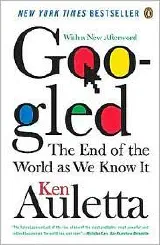
Googled
New Yorker reporter's deep dive into Google's rise and impact on media and society.
The argument Ken Auletta makes in *Googled* isn't really about Google. It's about the executives who ran media companies in 2002 and couldn't figure out why their business was evaporating. His organizing metaphor comes from Poe: the prefect in "The Purloined Letter" who can't find the stolen letter because it's sitting in plain sight. Traditional media companies had the same problem with Google. It wasn't hiding. They just couldn't see it.
Auletta had remarkable access for this book — over 150 interviews inside Google including Larry Page and Sergey Brin, plus an equal number of executives from the industries Google was disrupting. The result is an unusually well-sourced portrait of a company that, by 2009, had become the largest single force reshaping how information gets distributed and monetized. His strongest material comes from the media executives who watched their advertising revenues vanish while insisting Google was a partner, not a predator. They were wrong on both counts.
The Internet makes information available. Google makes information accessible.
— Auletta, Googled
Where the book gets interesting is in its portrait of the founders' cognitive style. Page and Brin were engineers who genuinely believed that data could explain human behavior if you had enough of it. This wasn't arrogance exactly; it was a category error. They built systems that worked, then assumed the same approach could be applied to journalism, books, healthcare, and anything else that involved the movement of information. The book captures this tension well: a company that was often right about technology, and often wrong about people. Eric Schmidt, brought in as CEO in 2001, spent years trying to manage the gap between what the engineers believed and what the world actually required.
naively believe that most mysteries, including the mysteries of human behavior, are unlocked with data
— Auletta, Googled
Auletta is less useful when it comes to the technology itself. He explains Google's ad auction mechanism clearly enough — the insight that advertisers should only pay when someone clicks, and that relevance should determine ranking rather than who pays most — but he doesn't go much deeper. A reader who wants to understand PageRank as an algorithm, or why Google's infrastructure gave it durable advantages over competitors, will need to look elsewhere. This is a book written by a journalist for *The New Yorker*, which means the prose is polished and the access is enviable, but the technical analysis is thin.
If you can solve search, that means you can answer any question. Which means you can do basically anything.
— Auletta, Googled, quoting Larry Page
The honest criticism of the book is that it overweights the anxiety of the people being disrupted. Auletta spent as much time talking to newspaper editors and television executives as he did to Google insiders, and that balance shapes the narrative. He treats the damage to traditional media as roughly equivalent in moral weight to the benefits Google delivered to users. That framing now looks wrong. The people who lost their classifieds revenue had a real problem, but the people who got free instant access to the sum of human knowledge got something more valuable. The book records the transition without fully endorsing either side.
Published in 2009, *Googled* is dated in specific ways but not in its central argument. The underlying dynamic — engineers with access to massive data and computing power reshaping industries whose owners thought they were protected by relationships and brand — has only accelerated. Auletta wrote the first serious draft of a story we're still living inside. That's worth something, even if it isn't the final word.