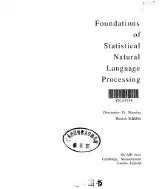
Foundations of Statistical Natural Language Processing
Writing the book summary for Manning & Schütze now.
---
The need for a thorough textbook for Statistical Natural Language Processing hardly needs to be argued for.
— Manning & Schütze, Foundations of Statistical Natural Language Processing, Preface
The statistical revolution in NLP had already won by 1999 — half of all Computational Linguistics papers that year used empirical methods — and *Foundations of Statistical Natural Language Processing* arrived as its first real textbook, the canonical reference for a field that had outgrown its informal literature.
decided against attempting to present Statistical NLP as homogeneous in terms of mathematical tools and theories
— Manning & Schütze, Foundations of Statistical Natural Language Processing, p. xxx
What Manning and Schütze built is a reference more than a pedagogy. The book opens with three chapters of groundwork: probability theory, information theory, linguistic concepts, and the practical realities of corpus work — smoothing, underflow, hypothesis testing, cross-validation. It then moves through the toolbox: n-gram language models, hidden Markov models, probabilistic context-free grammars, supervised and unsupervised classification, vector-space representations, and finally a set of applications — word sense disambiguation, part-of-speech tagging, probabilistic parsing, machine translation alignment, clustering, information retrieval, and text categorization. At 680 pages, nothing is missing from the inventory. This is the book you hand someone who needs to build an NLP system and cannot afford to consult a dozen separate papers to understand the pieces.
as linguists, we find it a little hard to take seriously problems over an alphabet of four symbols
— Manning & Schütze, Foundations of Statistical Natural Language Processing, p. 340
The organizational choice that haunts it is a deliberate one. The authors decided against presenting statistical NLP around a unified mathematical framework — arguing that no such framework yet existed — and instead introduce concepts on a need-to-know basis. The result is that word sense disambiguation shows up two chapters before hidden Markov models, because WSD is more intuitive and gets students working faster. That's a reasonable pedagogical bet, but it costs coherence: classification methods get split across Chapters 7 and 16, clustering across 7 and 14, with no clean comparative treatment of either. The EM algorithm appears several times, in different guises, without a derivation rigorous enough to let a reader reconstruct it for a new application. The honest read is that there is a tighter, more principled book struggling to get out of this one — background, theory, applications, in that order — and the authors know it. They chose breadth over structure, and the field was probably grateful for it at the time.
A word on what this book is in 2026: a time capsule of the last generation of NLP before neural networks made most of it obsolete as practice while leaving it intact as theory. The Viterbi algorithm, Good-Turing smoothing, IBM translation models, tf-idf — the mechanisms here still underpin intuitions that matter, even when the implementations look nothing like them. Researchers who trained on transformers and find themselves confused by why certain things work the way they do will find this book useful in a specific way: it explains the probabilistic reasoning that neural models encode implicitly. For that reader, the relevant chapters are probably 5 through 12. For someone entering the field in 1999, this was the only comprehensive map available. It remains useful, but read it knowing the map was drawn before the territory changed.