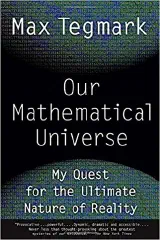
Our Mathematical Universe: My Quest for the Ultimate Nature of Reality
Tegmark's central bet is that reality isn't merely described by mathematics — it *is* mathematics, all the way down, including you, the reader, the chair you're sitting in, and the part of the electromagnetic spectrum your eyes happen to detect.
The first half of *Our Mathematical Universe* is some of the clearest popular cosmology I've encountered. Tegmark built his career on the Cosmic Microwave Background — the faint thermal glow left over from the early universe — and it shows. His explanation of why inflation is necessary to make the Big Bang work is genuinely illuminating, the kind of explanation that doesn't just tell you the conclusion but shows you the problem the conclusion solves. From there, he builds up four levels of multiverse in a sequence that feels almost compulsory: if space is infinite, then somewhere far beyond our observable horizon identical copies of everything exist. If inflation is eternal, different pockets of space bud off with different physical constants. If quantum mechanics is taken at face value without wavefunction collapse, every quantum event branches the universe. By the time he's finished, you're three levels deep into parallel worlds and the argument doesn't feel nearly as crazy as it should. That's the skill here: the scaffolding is solid enough that you barely notice when the building starts floating.
economics was largely a form of intellectual prostitution where you got rewarded for saying what the powers that be wanted to hear.
— Tegmark, *Our Mathematical Universe*
The fourth level is where it gets difficult. The Mathematical Universe Hypothesis — that all mathematical structures that can exist do exist physically — is either the most profound claim in the book or its fundamental flaw, depending on how you read it. The critics aren't wrong to call it circular: Tegmark essentially assumes that abstract structures have the same ontological status as observable physical reality, then concludes that physical reality is an abstract structure. There's also a testability problem that he acknowledges but doesn't solve: he argues we'll eventually find the boundaries of mathematically describable physics and that would falsify MUH, but mathematically describable physics has never met a boundary before, so this test has no teeth yet. What's more frustrating is that the hypothesis predicts everything — any mathematical structure is a universe somewhere — which means it predicts nothing in particular about *ours*.
Exploring the Level IV multiverse doesn't require rockets or telescopes, merely computers and ideas
— Tegmark, *Our Mathematical Universe*
None of this makes the book a waste. The MUH forces a reckoning with a question most physics books sidestep: *why* does mathematics describe reality at all? Wigner called it the unreasonable effectiveness of mathematics. Tegmark's answer is that the map is the territory. You might not buy it, but the question itself is real, and having to argue against his answer is a useful exercise. The last chapter, on existential risk, is unexpectedly good — he's worried about nuclear war and rogue AI decades before it became fashionable, and the worry reads as genuine rather than performative.
I think that consciousness is the way information feels when being processed in certain complex ways.
— Tegmark, *Our Mathematical Universe*
Who will find this most useful: anyone who's comfortable with the concept of the Big Bang but fuzzy on why physicists take inflation seriously, and anyone curious about the philosophical foundations under modern physics. Read the first two-thirds, argue with the rest. Tegmark doesn't deliver the theory of everything he's chasing, but the chase itself is worth following.