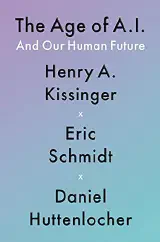
The Age of AI: And Our Human Future
And Our Human Future
The core claim worth wrestling with: AI is the first technology that doesn't just change what humans do but what humans are — a shift Kissinger compares to the Enlightenment, when the Western world moved from religious to rational perception of the world, except this time there's no dominant philosophy to push back against.
The book's argument rests on a genuinely strange fact: modern AI systems produce correct answers through processes their creators cannot explain. An AlphaZero-style chess AI played moves no human had ever conceived and beat every opponent — but the system learned by playing itself for four hours, not by absorbing any human theory of chess. Scale that dynamic to medicine, materials science, and military targeting, and you get the book's central anxiety: we are deploying tools whose reasoning is opaque even to their designers, in domains where the decisions matter enormously.
With artificial intelligence, the astounding thing is, you come up with a conclusion which is correct. But you don't know why. That's a totally new challenge.
— Kissinger, The Age of AI
Kissinger brings the historical weight. Schmidt brings the confession: he didn't see the internet being used to undermine elections, to power anti-vaccine movements, and he says so directly. What's notable is that Schmidt doesn't use that admission as cover — he argues that this time around, the authors see the risks coming and want to get ahead of them. The proposal isn't regulation (they're skeptical of that) but something like the small expert groups that gave us arms control after nuclear weapons: get the right people talking, give them years, let them develop a framework.
We are moving into a new period of human consciousness which we don't yet fully understand.
— Kissinger, The Age of AI
That's where the book earns its main criticism, and it's fair: the diagnostic is sharp, the prescription is thin. The book raises questions about autonomous weapons, AI-driven information monopoly, and the erosion of human agency with more rigor than it answers them. Kissinger argues that AI is the biggest threat to humanity's philosophical continuity since religion ceded ground to reason. Schmidt built some of what he's warning about, then admits he'd have done it differently. The gap between the scale of the problem they describe and the smallness of their proposed solution is uncomfortable.
We've gone from the ability to read books to being described books, to neither having the time to read them nor conceive of them nor to discuss them, because there's another thing coming.
— Schmidt, The Age of AI
For anyone who finds the doom framing tiresome, there's a useful counterweight here: the book never argues for stopping AI development. The position is closer to "this will happen regardless, so humans need to claim a role in shaping it before they lose the chance." That's more defensible than either techno-utopian salesmanship or the catastrophism that fills most popular AI discourse.
The book is better as a provocation than a roadmap. Three very different thinkers — statesman, executive, computer scientist — spent Sunday afternoons for a year talking about this, and the intellectual range shows. The geopolitics chapters are the strongest; the philosophy can be dense. If you want to understand why AI might be categorically different from previous technologies, and why the people building it should be more worried than they appear, this is a good starting point.
Read the longer summary
What this book actually is
The Age of AI is what happens when a 98-year-old former Secretary of State, a former Google CEO, and the computer scientist who runs MIT’s computing college spend a year of Sunday afternoons trying to figure out what artificial intelligence means. Published November 2021 — pre-ChatGPT, pre-DALL-E going mainstream, pre-Midjourney, pre-everything that defines the current AI moment — it’s a strategic essay rather than a technical one. Kissinger died in 2023, so this was effectively his last serious swing at a brand-new domain. The argument the trio make is that AI is not just another tool but a rupture in how humans relate to knowledge, power, and each other. They are right about a lot of it. They oversell some of it. And they spend far more time naming the problem than they do prescribing a fix.
The central claim
Strip away the diplomatic prose and the argument is this: for most of recorded history, humans have explained the world either through faith or through reason, and AI is now producing a third mode — knowledge that works without being explainable. AlphaZero plays chess moves no grandmaster would consider, and wins. An MIT lab’s AI screens compounds and identifies a candidate antibiotic — halicin — that no human chemist had flagged. The system is right. We don’t know why. Kissinger, in the TIME interview that accompanied the book launch, put it this way: “you come up with a conclusion which is correct. But you don’t know why. That’s a totally new challenge.”
The authors think this isn’t a quirk of current technology but a structural feature. AI’s pattern recognition operates over data volumes and dimensional spaces human cognition can’t follow. As more decisions get delegated to it — medical, military, civic — humans will increasingly accept correct answers we can’t audit. The question the book turns over, from several angles, is whether that’s a manageable shift or a civilisational one.
This is not a wild claim. It’s also not as novel as the authors sometimes suggest. The history of human civilisation is mostly the history of using systems we don’t individually comprehend — pilots fly aircraft we couldn’t repair, doctors prescribe drugs whose mechanisms aren’t fully mapped, central banks set rates whose effects are debated decades later. What’s actually new about AI is the speed at which it consumes domains and the breadth of what it can do, not opacity itself. The book is at its best when it stays on the speed-and-breadth point and at its weakest when it leans on opacity as a categorical break.
Where Kissinger earns his keep
Kissinger is the surprise of this book. The temptation when a celebrity name is attached to a technical book is to assume the technologist did the actual work. But the chapter on security and world order is the strongest in the book, and it bears Kissinger’s fingerprints. He brings a frame nobody in tech writing has: he was in the room when the United States and the Soviet Union worked out arms control, he saw what worked and what didn’t, and he can read AI competition through that lens.
His core worry is concrete. AI-enabled weapons compress decision time below what humans can analyse. If your adversary’s system can launch in milliseconds, you have a structural incentive to automate your launch authorisation. Now both sides are running platforms whose interactions nobody has tested in real-world operation, on doctrines nobody has formalised. World War I, he reminds us, was unleashed by mobilisation timetables that, once started, couldn’t be stopped without strategic disadvantage. AI risks the same dynamic, faster.
His proposed answer is borrowed from his own youth: small groups of technically competent people, talking across institutional lines, working out what the equivalent of arms control looks like for AI. He explicitly cites the Saturday-afternoon meetings at Harvard, MIT, and Caltech in the early Cold War that produced the conceptual scaffolding for nuclear arms control. The analogy isn’t perfect — AI proliferates through code and compute, not through enrichment plants — but it’s the most actionable thing in the book, and three years on it looks more right than wrong.
The chess move and the antibiotic
If you remember two things from this book, remember these. They’re the examples the authors return to repeatedly, and they’re the examples that do the real work.
DeepMind’s AlphaZero learned chess in four hours by playing itself, with no human game data, and produced a style grandmasters describe as alien. It sacrifices material in patterns no human school of chess teaches. It wins anyway. The authors use this as the load-bearing example for their epistemic claim: here is intelligence that produces correct outcomes through processes humans cannot fully reconstruct, in a domain we’d already considered solved.
The halicin discovery is the matching example from biomedicine. An MIT lab trained a model on molecular structures known to inhibit bacterial growth, then turned it loose on a library of compounds. It flagged a candidate human chemists had not pursued. Subsequent testing confirmed it kills strains resistant to existing antibiotics, including some of the worst-behaved superbugs.
These are not parlour tricks. They’re proofs that AI can find structure in spaces too large for humans to search exhaustively, and that the structures it finds are real. If you accept these two examples — and you should — most of the book’s harder claims follow without much resistance. The book would have been stronger if it had stayed closer to this empirical ground and reached less often for the philosophical and historical superstructure.
Where the book stretches and where it stops short
Two weaknesses, related, worth being honest about.
The first is the Enlightenment overreach. Kissinger leans heavily on a historical arc — pre-Enlightenment faith, Enlightenment reason, post-Enlightenment AI — and the framing creaks. The Enlightenment never replaced faith with reason; it added reason as a coexisting mode, and most humans still operate in both. AI as a third mode, working alongside faith and reason rather than displacing them, is a more honest description of what’s actually happening. A reviewer at Air University Press made the sharper version of this critique: the historical analogies the book reaches for are doing more rhetorical than analytical work, and the genuinely new question — is AI categorically different from prior revolutionary technologies, or just faster and bigger? — is largely sidestepped. The book wants us to feel that AI is the biggest thing since the printing press. It does not actually argue the point so much as repeat it.
The second weakness is harder to forgive: the book is excellent at saying we should be worried about X, and bad at saying here is what to do about X. Take disinformation. Schmidt mentions in the TIME interview a “minor reference” in the book to a cryptographic-provenance solution — rank information by where it came from, push high-trust sources to the top. That’s a real engineering proposal; content provenance is a live area of work, with C2PA and similar standards now being deployed. But the book treats it as an aside rather than a recommendation. The pattern repeats. AI in warfare: serious worry, no proposed treaty framework. AI and children: serious worry, no proposed regulation. AI and democratic deliberation: serious worry, mostly hand-waving toward “we’ll need new institutions.” Asked in the TIME interview who should write the philosophy that would guide AI development, Kissinger says they need “a number of little groups that ask questions” — which is the actual answer, but is also a confession that the authors don’t have one yet.
I’d be more forgiving of this if the book didn’t position itself as the start of the conversation about AI. If you’re going to claim the agenda-setting slot, you owe more than diagnosis. Schmidt is candid in the same TIME interview about how he missed the misuse of the early internet — election interference, the anti-vax movement — and now wants to “call it ahead of time.” Kissinger replies, fairly: if you had known, what would you have done? Schmidt: I don’t know. That exchange is the whole book in miniature — three smart people looking at something genuinely new, more sure they should worry than they are about what to do. It’s an honest position. It’s also a thinner deliverable than the marketing implies.
What’s aged well, what hasn’t
Aged well: the geopolitical framing. Everything about US-China AI competition, autonomous-weapons doctrine, and the inadequacy of current arms-control infrastructure has held up. If anything the book underestimated how quickly AI would become the central competitive technology between great powers. Written in 2021, it predates the chip-export controls, the H100 export fights, and the open-vs-closed-weights debate that now dominate AI policy. The diagnosis is right; the urgency is higher than the book suggested.
Aged well: the worry about generative misinformation. The book warned about hyper-realistic synthetic media before the tools to make it were widely deployed. We’re living through the consequences now, and the policy infrastructure is still scrambling.
Aged less well: the chapter on global network platforms, which is largely about Facebook, Google, and TikTok as recommendation engines. The frame is now too narrow. The centre of gravity has moved from feed-ranking to foundation models, and the relevant platform questions are about who trains, who deploys, and who controls the weights — not who curates the feed. Schmidt himself has spent the years since the book working on exactly the foundation-model questions the book underweights, which suggests he saw this gap too.
Aged less well: the optimism about international coordination. The book hopes for arms-control-style cooperation between the United States and China on AI. Three years on, that cooperation looks unlikely. The technology is proliferating outside the two-power frame — DeepSeek, Mistral, Qwen, the broader open-weights ecosystem — and the assumption that the US and China would dominate AI together, leaving everyone else to negotiate around their settlement, looks more dated than the authors expected.
Aged less well: the prose itself. The book grew out of weekly conversations among the three authors, and that genealogy is audible — points get made, then remade, then restated for emphasis. Several reviewers flag this. It’s a 272-page volume with maybe 200 pages of actual argument, and a tighter edit would have produced a sharper book at 150.
Who should read it
If you want to think clearly about AI as a great-power and great-philosophical question, read this book. The security chapter is genuinely worth your time, and the framing of AI as an epistemic shift — not just a productivity tool — is the right framing, even if the authors push it too far. The chess and halicin examples are worth absorbing if you haven’t already. Pair the book with something more technical (Kai-Fu Lee’s AI Superpowers on the US-China competition; Ethem Alpaydin’s Machine Learning if you want the actual mechanics; Stuart Russell’s Human Compatible for a more rigorous treatment of the alignment worry) and you’ll come out with a useful synthesis.
If you want a how-to guide, skip it. If you want technical depth, skip it. If you want the post-ChatGPT version of these arguments, read its successor: Kissinger, Schmidt, and Craig Mundie’s Genesis, published 2024, which is essentially this book updated for the world we now live in.
There is one more reason to read it that doesn’t get enough credit. The book is the work of people who could have done other things with their last decade — and chose, instead, to spend it trying to understand a technology most of their contemporaries dismissed as overhyped. Kissinger learned a new domain at 95. Schmidt walked away from running one of the world’s most consequential companies and spent his time on this. Whatever else you think of the book, that’s not a small thing, and it sets a standard for taking AI seriously that more establishment voices should be held to. The book’s flaws are the flaws of a first draft on a subject that didn’t yet have a vocabulary. The flaws are real. The attempt deserves the credit it’s getting, and a little of the criticism it’s getting too.