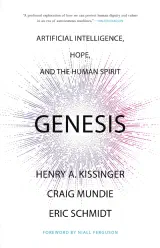
Genesis: Artificial Intelligence, Hope, and the Human Spirit
Kissinger finished the last chapter the week before he died at one hundred, and that fact does more than almost anything else to establish the stakes. This is not a book written by people who skimmed the tech news. Schmidt built one of the most powerful companies in history. Mundie advised four presidents on national security and emerging technology. And Kissinger spent a century watching powerful new tools reshape the balance between states, empires, and ideologies. When three people with that combination of credentials agree that artificial intelligence is the most consequential transition in centuries, the argument deserves attention.
Our concern about human passivity is not about the human loss of paid work. We already have a prototype of how people live when they can have what they want without working. We call them the rich and the retired.
— Kissinger, Schmidt, and Mundie, Genesis, pp. 158–159
The book's central claim is that AI doesn't merely automate tasks — it intermediates between humans and reality, reshaping how we know things, how we govern, how we wage war, and how wealth is created and distributed. The authors situate this as a "third age of discovery," comparable in scope to the era of oceanic exploration or the scientific revolution. What distinguishes their treatment is Kissinger's insistence on anchoring the whole conversation in Kantian ethics: human dignity — rooted in vulnerability, mortality, and the freedom to make moral choices — is the non-negotiable premise, not a sentiment to be traded away for productivity gains. That philosophical seriousness is rare in AI writing, and it keeps the book from dissolving into either techno-utopianism or panic. Their prescription is "sober optimism," which they mean literally: take the risks seriously, don't pretend the opportunities aren't real, and build institutions adequate to both.
Will we become more like them, or will they become more like us?
— Kissinger, Schmidt, and Mundie, Genesis, pp. 184–185
Where *Genesis* is weakest is in the gap between diagnosis and prescription. The arguments for taxing AI-generated wealth, redirecting proceeds to universal basic income, and building some form of international treaty governance are gestures rather than blueprints. Kissinger understood, better than almost anyone alive, how difficult it is to build functioning multilateral institutions even when the threat is obvious. The book diagnoses the coordination problem — corporations with no territorial loyalty, autocracies eager to weaponize AI for social control, democratic governments outpaced by innovation — with genuine precision. But the chapter on solutions reads more like a wish list than a strategy. A more honest conclusion would have admitted that "sober optimism" is considerably easier to articulate than to operationalize.
Neither blind faith nor unjustified fear can form the basis of an effective strategy; one needs self-doubt to have knowledge, but self-confidence to act.
— Kissinger, Schmidt, and Mundie, Genesis, p. 218
Still, the diagnosis earns the book its place. The sections on geopolitics are the strongest: the argument that corporations are becoming quasi-sovereign AI powers with capabilities that outstrip nation-states is understated by most commentators, and it landed here as early as anywhere. If you're thinking seriously about what AI means for global power rather than product development, this is essential reading. Come for what it sees; expect to do your own homework on the solutions.
Read the longer summary
A statesman’s last argument
Henry Kissinger spent his final months writing about AI. He died in November 2023; the book came out a year later, with technologists Eric Schmidt and Craig Mundie carrying the manuscript across the line. That biographical fact matters because it shapes everything. Genesis is not a technologist’s primer on transformers, and it isn’t a doomer manifesto. It’s the last argument of a 100-year-old diplomat who watched AI demonstrations alongside Demis Hassabis and Dario Amodei, then asked what civilization should do about a technology that may soon outthink the people building it.
The central claim: humanity is entering what the authors call a “third age of discovery,” and the only way through it without losing ourselves is to anchor the transition in human dignity. Schmidt and Mundie supply the technological texture. Kissinger supplies the historical analogy and the moral spine. The combination is what makes the book worth reading. Most AI books written by technologists undercount geopolitics. Most AI books written by philosophers undercount the engineering. Genesis tries to hold both.
Whether it succeeds is another question.
Why dignity, and why Kant
The book’s most important move is to stake everything on a Kantian conception of dignity — humans are ends in themselves, not means, and any future with AI must preserve that. This is not throat-clearing. The authors return to it constantly, and it does real work: it gives them a non-arbitrary reason to reject futures where AI optimizes humans the way a logistics system optimizes packages.
Kissinger’s biography matters here. He was a Jewish teenager who escaped Nazi Germany, returned in a U.S. Army uniform, and helped liberate a concentration camp at age 21. When he writes about dignity being non-negotiable, the word has weight. He has seen what happens when a powerful system decides certain humans are not ends but obstacles.
The dignity frame is also where the book becomes provocative. The authors ask whether AI itself might one day deserve dignified treatment — whether, if a machine becomes a moral agent, it joins the category of beings we cannot use as mere means. They don’t answer the question. They just refuse to wave it away. That refusal is more honest than most AI writing, which tends to either declare AI obviously a tool or obviously a successor.
The weakness of the frame is that it tells you what to value but not how to enforce it. A sentence about dignity underpinning our partnership with AI is exactly the kind of sentence tech CEOs can sign without changing anything they’re doing. The book gestures at audits, value alignment, and global cooperation, but the gap between the moral claim and the policy mechanism stays wide.
Abundance, and the question of what people will do
The economic chapter is where the technologist co-authors are most visible. Schmidt and Mundie believe AI can collapse the cost of intelligence itself, which means abundance — cures for diseases, climate models, productivity gains large enough to make scarcity feel optional. They cite Sam Altman’s writing on growth and inclusion approvingly. They propose taxing AI-generated wealth, redirecting it toward universal basic income or public services, and building international funds so the Global South isn’t locked out of the gains.
This is the part of the book most likely to age badly, and not because the technical claims are wrong. The proposals are reasonable in shape and unspecified in detail. Who collects the AI wealth tax when the value is created by a model trained in California, fine-tuned in Singapore, and deployed in fifty jurisdictions? What stops the same compute monopolies from capturing the redistribution mechanism the way they captured the platform layer? The authors raise the question of corporations operating as quasi-sovereign actors — and then mostly leave it there.
The more interesting move is the chapter’s confrontation with what humans will actually do if AI takes most of the work. The authors are blunt: we already know what people do when they don’t have to work, because we have the rich and the retired. Some will rot. Most, given time, will find something to be good at. They argue, plausibly, that the transition will be jarring and the steady state will be fine — humans will work for pride and pleasure rather than survival.
I think they underestimate how hard the transition will be, and they barely mention the political consequences of a generation whose labor stopped mattering before the redistribution arrived. But the underlying optimism is defensible. People did adapt to the end of subsistence farming. They did adapt to the factory. The question is whether the adaptation period this time is twenty years or two hundred.
“Will we become more like them, or will they become more like us?”
Halfway through, the authors land on the framing they’ve been circling: that one question. It is the strategy question of the book. Either humans modify themselves — implants, gene edits, neural interfaces — to keep up with AI, or AI is engineered to internalize human values so deeply that we don’t have to chase it.
The authors come down, gently, on the second path. They think extreme self-redesign is undesirable and probably unnecessary. The better move, they argue, is to teach AI what we are — to encode our nature into our machines, knowing this requires us to first understand our own nature better than we currently do. As Kissinger and his coauthors put it: “we must, while we are able, find ways to make them more like us.”
This is the most Kissinger-shaped sentence in the book. It is also the one that most exposes the blind spot. Whose “us”? American liberal-democratic values? Confucian harmony? Islamic jurisprudence? The authors acknowledge the difficulty and propose diplomatic harmonization between nations on AI. They do not pretend to have solved it. But the gap between “encode human values into AI” and “decide whose values” is the entire alignment problem, and the book treats it as a coordination challenge rather than a foundational one.
The strongest argument in this chapter is one a pure technologist would never make. Kissinger argues — and Schmidt and Mundie sign on — that some risks of AI may only be manageable by AI itself. The reasoning is uncomfortable but coherent: human decision-making in crises is too slow, too biased, and too self-interested to be trusted with technologies operating at machine speed. We may have to accept AI as a mediator the way we accept a third-party arbitrator in a contentious divorce. The authors are clear-eyed that this is a loss of human agency. They argue it may be the price of survival.
You can disagree. I’m not sure I buy it. But it’s the kind of argument that requires you to think about decision-making under adversarial conditions across long time horizons, and Kissinger’s whole career was about that. The chapter is worth the price of the book.
Where the diagnosis outpaces the prescription
For all the strengths, the recurring weakness of Genesis is that the prescriptions are systematically softer than the diagnoses.
The geopolitical analysis is sharp. The authors warn that the concentration of AI capability in a few American and Chinese firms creates power asymmetries classical international relations theory doesn’t yet know how to handle. Authoritarian regimes will use AI for surveillance and social control — they already are, and the book is specific about Chinese deployments. Democratic governments are slower to regulate, and the corporations operate across jurisdictions none of them fully control. That diagnosis is harder-edged than what most AI books offer.
Then comes the prescription, which is mostly: cooperate. International standards, deliberate coexistence, value alignment frameworks. There is little acknowledgment that the actors with the most to lose from cooperation are also the actors with the most leverage to prevent it. A book co-authored by a former Google CEO and a former Microsoft research chief is well-positioned to be specific about how to constrain Google and Microsoft. Genesis mostly isn’t.
The book also underweights how much of “AI alignment” is currently an unsolved technical research program, not a values-coordination exercise. Reading Genesis, you might come away thinking the alignment question is mostly about which human values to encode. The harder question, the one that occupies the labs Schmidt funds, is whether we can reliably encode any values at all in a way that survives capability increases. The book gestures at DeepMind’s Frontier Safety Framework and moves on. The actual technical state of the art deserved more pages.
A reader finishing Genesis will need a few other books to round out the picture. It is light on the mechanics of frontier model training — Ethan Mollick’s Co-Intelligence or one of the more technical introductions does that work better. It is light on the labor-market specifics — Daniel Susskind is more rigorous there. It is light on the operational China-US dynamic — Kissinger and Allison’s 2023 Foreign Affairs essay covers more ground than the book does.
The prose also carries the marks of three authors with different concerns edited into one voice. Some passages feel like Kissinger’s late-career Foreign Affairs essays. Others read like a McKinsey deck on the future of work. The dignity frame is the binding agent, and it mostly holds, but the seams show.
Who should read it
If you’ve read three AI books and they were all by technologists, read this one. If you’ve read three AI books and they were all by philosophers, read this one too. Genesis is a corrective to whichever direction you’ve been leaning. It will not teach you how transformers work, and it will not give you a policy roadmap detailed enough to act on, but it will sharpen your sense of what’s at stake in geopolitical and moral terms.
What Genesis gives you that nothing else gives you is the perspective. Kissinger lived through the nuclear age, watched the post-war order rise and crack, and brought the same instincts to AI that he brought to arms control. The book is worth reading for that lens alone, even when the conclusions feel underspecified. The premise — that AI is a generational technology, that strategy and dignity matter as much as engineering, that humanity has navigated comparable inflection points before and can do so again — is unfashionable in a discourse dominated by either utopians or doomers. The authors’ phrase for the alternative is “sober optimism.” It’s a useful phrase.
The book is also worth reading as the close of a particular kind of public intellectual — the elder statesman who refused to pass the microphone, who treated his hundredth year as a working year, who dictated a final book in a German accent so thick that Google’s own transcription tools couldn’t parse it. There won’t be many more like him. The voice he ended on was, against expectation, hopeful. We’d do well to take the hope as seriously as the warnings.