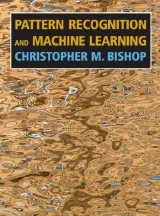
Pattern Recognition and Machine Learning
The argument Bishop makes, quietly and at length, is that probability theory is sufficient. You don't need separate toolkits for classification, regression, density estimation, and sequential modeling — you need one framework, applied consistently, and the rest follows. That framework is Bayesian inference, and *Pattern Recognition and Machine Learning* is its 778-page proof of concept.
This is a textbook, and it reads like one. But what sets it apart from the field's other foundational texts is the organizing principle: every algorithm is derived as a consequence of putting a prior on something and then conditioning on data. Gaussian processes emerge from linear regression with the right prior. Neural networks from parametric basis functions. Support vector machines from a kernel trick applied to a maximum margin principle. The Bayesian lens doesn't flatten these distinctions — it clarifies where each method lives and what assumptions it secretly makes.
Our geometrical intuitions, formed through a life spent in a space of three dimensions, can fail badly when we consider spaces of higher dimensionality.
— Bishop, Pattern Recognition and Machine Learning, ch. 1
The first chapter alone earns the book its place on any serious practitioner's shelf. Bishop walks through polynomial curve fitting — simple enough to be a textbook example — and uses it to derive the entire conceptual architecture of the book: overfitting as a consequence of maximum likelihood with finite data, regularization as the imposition of a prior, Bayesian model comparison as a way to avoid held-out validation sets. Everything else in the next 700 pages is an elaboration.
The chapters on probability distributions and linear models are meticulous to the point of being exhausting, but that meticulousness pays off. By the time Bishop introduces mixture models, the EM algorithm, and variational inference, you've seen every piece of the machinery laid out slowly enough to hold in your head. The graphical models chapter — one of the book's genuine contributions — gives you a notation for reasoning about conditional independence that transfers cleanly to new architectures and new problems. This is the part where the book stops feeling like a survey and starts feeling like a way of thinking.
Intuitively, what is happening is that the more flexible polynomials with larger values of M are becoming increasingly tuned to the random noise on the target values.
— Bishop, Pattern Recognition and Machine Learning, ch. 1
The weaknesses are real. It was written before deep learning's second wave, and the neural network chapter, while technically sound, reads as a warm-up to something that never arrives in these pages. You won't learn to train a transformer here. The treatment of sampling methods is competent but feels like a gesture toward completeness rather than deep commitment. And the book is dense in the way only a textbook can be: every claim supported, every formula derived, which is virtuous but occasionally makes it hard to see what matters.
Essentially, the simpler model cannot fit the data well, whereas the more complex model spreads its predictive probability over too broad a range of data sets and so assigns relatively small probability to any one of them.
— Bishop, Pattern Recognition and Machine Learning, ch. 3
What this book does that no other single text manages is give you a working vocabulary that cuts across the whole field. After working through it — this is not a book you read, it's a book you do — you can walk into a paper on Gaussian processes, latent variable models, Bayesian neural networks, or approximate inference and recognize the underlying structure. That recognition is worth a lot.
It's not the most approachable entry point to machine learning. But if you want to understand why things work the way they do, and you're willing to sit with the math, this is the one.
Read the longer summary
The central claim
Bishop’s argument is that pattern recognition (engineering origin) and machine learning (computer science origin) are two faces of the same field, and the right way to teach both is through a probabilistic, Bayesian lens with graphical models as connective tissue. He isn’t the first to make this argument, but PRML is the most committed execution of it. Every model in the book — regression, classification, clustering, neural networks, mixtures, sequential data — gets cast into the same shape: write down a likelihood, pick a prior, work out the posterior or an approximation to it, and figure out what to do when the integrals don’t close.
This commitment is the spine of the book. It’s why the chapter on linear regression spends roughly as much time on Bayesian inference for the parameters as on least squares, and why the neural networks chapter ends on Bayesian neural networks rather than on tricks for getting deeper architectures to converge. If you open PRML expecting a recipe book of algorithms, you’ll be disappointed. The book is making an argument about what the algorithms are for, and what they look like when you stop treating each one as a separate thing to memorize.
Probability theory as scaffolding
Chapter one looks like a probability primer, and you can read it that way — sum rule, product rule, Bayes’ theorem, expectations, Gaussians. But Bishop is laying down equipment that gets reused chapter after chapter. The polynomial curve-fitting example introduced in chapter one returns three more times: as a maximum likelihood problem, as a MAP estimation, and finally as a fully Bayesian treatment with a predictive distribution that integrates over the parameters. By the third pass you understand both the polynomial fitting and the difference between the three approaches. That’s the book’s pedagogical move, and it works.
Decision theory comes next and is similarly load-bearing. The minimum misclassification rate, the squared loss giving the conditional mean, the decomposition of classification into inference and decision — all of this gets cited in later chapters as if you’ve already internalized it, because by then you have. The information theory section at the end of chapter one feels like a detour but isn’t. KL divergence shows up centrally in variational inference. Differential entropy reappears in the discussion of the Gaussian as the maximum-entropy continuous distribution. The book doesn’t waste pages.
The early chapters also do something subtle: they make you comfortable with marginalization as a tool. Bayesian inference is essentially “integrate the parameters out.” If your reflex when you see an integral is to flinch, you’ll struggle with the rest of the book. Bishop spends enough time computing Gaussian integrals by completing the square that by chapter four it stops feeling like an exotic operation.
From distributions to neural networks
Chapter two is the distributions atlas: Bernoulli, beta, multinomial, Dirichlet, Gaussian in all its forms (conditional, marginal, conjugate, with unknown mean, with unknown precision, with both), Student’s t, von Mises, exponential family. It’s exhaustive. The most useful sections aren’t the formulas themselves but the worked examples of conjugacy — the beta-binomial, the Dirichlet-multinomial, the Gaussian with normal-gamma posterior. Once you’ve watched conjugacy work three or four times, you stop being surprised by it, which is the point.
The transition from chapter three (linear regression) to chapter four (linear classification) to chapter five (neural networks) is one of the book’s strongest stretches. Bishop builds linear regression in two passes: frequentist first, then Bayesian, and shows that the Bayesian predictive distribution gives you a principled measure of uncertainty that point estimates cannot. The picture of the predictive distribution narrowing around the data points and widening in regions with no data is one of those images that stays with you.
In chapter four, the same template is reused for classification — discriminant functions first, then probabilistic generative models, then probabilistic discriminative models, then a Bayesian treatment with the Laplace approximation because the integrals stop being analytic. By the time the chapter discusses softmax regression and the iteratively reweighted least squares algorithm, you’ve seen the same Bayesian skeleton three times in three contexts and can predict where the chapter is going.
By chapter five, the neural network is presented as a linear model where the basis functions themselves have been made adaptive. This framing is cleaner than how neural networks usually get introduced. The backpropagation derivation is one of the clearest in print — Bishop derives it for a fully general feed-forward topology rather than a specific architecture, and the message-passing interpretation makes the algorithm feel obvious rather than mysterious.
What it does best
Three things stand out.
First, the book is honest about when methods fail. The maximum likelihood estimator for the variance is biased and Bishop walks you through why. Maximum likelihood for a mixture of Gaussians can blow up if a component collapses onto a single data point, and Bishop is explicit that this is a real problem the algorithm has rather than a numerical curiosity. The bias-variance decomposition gets a careful treatment, but Bishop is also clear that it’s “of limited practical value” because in real applications you don’t have ensembles of training sets, only the one. The book doesn’t oversell its tools.
Second, the geometric intuition is excellent. The figures in PRML are famously good. The multivariate Gaussian gets visualized through its eigenvectors with elliptical contours scaled by the eigenvalues. Least squares appears as orthogonal projection of the target vector onto the column space of the design matrix. The Bayesian linear regression posterior is shown contracting as data accumulates. Bishop spent real time on these figures and it shows; the visual reasoning often communicates the result faster than the algebra does.
Third, the unification works. By the time you reach the chapter on graphical models (chapter eight), it genuinely feels like the framework everything has been building toward. Bayesian networks for directed dependence, Markov random fields for undirected, factor graphs as the common language, sum-product and max-sum as the unified inference algorithms. A reader who has been through the first seven chapters can read chapter eight and see how the linear regression model, the mixture of Gaussians, and the hidden Markov model are all instances of the same kind of object. That moment of recognition is the payoff for a lot of earlier work, and it lands.
The chapters on approximate inference (variational methods in chapter ten, sampling in chapter eleven) are also among the book’s strongest. The variational mixture of Gaussians worked example in chapter ten is genuinely valuable — it’s complex enough to feel real but small enough to follow line by line. The same is true of the Gibbs sampling and Metropolis-Hastings derivations.
Where it shows its age
PRML was published in 2006. Some of what it omits has become important since.
The biggest gap is depth. The neural networks chapter treats two-layer networks with hand-coded basis functions extending to “feature extraction” via adaptive basis functions. There’s no real discussion of why depth matters, no convolutional networks beyond a passing mention in the regularization section, no recurrent networks, no attention, no transformers. This isn’t Bishop’s fault — the book predates the deep learning era — but if you’re reading PRML in 2026 to understand modern machine learning, you’re getting the foundations and not the field’s current state.
Optimization is similarly dated. The book teaches scaled conjugate gradients and quasi-Newton methods for training neural networks. Stochastic gradient descent gets a mention as “useful in practice for training neural networks on large data sets,” but the tooling that makes deep nets actually work — momentum, Adam, batch normalization, learning rate schedules, gradient clipping — is either absent or in a prehistoric form. The chapter on neural networks reads like neural networks looked before they started winning everything, which is jarring once you know how the story ends.
The treatment of approximate inference is, paradoxically, both a strength and a weakness. Bishop spends entire chapters on variational inference and MCMC and they’re well-written. But the modern toolkit for Bayesian deep learning — normalizing flows, variational autoencoders, stochastic variational inference at scale, score-based methods — is missing, again because of when the book was written. The foundations transfer cleanly. The methods built on those foundations in the last fifteen years do not.
There’s one weakness that isn’t a matter of date. The chapter on combining models (chapter 14) is the weakest in the book. Boosting and tree-based models get covered in a way that feels obligatory rather than animated. Random forests barely appear. Stacking gets a paragraph. Boosting in particular doesn’t fit naturally into the Bayesian frame Bishop has been building, and the chapter doesn’t really pretend that it does. If the rest of the book is making an argument, this chapter is making a list.
What’s missing
After PRML you’ll have the theoretical foundations of pre-deep-learning machine learning in better shape than most working practitioners. What you won’t have:
The deep learning toolkit. Goodfellow, Bengio, and Courville’s “Deep Learning” is the obvious complement, though it’s now itself starting to show its age. For transformers and modern architectures specifically, you’ll be reading papers and recent surveys rather than textbooks.
The optimization perspective. PRML treats optimization as a means to an end — you maximize a likelihood, you minimize an error. Modern machine learning increasingly treats optimization as a first-class object: the choice of optimizer matters, the loss landscape matters, implicit regularization from SGD matters. PRML doesn’t engage with this view.
The empirical craft. This isn’t a book about how to train models on real data. It’s a book about what the models are. You’ll still need to pick up feature engineering, data leakage avoidance, cross-validation discipline, hyperparameter search strategies, distributed training. None of that is here.
What PRML does give you that the practical books mostly don’t is the answer to “why does this work.” If you want to understand why dropout looks like ensemble averaging, why a particular loss function corresponds to a particular noise model, why softmax is the right activation for multiclass problems and not just an arbitrary choice, the chapter-by-chapter thinking in PRML transfers cleanly to the deep learning era even though the specific architectures don’t.
Who should read it
Two kinds of people.
First, anyone serious about machine learning who has the math background and hasn’t been through a textbook of this caliber. PRML demands multivariate calculus, basic linear algebra, and a working comfort with probability. Bishop says he doesn’t assume previous probability knowledge but in practice you’ll struggle without it. If you have those tools and you’ve been picking up ML through papers and tutorials, PRML will retroactively explain a lot of what you’ve been doing. The way maximum likelihood for a Gaussian noise model gives you sum-of-squares regression isn’t deep, but you don’t really know it until you’ve worked through the derivation, and Bishop walks you through it.
Second, anyone teaching a graduate course in statistical machine learning. PRML is still close to optimal as a primary textbook for that purpose. The exercises are excellent — some of the proofs you skim past in the chapter are turned into exercises that force you to do the work yourself. The book scales with the reader: someone who reads only the main text gets a coherent overview, and someone who works the exercises gets a grounding deeper than most working practitioners ever obtain.
If you’re trying to ship a deep learning system at work next month, this is not the right book to pick up. There are better books for that, and they were written more recently. But if you’re trying to understand machine learning at a level deeper than the next blog post — if you want to know what’s actually going on when you call model.fit() — PRML is still one of the best books available, twenty years after publication. That’s a remarkable shelf life for a technical book in this field, and it’s because the foundations Bishop chose to teach turned out to be the right ones.