
Microsoft Technical Fellow, founder of AI for Science research
Christopher Bishop
Profile
Christopher Bishop is, for a very large share of working machine learning researchers, the author of the book — the one whose spine cracked open on countless grad-student desks long before “deep learning” was a household phrase. A Microsoft Technical Fellow and the founder of Microsoft Research’s AI for Science group, Bishop occupies a rare position in the field: he is simultaneously a serious research leader and one of its most effective teachers. If you have ever tried to genuinely understand the math under a model rather than just call model.fit(), you have probably met him on the page.
His path is worth knowing because it explains his style. Bishop trained as a physicist — a BA in physics from Oxford and a PhD in quantum field theory from the University of Edinburgh — before pivoting into neural networks in the late 1980s, when doing so was an unfashionable bet. He built and led the Neural Computing Research Group at Aston University, joined Microsoft in 1997, and ran Microsoft Research Cambridge as Lab Director from 2015 to 2022. That physicist’s instinct — to reduce a messy field to a small set of durable principles — is exactly what makes his textbooks readable. He is a Fellow of the Royal Society, the Royal Academy of Engineering, and the Royal Society of Edinburgh, and delivered the 2008 Royal Institution Christmas Lectures, the same public-science tradition Michael Faraday started in 1825.
In 2022 he founded Microsoft Research AI for Science, and that is where his current conviction lives: that machine learning is becoming a genuine engine of scientific discovery, not just a product feature. Bishop frames this as a “fifth paradigm” of science — using deep learning trained on simulation data to model physics, chemistry, and biology at a speed classical numerical methods can’t touch. It is the same territory that made DeepMind’s AlphaFold, led in part by John Jumper, a Nobel-winning result, and Bishop is one of the most credible voices arguing it generalizes far beyond protein folding. For developers, the takeaway is that “AI for X-science” is not hype-adjacent — it is where a lot of the next decade’s hardest and most rewarding modeling problems sit.
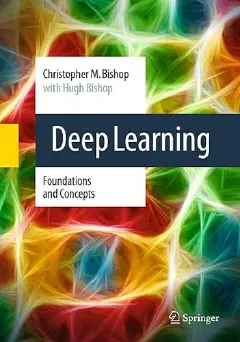
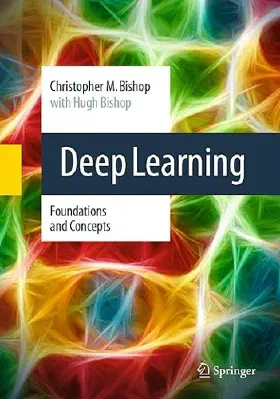
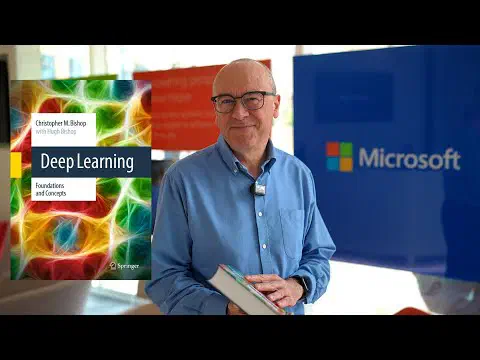
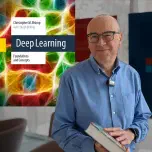
What makes Bishop matter right now, though, is timing. In 2024 he published Deep Learning: Foundations and Concepts, co-written with his son Hugh Bishop (an applied scientist at Wayve) — and it became Springer-Nature’s single best-selling book of both 2024 and 2025. It is the rare text that bridges the classical Bayesian foundations of his 2006 work with the transformer-era architectures developers actually deploy today. If you want to understand the mathematics under large language models without either drowning in blog-post hand-waving or getting stranded in pre-2012 theory, this is the book being handed to you. The free digital edition removes the last excuse.
Books
Key Articles & Papers
Pattern Recognition and Machine Learning (PRML) GTM: The Generative Topographic Mapping Mixture Density Networks Deep Learning: Foundations and ConceptsVideos
Spotify Podcasts
YouTube