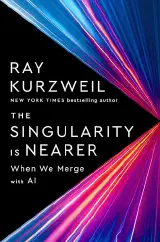
The Singularity Is Nearer: When We Merge with AI
When We Merge with AI
Kurzweil's central bet has always been that intelligence is information, and information compounds. *The Singularity Is Nearer* is the 2024 update to that bet: AI reaches human-level performance by 2029, nanobots connect the neocortex to cloud-based AI by the mid-2030s, and by 2045 we arrive at the Singularity — a point where human and machine intelligence become so entangled that prediction from our current vantage point breaks down entirely.
The first half of the book is strongest as a data exercise. Kurzweil marshals decades of charts tracking computing cost per calculation, global poverty, violence, literacy, and life expectancy — all on exponential curves bending the right direction. His Law of Accelerating Returns holds that information-based technologies create feedback loops that compound, and Moore's Law is just one instance of a deeper pattern. If you find yourself skeptical that progress is real, this section will work on you. The historical record he assembles is genuinely persuasive, and drawing a straight line from transistor density curves to the rise of large language models is an argument worth taking seriously.
One of the key advantages of the connectionist approach is that it allows you to solve problems without understanding them.
— Kurzweil, The Singularity Is Nearer, 2024
The second half is where Kurzweil the evangelist elbows out Kurzweil the analyst. His timeline for medical nanobots rests heavily on extrapolation from adjacent curves — similar to how someone in 1985 might have predicted the internet's arrival but gotten the decade wrong. More critically, his treatment of adoption barriers is thin. The resistance to radical life extension will evaporate because people don't want to die; lab-grown meat will win out because eventually it will taste right. These aren't stupid arguments, but they skip past what actually makes institutional change hard: regulatory frameworks, liability law, professional guilds, and insurance markets move on their own timescales, indifferent to how good the underlying technology is. Kurzweil acknowledges barriers exist; he consistently waves them away rather than engaging with them.
It will be a process of co-creation—evolving our minds to unlock deeper insight, and using those powers to produce transcendent new ideas for our future minds to explore.
— Kurzweil, The Singularity Is Nearer, 2024
The chapter on identity and consciousness is the philosophical spine of the book, and it earns its space. Questions about what happens to personhood when memory can be backed up, duplicated, or extended through non-biological substrate are questions AI will force on us regardless of whether the specific 2045 timeline holds. The risks section — bioengineered pandemics, weaponized nanotechnology, self-replicating systems — is handled with more rigor than critics typically acknowledge, even if it reads as secondary to Kurzweil's fundamental optimism.
The Sixth Epoch is where our intelligence spreads throughout the universe, turning ordinary matter into computronium, which is matter organized at the ultimate density of computation.
— Kurzweil, The Singularity Is Nearer, 2024
Read it as a quantitative case for AI progress and it delivers. Read it as a roadmap for how that progress becomes lived human experience, and the gaps show. Kurzweil is at his best arguing that the exponential curve is real; he's less convincing on the path from curve to civilization. For anyone who wants to argue about AI's trajectory in either direction, this is the clearest statement of the bullish case.
Read the longer summary
The bet at the center of the book
Kurzweil has been making the same wager for twenty-five years, and The Singularity Is Nearer is his attempt to collect on it. The bet has two specific dates. By 2029, an AI will pass a serious version of the Turing test — meaning indistinguishable from a competent human in extended text conversation. By 2045, we will have merged our biological brains with cloud-based intelligence via nanobots injected into the bloodstream, expanding our cognition by a factor of roughly a million. He calls that second event the Singularity, and the title of this book is his way of saying: I told you so in 2005, I am telling you so again, and the timeline holds.
This is a sequel to The Singularity Is Near (2005), and Kurzweil treats it as one. He spends a lot of pages reviewing his older predictions and grading himself favorably. That self-grading is reasonable on the AI front — large language models have done things in 2023 and 2024 that looked outlandish when he first sketched them. It is more strained on the embodied, practical predictions, which we will get to. But the structural argument of the book is straightforward: information technology compounds, biology is becoming an information technology, and so the timeline he laid out in 2005 is now in its final visible stretch.
The book is organized around a small number of big chapter-blocks: a chapter on identity and what it means to be a self (“Who Am I?”), a long chapter arguing that life is getting exponentially better, a chapter on jobs, a chapter on the next thirty years of health, a chapter on peril, and a closing dialogue with a skeptic called Cassandra. We will work through each of these in turn, but the load-bearing argument is in the second one. Everything else either flows from “the curves keep going up” or pushes back against the obvious objection that they will not.
Why Kurzweil thinks the math works
The engine of every prediction in this book is what Kurzweil calls the law of accelerating returns. He proposed it in 1999, restated it in 2005, and restates it again here. The version he prefers in this book is something like: information technologies create feedback loops that accelerate further innovation, because each generation gives us better tools for designing the next generation. Moore’s law is the famous exponential curve, but to Kurzweil it is just one expression of a deeper trend that runs through computation, sequencing, brain-imaging resolution, solar panel cost, and the capacity to manipulate matter at the molecular level.
The book leans on this argument harder than the previous one did, because so many of its concrete predictions — radical life extension, full-brain emulation, atom-by-atom manufacturing — depend on multiple curves crossing useful thresholds at the same time. If you grant Kurzweil his exponentials, the rest of the book mostly follows. If you don’t grant them, it doesn’t.
The strongest part of the case is that Kurzweil has, in fact, been right more often than the people who said he was crazy. His 2005 prediction that AI would reach human-level intelligence by 2029 looked absurd when GPUs were a niche graphics product. It looks defensible now. He frames AI history through a frame he learned from Marvin Minsky: the symbolic approach (rules and logic, hand-coded knowledge) versus the connectionist approach (neural networks that learn patterns from data). The connectionists won. One reader-highlighted line from the book — “One of the key advantages of the connectionist approach is that it allows you to solve problems without understanding them” — captures both the recent triumph of deep learning and the philosophical anxiety that comes with it. We have systems that perform surgery on protein folding without anyone being able to explain, line by line, why the answer is right.
The weakest part of the case is that Kurzweil treats curves as destiny. Exponentials are a description of the past. Whether they continue is an empirical question, and the book mostly answers it by pointing at more graphs. There is a difference between “Moore’s law has held for decades” and “Moore’s law is a law of nature.” Kurzweil tends to elide that difference.
The case that we live in the best of times
The longest single chapter of the book is the one that argues that more or less everything has been getting better for the human species — health, wealth, literacy, food production, sanitation, electrification, communication, peacefulness — and that the rate of improvement is accelerating. This is the part of the book closest in spirit to Steven Pinker’s Enlightenment Now, but with a tighter linkage to information technology as the cause of the upswing.
The data Kurzweil marshals here is real, and on the whole he is right. Global poverty has collapsed since 1990. Literacy was a luxury good in 1800 and is now nearly universal. The cost per unit of computation has fallen by something like four orders of magnitude in a generation. If the only thing you knew about the world was what cable news showed you, this chapter would be the most useful pages in the book.
But Kurzweil weakens his own case by stretching the time horizons until they become absurd. He compares modern murder rates to fourteenth-century Europe. He spans agricultural improvement over twenty-three thousand years. The lit.newcity reviewer pointed out that this kind of telescoping reads as unintentional comedy: the implication that today’s voters worry about crime because they have forgotten how dangerous medieval village life was. We agree. Pinker fell into the same trap, and you do not need to triangulate against the year 1300 to make the modern case for cautious optimism. The chapter is stronger when Kurzweil sticks to recent decades and concrete metrics like real cost of solar power per kilowatt-hour.
The deeper move in this chapter, though, is rhetorical: it is meant to soften you up for the wilder predictions later. If progress has been this consistently good for this long, then the strange-sounding promises about nanobots and uploaded minds are continuous with what has already happened, not a break from it. The reader is being walked from “things have improved” to “all the improvements still to come will also be net good.” Whether that walk lands depends on how much you trust the analogy between “we got better at growing wheat” and “we will get better at editing the substrate of human consciousness.”
The brain-cloud merger and the identity puzzle
The core image of The Singularity Is Nearer, the one Kurzweil keeps coming back to, is a fleet of nanobots small enough to travel in your bloodstream, crossing the blood-brain barrier, and connecting the upper layers of your neocortex to a cloud-based AI. The bandwidth of that connection, in his telling, is high enough that the cloud effectively becomes part of you. You think a question and the answer is just there, the way a memory is just there, except the memory is the entire searchable internet plus an AI that thinks alongside you a million times faster than biological neurons can fire.
Kurzweil thinks this happens in the 2030s. His framework calls this the dawn of the Sixth Epoch — the cosmological extension of intelligence past biology. One of the book’s most-highlighted passages reads: “The Sixth Epoch is where our intelligence spreads throughout the universe, turning ordinary matter into computronium, which is matter organized at the ultimate density of computation.” This is the kind of sentence that makes Kurzweil’s critics call him a prophet of a religion. It is also the kind of sentence that makes his admirers love him. He does not hedge. He thinks consciousness is going to leave the skull and start refactoring the cosmos.
The most interesting chapter in the book — by some distance, in our reading — is “Who Am I?”, which is where Kurzweil engages the philosophical objections to all of this. If you scan your brain and run a copy of yourself in silicon, is the copy you? If you replace your biological neurons one at a time with synthetic ones until none remain, did you die at some midpoint? Kurzweil takes these questions seriously enough to engage David Chalmers and the literature on personal identity, which is a real upgrade from the 2005 book, where this material got waved through. He concludes, predictably, that continuity of pattern is what matters and that a sufficiently faithful upload is you. We are not sure he wins the argument, but he at least shows up for it.
The chapter that connects to this most directly is the one on “After Life” technology, where Kurzweil entertains the project of digitally reviving deceased individuals through a combination of their preserved data — text, video, voice, behavioral traces — and surviving DNA. He does not claim this would resurrect the original person in any strict sense, but he thinks something like a faithful simulation will be possible, and he is open about the fact that he wants to try this with his late father. There is a personal pull behind the technical optimism here that is worth noticing. Some of Kurzweil’s most aggressive predictions are not just engineering claims; they are bets about whether grief can be undone. The reader gets to decide whether that motivation makes the predictions more credible or less.
What the book gets wrong about institutions
The single most important weakness of The Singularity Is Nearer is that Kurzweil consistently underestimates how slowly real institutions adopt new technology. He notices the problem and waves it away. He acknowledges that regulators, hospitals, school systems, courts, insurers, and zoning boards exist, and then he predicts as if they did not. The lit.newcity reviewer named this clearly: technology changes fast, individuals change slower, institutions change much more slowly than either, and Kurzweil’s curves do not include institutional friction as a variable.
The examples accumulate as you read. He treats lab-grown meat as a sure thing once the texture problem is solved, ignoring the multi-decade regulatory and cultural fight that is actually unfolding. He treats vertical farming as the future of food, when in 2024 and 2025 the marquee vertical farming companies are closing their facilities because the unit economics did not work. He treats medical nanobots as a near-term clinical reality, when even routine medical-device approval timelines are measured in years per device. He treats nuclear fusion as a serious power source on his timeline, even though fusion has been “thirty years away” for sixty years and the recent breakthroughs are net-positive only in a narrow accounting sense.
This is not an unfair complaint. Kurzweil’s whole method depends on extrapolating curves into a real economy made of humans, and the parts of that economy where exponentials hold (compute, sequencing, model parameters) are not the same as the parts where his predictions need to land (clinical practice, urban planning, the food system). Saying “the technology will be ready” is not the same as saying “we will use it.” A reader who is willing to grant Kurzweil his AGI date but skeptical of his everything-will-be-radically-different-by-2035 timeline is making, in our view, the right cut.
There is a related weakness around politics. Kurzweil’s optimism extends to the assumption that the gains from AI will be widely distributed, that geopolitical actors will not weaponize advanced biotechnology, and that the major economies will cooperate on safety standards. He is not naive about these things — he writes the Peril chapter, after all — but he treats catastrophic outcomes as solvable engineering problems and beneficial outcomes as the default. The book is, in this respect, a snapshot of a particular Silicon Valley sensibility that has become harder to defend in the years since the manuscript was finalized.
The peril chapter, and what it admits
To Kurzweil’s credit, The Singularity Is Nearer contains a long chapter explicitly devoted to the things that could go catastrophically wrong. He covers AI misalignment, bioengineered pandemics, the gray-goo scenario in nanotechnology, the use of AI to design new nuclear weapons, and the use of AI to manipulate political systems. He does not duck the existential-risk literature; he engages Nick Bostrom and the rest of the doomer canon by name.
This is the chapter where Kurzweil is at his most sober, and it is also the chapter that exposes the contradiction at the heart of the book. If the technologies he describes are powerful enough to grant immortality and reshape matter, they are powerful enough to be misused by a single state actor, a single lab, or a single sufficiently bored programmer. Kurzweil’s response is essentially that the same wave of intelligence that creates these risks will also be smart enough to manage them. We find this less reassuring than he seems to. The historical track record of “we will be wise enough by the time it matters” is mixed.
The closing chapter, the dialogue with Cassandra, is structured as Kurzweil debating a fictional skeptic named after the Greek prophet who was always right and never believed. It is a useful framing device, and it lets him steelman objections more directly than the body of the book does. If you read nothing else in The Singularity Is Nearer, read this chapter and the “Who Am I?” chapter back to back. They are the two places where Kurzweil is actually arguing rather than asserting.
The Becca Rothfeld review in the Washington Post called the book “careless and careening” and said Kurzweil’s prophecies “read like passages from messianic religious texts.” This is harsh and partly right. The structural problem with the book is that Kurzweil cannot decide whether he is writing an engineering forecast, a philosophical argument, or a manifesto, and he switches modes without warning. A graph of solar costs sits next to a paragraph about expanding consciousness across the cosmos. The Cassandra chapter helps, because the dialogue form forces him to slow down.
Who should read it, and what is missing
If you have already read The Singularity Is Near (2005), you do not strictly need this book. The framework is the same, the curves are the same, and the punchlines are the same. What you get for the price of admission is updated data, the much-improved chapter on identity, the long Peril chapter, and Kurzweil’s victory lap on the AI predictions that have actually come true since 2017. That is enough to justify the read for someone who cares about Kurzweil’s intellectual project, but not necessarily enough for a casual technology reader.
If you have not read the 2005 book, this is the better entry point. It is more current, the philosophical chapters are stronger, and you do not need the older text to follow the argument. We would pair it with Mustafa Suleyman’s The Coming Wave — which Kurzweil cites approvingly — for a more grounded view of the near-term geopolitics, and with something from the existential-risk side (Bostrom’s Superintelligence if you want the canonical doomer text, Yudkowsky and Soares’ more recent work if you want the urgent version) to balance Kurzweil’s optimism.
What is missing from the book, more than any single technical topic, is a serious treatment of what humans will do with all of this. Kurzweil writes confidently about the coming abundance — declining work hours, longer lives, abolished poverty — but the question of what people are for, in a world where machines are millions of times smarter than they are, gets surprisingly little attention. He gestures at it, especially in the jobs chapter, but he treats meaning as a problem that more leisure and better technology will dissolve. We are not sure that is true. The history of unemployment in wealthy societies suggests that even modest disconnection from productive work corrodes wellbeing in ways that more consumption does not fix. A book that predicts a thousand-fold expansion of human cognition should have something to say about what that expanded mind is supposed to be doing.
The other gap is more parochial: Kurzweil writes as if the West is the only relevant actor. China barely appears. The fact that frontier AI development is now a two-power race with state-backed labs in Shanghai and Beijing is not seriously integrated into his timelines. If you want to know what the Singularity looks like when it is being built simultaneously by parties with incompatible political values, you will not find it here.
None of which changes the basic recommendation. The Singularity Is Nearer is the most credible long-form statement of the technological-optimist case in 2024, written by the person who has the longest and most respectable track record at this kind of forecasting. We do not agree with all of it — the institutional naivety is real, the messianic register is real, the political blind spots are real — but the book deserves to be read on its own terms before it is dismissed. Kurzweil is wrong less often than his critics are.