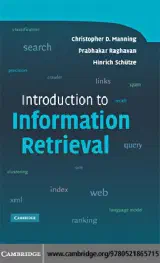
Introduction to Information Retrieval
Every time you type a query into a search engine and get a ranked list back in under a second, something remarkable has happened. *Introduction to Information Retrieval* by Manning, Raghavan, and Schütze is the textbook that explains how -- from the first inverted index through TF-IDF weighting, probabilistic ranking, and web-scale crawling -- and it does so with the rigor of computer science and the breadth of a field that touches linguistics, statistics, and systems engineering.
The book's organizing logic is a clean progression from simple to sophisticated. Start with Boolean retrieval: a document either matches your query or it doesn't. Show why that's insufficient. Add term weighting, then vector space models, then probabilistic frameworks, then machine learning for classification. Each chapter builds on the last, and the authors are disciplined about showing why each new idea is necessary before introducing it. The chapters on index compression and construction are particularly strong -- the kind of material other textbooks wave away but which is central to making retrieval work at scale. Learning that a positional index can be 2-4 times larger than a non-positional index, or that gamma codes compress a posting file to roughly a tenth of the original collection size, gives you the intuition you need to actually build systems.
To the surprise of many, the field of information retrieval has moved from being a primarily academic discipline to being the basis underlying most people's preferred means of information access.
— Manning, Raghavan & Schütze, Introduction to Information Retrieval, Preface
Where the book earns its reputation is in the middle sections on scoring and probabilistic models. The explanation of TF-IDF as an approximation of a probabilistic quantity, followed by the separate development of the Binary Independence Model and BM25 as genuine probabilistic approaches, is illuminating. You understand not just the formulas but where they come from and why BM25, with its tunable k1 and b parameters, dominated benchmark evaluations for two decades. The language modeling chapters are similarly strong, showing how document retrieval can be framed as estimating the probability that a query was generated by a document model -- with smoothing doing the heavy lifting that TF-IDF achieves through heuristic weighting.
NB classifiers estimate badly, but often classify well.
— Manning, Raghavan & Schütze, Introduction to Information Retrieval, ch. 13
The book's weakness is the one that afflicts all textbooks from 2008: it predates the neural turn in NLP and information retrieval. The chapters on text classification cover Naive Bayes, SVMs, and kNN, which is solid work, but there is no mention of dense vector representations or learned embeddings. This is a consequence of timing, not a failure of judgment. The chapter on XML retrieval has aged the worst. XQuery-based structured retrieval never became the dominant paradigm its advocates anticipated, and those pages now read more as archaeology than engineering.
It seems reasonable to assume that relevance of results is the most important factor: blindingly fast, useless answers do not make a user happy.
— Manning, Raghavan & Schütze, Introduction to Information Retrieval, ch. 8
For anyone learning the mathematical foundations of search -- a first-year graduate student, a software engineer trying to understand what their search cluster is actually doing, or a practitioner building a retrieval pipeline without neural components -- this book is the right starting point. It is rigorous where rigor matters, clear where clarity is achievable, and honest about where the field remained uncertain in 2008. The fact that the online edition is freely available removes the last remaining objection to reading it.