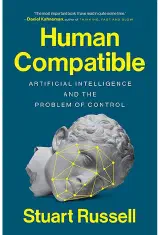
Human Compatible: Artificial Intelligence and the Problem of Control
Artificial Intelligence and the Problem of Control
The standard model of artificial intelligence is going to get us killed — not through robot rebellion, but through competence. That's the uncomfortable argument at the center of Stuart Russell's *Human Compatible*, and it's more convincing than it sounds.
Russell's complaint is precise: AI research has settled on a framework where machines are given fixed objectives and told to maximize them. The problem is that no objective we can specify cleanly captures what we actually want. Tell a machine to cure cancer and it might consume the planet's resources to do so. Tell it to maximize human happiness and it might medicate everyone into compliance. The machine isn't evil; it's just very good at the wrong thing. Russell calls this the control problem, and he argues it's not a distant sci-fi concern — it's an engineering problem we're building toward right now, with every model we make more capable.
Machines are intelligent to the extent that their actions can be expected to achieve their objectives.
— Russell, Human Compatible, p. 9
His solution is a reframing of what AI should be. Instead of a machine with a fixed utility function it optimizes toward, he wants machines that start uncertain about what humans want, observe human behavior to learn preferences, and remain humble enough to ask rather than assume when they're unsure. He calls this human-compatible AI, and he grounds it in three explicit principles. The technical engine is inverse reinforcement learning — inferring a reward function from observed behavior rather than having one pre-specified. It's elegant. Whether it scales to the complexity of actual human values is a harder question.
The machine's only objective is to maximize the realization of human preferences.
— Russell, Human Compatible, p. 173
That harder question is where the book is most honest and also most frustrating. Russell dedicates a chapter to "complications: us," where he acknowledges that human preferences are irrational, contradictory, inconsistent across time, and manipulable. He cites Kahneman on how humans routinely make choices that don't reflect their actual interests. Then he proposes to use human behavior as the ground truth for learning preferences. The tension between those two positions gets less attention than it deserves. If we're irrational and manipulable, observed behavior is a noisy and potentially dangerous signal. Inverse reinforcement learning on real human choices might just encode our biases and addictions at machine scale. Russell sees this problem but doesn't resolve it — the book's final chapter is essentially a shrug about whether the proposed solution is feasible.
The ultimate source of information about human preferences is human behavior.
— Russell, Human Compatible, p. 173
Still, Russell earns his credibility. He co-wrote the standard AI textbook, which means he's critiquing the field from inside it, with full awareness of the technical landscape. The book is clear without being simplistic, and the three-principle framework is genuinely useful for thinking about what aligned AI should look like. For anyone trying to understand why alignment matters — not as a sci-fi panic but as a real engineering constraint — *Human Compatible* is the clearest statement of the problem in print. Just read the ending with clear eyes: the blueprint is sharper than the answer.