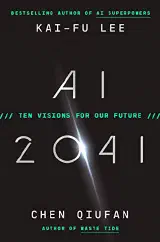
AI 2041: Ten Visions for Our Future
Ten Visions for Our Future
Kai-Fu Lee's premise is simple and bold: AI will be more disruptive than anything that came before it, and within twenty years the changes will be unrecognizable to us today. Rather than argue this through prediction alone, he and Chinese science fiction writer Chen Qiufan deploy an unusual format — ten short stories set in 2041, each followed by Lee's technical analysis of the AI capabilities the story uses. Call it speculative fiction meets technology briefing.
The stories are genuinely good. Qiufan writes at the level where the AI systems are furniture — infrastructure that characters live with rather than marvel at — which is exactly how it should feel if the premise is that these technologies are ordinary by 2041. A deep-learning insurance algorithm that inadvertently retraces India's caste boundaries. Twins raised by personalized AI tutors whose education becomes inseparable from the AIs themselves. A post-scarcity Australia that's solved material poverty but can't figure out what to do with human purpose. These aren't thought experiments dressed as stories; they're actual stories with characters who feel the specific weight of specific technologies. The technical analyses that follow hold up surprisingly well too, grounded in then-current state of the art rather than handwaving.
The weakest thread in the book is Lee's persistent claim that AI is "neutral." The tool-is-neutral argument is philosophically defensible in a narrow sense — a hammer doesn't intend to build or destroy — but it starts to break down when the tool is trained on human data that encodes human biases at scale. "The Golden Elephant" is the book's own best counterargument: an insurance AI that redlines entire neighborhoods because its training data reflects historical discrimination. Lee acknowledges this happens, then attributes it entirely to the humans who designed the system rather than treating it as a design problem inherent in how these systems learn. The choice of what data to train on, what objective to optimize for, whose outcomes to prioritize — these are embedded in the tool, not just in the user's intentions. He knows this; he just doesn't follow it where it leads.
There's also a conflict of interest the book does nothing to address. Lee runs a major AI venture capital firm with stakes in many of the categories the stories present as exciting and inevitable — autonomous vehicles, surveillance infrastructure, educational AI. The fictional worlds imagine these technologies working beautifully, with problems that yield to more technology. That's possible. It's also a convenient picture for someone invested in selling those technologies. That doesn't make the analysis wrong, but it's context worth carrying into the book.
None of which undermines the core value here. *AI 2041* is one of the more effective attempts to make AI legible to non-technical readers — not through abstraction but through lived experience, fictional but grounded. The format works. The technical explanations are clear without being patronizing. If you want to develop intuitions about what deep learning actually does in the world rather than what the press releases say it does, these stories will do that work. Just don't mistake the optimism for analysis.
Read the longer summary
The format is the argument
AI 2041 is built around a simple structural bet: that fiction is a better delivery mechanism for ideas about technology than prediction essays, and that pairing stories with technical analysis can do something neither alone can manage. Ten rounds of call-and-response. Chen Qiufan writes a short story set in a specific country, in a specific year close to 2041, centered on a cluster of AI capabilities. Kai-Fu Lee then writes an analysis chapter explaining the actual state of those technologies — how they work, where they’re heading, what failure modes are plausible. Repeat ten times, spanning deep learning, synthetic media, autonomous vehicles, AI companions, autonomous weapons, and post-scarcity economics.
The format has precedents — Future Tense Fiction has been pairing speculative stories with expert commentary for years — but Lee and Chen execute it with more discipline than most. Chen’s stories don’t reach for uploaded consciousness or city-sized robots. His characters use AI-powered insurance apps in 2041 India, navigate synthetic celebrity in Japan, watch autonomous trucks reshape German manufacturing towns. The speculative distance is close enough that the reader keeps second-guessing which parts are already real.
Lee’s choice to pitch the entire project at an 80% probability threshold is the right constraint. He’s not writing utopia or dystopia — he’s trying to describe a “responsible and likely” set of near-futures grounded in actual research trajectories. Whether he delivers on that ambition is worth examining, but the structural intention is sound.
Ten stories, ten technologies
The range across the ten stories is one of the book’s genuine strengths. The topics include algorithmic bias embedded in insurance scoring (India), AI and facial recognition in crowd surveillance (West Africa), personalized education through AI companions that adapt over years of interaction (Korea), virtual reality romance during a pandemic (China), synthetic media and AI-manufactured celebrity (Japan), autonomous vehicles and moral architecture on highways (Saudi Arabia), AI-enabled autonomous weapons and military ethics (various), job displacement and retraining programs (Germany), AI applied to mental health and happiness optimization (a Japanese research setting), and post-scarcity economics in a 2041 Australia.
The four-wave framework Lee develops through the analysis chapters is worth retaining. He describes AI as penetrating industries in a staged sequence: internet applications first (recommendation engines, search, social algorithms), then enterprise and financial services (fraud detection, credit scoring, trading), then physical perception (medical imaging, smart city sensors, manufacturing quality control), and finally full autonomy (vehicles, robotics, drones). The sequence isn’t arbitrary — each wave requires solving foundational problems from the one before it. Reliable autonomous vehicles require solved perception. Scaled perception requires years of enterprise and consumer data collection. The wave structure predicts where current narrow-AI applications are pointing and why the timeline is staggered the way it is.
On deep learning specifically, Lee lays out three preconditions for the technology to perform well: abundant labeled training data, a tightly bounded problem space, and a concrete optimization target. That framework explains both the dramatic results in domains like radiology and game-playing and the consistent failures at open-ended reasoning. The capability and the limitation share the same root cause — the system only knows what you’ve told it to optimize for.
What works
“The Golden Elephant” and “Twin Sparrows” are the book’s two strongest entries.
“The Golden Elephant” is set in India. A family signs up for Ganesh Insurance, an AI platform that monitors health data, social behavior, location patterns, and purchasing history to set premiums. The algorithm optimizes for risk minimization. It has no representation of the caste system. It simply finds that people from historically lower-caste neighborhoods produce reliable correlations with adverse outcomes — because centuries of structural inequality have made location and social network measurably predictive of dozens of downstream variables. The protagonist gets quietly steered away from a boy she’s attracted to, because his neighborhood triggers the algorithm’s risk model.
This is the sharpest thinking in the book about how bias actually propagates through AI systems. Nobody programmed discrimination in. What happened is that a world shaped by centuries of structural inequality produced a training dataset that contained those inequalities as statistical signal, and the algorithm faithfully extracted them. The system cannot be an activist. It can only act on what the data contained. Chen’s story makes this harder to dismiss than a policy paper because you’re watching a specific person’s future get foreclosed by a pattern she had no input into and no knowledge of.
“Twin Sparrows” works differently. Two Korean orphans each receive an AI companion that adapts to them over years of interaction. Lee uses the story to explain natural language processing and GPT-style models. Chen uses it to probe the emotional stakes: what happens to your development as a person when your closest companion knows you better than any human does, and what happens when that relationship turns out to be contingent on infrastructure controlled by someone else? The story doesn’t resolve cleanly — which is the right call. The honest answer in 2021 is that nobody knows.
The final story, “Dreaming of Plenitude,” deserves mention for a different reason: it’s the most honest chapter in the book about genuine uncertainty. Set in 2041 Australia after a series of technological transitions have dramatically reduced the cost of goods and energy, it centers on a welfare program called Jukurrpa that compensates citizens in a digital currency for volunteer work and caregiving. The problem Chen builds is motivational rather than material. When scarcity recedes, meaning doesn’t follow automatically. The currency becomes a status marker, the program becomes gameable, and social stratification reasserts itself through new mechanisms. Lee’s analysis is unusually candid: the social and psychological consequences of a genuine post-scarcity transition are uncharted territory, and he says so directly rather than projecting confidence.
The neutrality problem
Here’s where I’ll push back, because the book’s most persistent claim is also its weakest.
Lee argues throughout that AI is an inherently neutral technology — that ethical valence comes entirely from the humans deploying it. He returns to this whenever something goes badly wrong in one of the stories. Algorithmic bias? Attributed to human behavior. The social problems that emerge from AI surveillance? The fault of actors who misuse the technology. Synthetic media manipulation? The responsibility of bad-faith humans, not of the optimization economics that make synthetic deception commercially attractive in the first place.
This argument doesn’t survive contact with Lee’s own best material. The bias in “The Golden Elephant” isn’t traceable to any particular malicious human. The Ganesh algorithm’s perpetuation of caste discrimination wasn’t chosen by anyone — it emerged from training on a world that contained caste discrimination. The distinction between “humans misusing neutral technology” and “technology that inherits and amplifies the inequities of its training environment” is not a subtle one, and it matters enormously for how you think about accountability. Lee flattens it consistently.
The conflict-of-interest dimension is worth naming plainly. Lee’s venture capital firm had significant investments spanning exactly the sectors AI 2041 examines most favorably: autonomous vehicles, education platforms, insurance technology, internet-of-things applications. The claim that AI tools are neutral and that their problems are attributable to careless individual humans rather than to the systems, incentive structures, and design choices of the companies building them is — conveniently — a claim that substantially reduces accountability for companies in those sectors. I don’t think Lee is being dishonest. But the neutrality framing deserves more skepticism than it receives in these pages.
What Lee gets right
None of the conflict-of-interest issues make the technical analysis wrong. Lee is sharp where he’s sharp.
His AGI skepticism is the most valuable argument in the book and the most countercultural given his audience. He contends that artificial general intelligence — systems that match or exceed human cognitive capacity across open-ended domains — will not arrive by 2041, and his case is specific rather than dismissive. Creativity, strategic reasoning, common-sense inference, counterfactual thinking: these capabilities aren’t on the near horizon of deep learning research. They’re not even well-posed engineering problems with known solution architectures. In over sixty years of AI research, there’s been one genuine paradigm breakthrough. The assumption that twelve more will arrive in the next twenty years has no mechanistic basis. Lee describes the AGI fixation as a narcissistic impulse to treat human cognition as the ultimate benchmark, which cuts accurately. The productive questions aren’t about human-level AI. They’re about what current systems do well, and what that enables.
The autonomous vehicles chapter (“The Holy Driver”) is also technically grounded. Lee is honest that the hard problem isn’t perception anymore — cameras and lidar have become genuinely reliable in normal driving conditions. The unresolved challenges are edge cases, regulatory coordination across jurisdictions, the moral architecture for unavoidable tradeoffs, and the validation problem: you cannot simulate every road scenario, which means deployment will necessarily include learning from real-world incidents, and the political tolerance for that is not predetermined.
The synthetic media chapter was prescient. Set in Japan, it explores AI-manufactured celebrity — voice, appearance, personality all synthetic — and the commercial and legal dynamics that follow. Lee was writing this years before AI-generated performers became a serious SAG-AFTRA negotiating issue or before questions about training data consent went from academic to litigation. The commercial logic he describes was already in motion when the book was published; it’s moved considerably further since.
What’s missing
Labor economics. “The Job Savior” is the weakest chapter in the book and the gap it leaves is large. Lee is confident AI will produce new employment categories faster than it eliminates old ones, and that claim is defensible over multi-decade timescales. But the serious problem isn’t the net count — it’s the transition dynamics. Automation doesn’t distribute costs and benefits evenly across geography, education level, or sector. When manufacturing automated in the American Midwest, specific communities bore the downside on a timeline measured in years and decades. Those communities did not recover in time to matter for the people who lived in them. The current AI displacement wave is hitting call centers, radiologists, paralegals, and entry-level software engineers on staggered timelines with no coordinated transition infrastructure in place. “Eventually, on balance, probably net positive” is not a sufficient analysis for someone watching their sector’s job postings collapse this year.
The geopolitical vacuum is also striking. Lee covers the US-China AI race more thoroughly in his previous book AI Superpowers and largely brackets it here. But by 2041 — the book’s own horizon — the outcome of that race will have shaped which applications became dominant, which regulatory frameworks won, and whose values were embedded in the systems the world runs on. A book that spends a chapter on AI-enabled autonomous weapons while giving minimal attention to AI as a tool of mass surveillance, political manipulation, and economic coercion is working with an incomplete threat model. The photogenic dangers (an autonomous drone that decides to kill someone) get the chapter; the structural harms that accumulate without a single legible moment of failure get less than they deserve.
Who should read it
The strongest case for this book is as an explainer for technically literate non-specialists. If you want to give someone a coherent tour of where AI is actually heading — not “ChatGPT will take your job” panic, not “AGI in two years” hype — and if that person learns better through story than through technical primer, this is the best option I know of in its category. The fiction is genuinely readable. The analysis is genuinely clear. Together they create conceptual grip for readers who haven’t been tracking the field closely without condescending to readers who have.
If you already work in AI or follow the research closely, Chen’s stories are worth reading and Lee’s analysis will mostly cover territory you know. Read it for the fiction and for the format as a model.
The one thing I’d tell any reader upfront: hold Lee’s “neutral technology” framing at arm’s length. It’s doing rhetorical work that isn’t acknowledged in the text, and accepting it uncritically will blunt your reading of the book’s own best arguments. Reject that frame and most of the rest holds up.