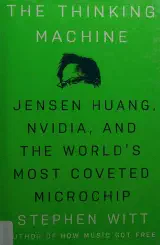
Thinking Machine
Jensen Huang, Nvidia, and the World's Most Coveted Microchip
Stephen Witt's biography of Jensen Huang—how Nvidia conquered AI hardware and became the world's most valuable company.
Nvidia didn't become the most valuable company in the world by building better graphics chips. It got there by making bets that looked insane and holding them for thirty years while everyone else begged Jensen Huang to be reasonable.
That's the core argument of Stephen Witt's biography of Huang, and it's a good one. Witt spent years reporting on Nvidia, and his access shows — the book is stuffed with anecdotes from engineers who survived screaming matches, board members who fended off activist investors, and coworkers who watched Huang draw chip architectures in marker directly on the conference room walls. What emerges is a portrait of a man who thinks in first principles so instinctively that he sometimes can't explain his reasoning, only his conclusions.
Our company is thirty days from going out of business.
— Huang, in Witt, Thinking Machine, ch. 4
The book's best stretch covers the CUDA years — roughly 2004 to 2012 — when Huang bet his company's profits on scientific computing infrastructure that had no obvious customers. Every logical analysis said to stop. The stock flatlined. An activist investor circled. Researchers who actually wanted the technology couldn't even get Nvidia's engineers to return their emails. Huang kept going anyway, not from optimism exactly, but from a kind of patient reasoning: if parallel computing was going to be the future of any important computation, someone would eventually need to run it on his hardware. He shipped the tools early and waited for the scientists to show up. They showed up in a Toronto graduate student's bedroom in 2012, and everything that followed — AlexNet, GPT, ChatGPT, the $3 trillion market cap — flows directly from that moment.
It will come for the fiction writers first.
— Huang, in Witt, Thinking Machine, Introduction
Where the book is weaker is in its treatment of Huang's management style. Witt is clearly fascinated by the screaming, and there's genuinely interesting material here — the public dressing-downs as corporate pedagogy, the anger deployed as shared lesson rather than private punishment. But Witt's framing tips toward admiration too consistently. Nearly every employee quoted about the abuse also offers a tender story about Huang's loyalty or generosity. The pattern gets repetitive, and you start to wonder what the people who just quit without offering tender stories would have said. The book is a biography, not a hagiography, but the line gets blurry in the middle chapters.
Right now there are ninety-nine very smart people trying to make AI better and one very smart person trying to figure out how to stop it taking over.
— Hinton, in Witt, Thinking Machine, ch. 22
The final section, where Witt himself catches The Fear about AI and the book becomes partly about his own anxieties, is interesting but self-indulgent. The contrast between Yoshua Bengio's 50 percent probability of catastrophe and Huang's flat zero is genuinely worth exploring — these are two of the most credentialed people alive holding completely opposite views about whether their life's work might kill everyone. But Witt's own dread keeps pulling focus from what should be a more rigorous examination of that disagreement. He ends up writing about his feelings when the reader wants him to adjudicate the argument.
Still: read the book. Witt writes with a researcher's fluency and a journalist's timing. The hardware chapters aren't dry. The origin story — a ten-year-old Taiwanese kid crossing a rope bridge in Appalachian Kentucky while bigger kids tried to shake him off — is almost too perfectly symbolic, yet it's reported. For anyone trying to understand why Nvidia owns the infrastructure layer of the AI revolution, this is the primary source.
Read the longer summary
A biography of Nvidia disguised as a biography of Jensen Huang
Stephen Witt’s Thinking Machine is pitched as a Huang biography. It isn’t, really. Huang refuses to cooperate with his own life story — informing Witt “I hope I die before it comes out” — and ducks anything that sounds like psychoanalysis. What Witt gets instead, through close to two hundred interviews with cofounders, engineers, rivals, and board members, is the company. The result is the best book yet written on Nvidia: how a maker of graphics boards for teenage gamers ended up owning the hardware layer beneath every AI that matters.
Witt’s central claim is that Nvidia’s dominance is not an accident. It is the compounding result of a few stubborn bets placed by an engineer-CEO who absorbed Clayton Christensen’s work more carefully than anyone else in the semiconductor industry. Parallel computing was supposed to be a dead end. Neural networks were supposed to be obsolete. Huang bet the company on both, and the two out-of-favor technologies turned out to be complementary pieces of the same machine.
The Kentucky bridge and the Denny’s founding
Witt spends more time on Huang’s early life than you’d expect, and it pays off. Ten-year-old Jen-Hsun Huang arrived in rural Kentucky in 1973 and was enrolled, by a confused uncle, at what turned out to be a reform school for troubled boys. His roommate was a seventeen-year-old who couldn’t read and liked to show off knife scars. Huang taught him to read in exchange for weight-lifting lessons, did push-ups every night, cleaned latrines as his summer job, and finished first in his class. Fifty years later he would tell Witt, with no visible emotion, about being called racial slurs every day.
Witt keeps returning to the pattern this sets. Huang’s response to hostile environments was to outwork everyone and show no feeling. His cofounder Chris Malachowsky tells Witt that Huang was already doing superhuman logistics work at LSI Logic, the chip firm where he started his career. Jens Horstmann, who worked beside him in LSI’s open-plan cubicle farm for years, describes an engineer who could always sense when a problem had hit a wall and pivot, while most of his peers kept digging.
The company founding is narrated with affection. Huang, Malachowsky, and Curtis Priem incorporated Nvidia in 1993 at a bullet-pocked Denny’s in San Jose, or at least mostly there. Witt gets into the weeds on what each founder brought: Priem the architect with an enormous forehead and fifteen-minute verbal monologues about circuit architecture; Malachowsky the mechanic who flew his own plane; Huang the logistician who quietly ran the meeting.
The emulator bet and the thirty-days mantra
Here the book is at its best. The first Nvidia chip, the NV1, was a flop. Priem had loaded it with every clever idea he had, including a non-standard texture-mapping approach, and Microsoft mooted all of it by launching DirectX. By 1996 Nvidia had laid off two-thirds of staff and was burning through the last of its Sega settlement money.
Huang did two things that, in retrospect, defined the company. First, he took the remaining cash and bought a hardware emulator — a room-sized contraption that let a chip be designed in software and tested without physical fabrication. No chipmaker had ever shipped to production without a physical prototype. Huang did. The resulting Riva 128 worked, saved the company, and Nvidia has leaned on emulators ever since.
Second, and more importantly, Huang came away from the near-death with a culture. Every quarterly presentation at Nvidia still opens with the line “our company is thirty days from going out of business,” even when it is earning tens of billions. Witt argues this is deliberate: a management technique to keep a firm that is structurally a monopoly from behaving like one. Whether it still works in 2025 is a question the book raises but does not answer.
Witt is also sharp on the fall of 3dfx, Nvidia’s main early rival. Huang poached its engineers, outshipped them on a six-month cadence they could not match, and eventually bought the corpse for $70 million. Inside 3dfx, court filings revealed, Huang was referred to as “Darth Vader.” He kept Nvidia’s code base fast and sloppy. Ben Garlick, a 3dfx refugee who joined the winning team, calls the resulting tech debt “the battle scar of the survivor,” which is one of the best lines in the book.
The CUDA decade nobody wanted
The middle third of Thinking Machine is the part worth the price of admission. From roughly 2006 to 2016, Nvidia shipped its parallel-computing platform CUDA with every retail gaming card and watched almost nobody use it. Wall Street hated it. The first real CUDA customer, Witt reports, was a pair of breast cancer researchers at Massachusetts General who bought two cards.
This is where Witt is sharpest, because he is writing about a commercial phenomenon with almost no analog. Huang was deliberately serving what he called “zero-billion-dollar markets” — niches so small they could not meaningfully be called markets. He was subsidizing academic scientists. He was reading Christensen. He was loading an AI-capable architecture into every gaming GPU, a tax his gamer customers never asked for, against the possibility that some hungry disruptor would otherwise do to Nvidia what Nvidia had done to Silicon Graphics. Witt calls it paranoia more than optimism, and that reading is correct.
In 2013 Jeff Smith’s activist fund Starboard Value sent a letter questioning whether CUDA made any sense. Huang flew to Boston to plead with Fidelity not to fire him. Board member Jim Gaither tells Witt the meeting was brutal. Nvidia stock had not appreciated in a decade. Huang kept CUDA and killed the mobile modem business instead. Witt treats this as the wager that separated Nvidia from every other chip firm, and he is right. Lisa Su at AMD was meanwhile five years into being a feel-good turnaround story; Nvidia was still, on paper, an underperforming dog.
Horstmann gives Witt the best one-line description of Huang’s method during this period. It is not focus, he tells Witt, but resonance: constant low-level interaction with customers and engineers, sensing before the market does where the technology is heading. Witt captures how unusual this is. Musk starts from a science-fiction vision and works backward to the technology. Huang starts from what the transistors can already do and projects forward until logic runs out, then takes exactly one step into instinct. The difference matters more than commentary usually allows.
AlexNet, the transformer, and the snap-to-grid moment
The 2012 AlexNet story has been told many times. Witt tells it best. Alex Krizhevsky, a Russian-Ukrainian immigrant in Geoffrey Hinton’s lab in Toronto, trained an image-recognition neural net on two GeForce GTX 580s that he and Ilya Sutskever bought with pooled grad-student money. His parents paid the electricity bill. He effectively rebuilt computer vision from his childhood bedroom.
What’s new in Witt’s telling is the corporate reaction. Hinton had emailed Nvidia asking for a donated card and was ignored. The CUDA team did not bother to return his emails. Not a single Nvidia employee worked on AI until Bryan Catanzaro, a cultural misfit with a Russian literature degree, pushed Huang to build a deep-learning software stack. Huang read about neural networks for a weekend and converted instantly. Catanzaro tells Witt that after that weekend Huang began writing the acronym “O.I.A.L.O.,” for once-in-a-lifetime opportunity, on his whiteboard at every meeting.
Witt is also unusually good on the transformer. The 2017 Google paper “Attention Is All You Need” is typically framed as a mathematical insight. Jakob Uszkoreit, one of its authors, tells Witt the actual insight was about hardware. The transformer was designed for the GPU. The earlier recurrent neural network architecture had been designed for the CPU and fought parallelism at every turn. The transformer instead fed the GPU what it wanted: vast quantities of data and simple operations run in parallel. This is not how the breakthrough is usually explained, and Witt is right to press on it.
The chapters on ChatGPT, Sutskever, and the OpenAI coup are more familiar territory and less essential. Witt covers them competently and moves on.
What Witt gets right, and where he goes soft
The book’s strongest passages are technical and commercial. Witt can explain to a non-engineer why parallel programming is hard. His analogy for CPU versus GPU (a delivery van versus a fleet of motorcycles) is clumsy but serviceable, and his extended kitchen-knife-versus-Cuisinart metaphor for what the GPU actually does is genuinely useful. More importantly, Witt is clear that Nvidia’s moat is not the silicon. The silicon is commodity; AMD engineers can build equivalent hardware, as Nvidia’s own Arjun Prabhu tells him. The moat is the ten thousand programmers under Dwight Diercks writing domain-specific libraries nobody else bothers to write. This is the single most important fact to understand about Nvidia in 2025, and Witt is correct and clear about it.
He is also very good on Huang the manager. The public humiliations, the daily flood of three-word emails, the “speed of light” scheduling doctrine, the fifty-five direct reports, the refusal to fire people even after expensive mistakes — all of it is reported with specificity. Multiple sources describe a CEO who will verbally flay a subordinate for two hours in a cafeteria in front of 150 colleagues and then pay for that same person’s medical treatment out of pocket. Witt does not try to resolve the contradiction. He shows it.
Two sections soften the final third. The geopolitics chapter — Taiwan and TSMC, the China export controls, the Phoenix fab, the Hamas attack on Israel — feels dutiful. A careful newspaper reader will find little new. Morris Chang’s silicon-shield argument is worth the page; most of the rest is padding.
The AI-risk chapter is more of a problem. Witt gives generous space to Yoshua Bengio and Hinton’s fear conversion in early 2023 and considerably less to Yann LeCun and the researchers who disagree. By the closing chapter Witt is describing his own dread about ChatGPT replacing him as a writer, and admitting he was too afraid to use it to write the book. It is honest, and it makes for compelling prose, but the reportorial distance collapses. Huang refuses to play along. In their final interview Huang explodes at Witt for asking about mechanical evolution superseding biology. Witt frames the anger as strategic, a deliberate performance to shut the line of questioning down. That framing is probably right. But a reader who thinks Huang is simply correct that current AI is a sophisticated statistical tool and not a proto-mind will find that view reported but not seriously engaged with. It gets presented as the view of a busy man with a financial interest, rather than a defensible technical position held by people who actually build the systems.
What’s missing, and who should read it
A few things the book does not cover well. Lisa Su and AMD get one chapter, mostly devoted to the genealogical coincidence that she and Huang are first cousins once removed. If you want to understand whether Nvidia’s monopoly can hold, Su’s actual competitive strategy matters, and it is not really here. The in-house silicon programs at Google, Amazon, and Meta — arguably the real long-term threat — each get a paragraph.
There is also surprisingly little on the software stack below the application layer. PyTorch gets a footnote. CUDA is described repeatedly as the moat without the mechanics of why — the compiler behavior, the kernel library choices, the scheduling primitives — getting more than metaphor. A technically inclined reader will finish feeling slightly underfed.
If you have been tracking Nvidia through earnings calls and trade press, maybe 30% of Thinking Machine will be new, but it is the right 30%: the people, the near-death experiences, the texture of actually betting on parallel computing in 2009 when everyone told you it was stupid. The middle section on CUDA is the most useful business case study I have read on how a real monopoly position is built — not through founder genius in 1993, but through fifteen years of stubbornly serving customers nobody else wanted.
If you are coming in cold and want to understand why Nvidia is worth more than Apple, this is where to start. Skip the occasional Christensen over-application; Witt lays it on thick. Take the technical sections slowly. And read it for the Huang material and the CUDA decade, not for the final AI-risk chapter, where the reporter becomes the subject.