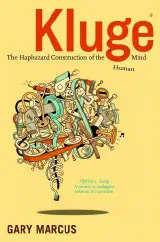
Kluge: The Haphazard Evolution of the Human Mind
Evolution is not an engineer. It's a tinkerer that makes do with whatever parts are lying around, and the human brain is the clearest proof.
That's Gary Marcus's argument in *Kluge*, and it's a good one. A kluge, in engineering slang, is a makeshift fix: ugly, cobbled together, but somehow working. Marcus applies the term to the whole architecture of the mind, which he argues was not designed so much as accumulated — layer upon layer of systems that evolved for different environments and don't always cooperate. The result is a brain that can recognize a face from decades ago but forgets where it put its keys, that can reason syllogistically in the abstract but stumbles the moment the same logic threatens a cherished belief.
Where Shakespeare imagined infinite reason, I see something else, what engineers call a 'kluge.' A kluge is a clumsy or inelegant—yet surprisingly effective—solution to a problem.
— Marcus, Kluge, p. 2
The strongest chapters are on memory and belief. Marcus is good at showing why contextual memory — the kind we have, organized by association rather than address — is a reasonable evolutionary outcome and yet a constant practical liability. We retrieve memories by reaching sideways through related concepts, which is why emotion, context, and stress so thoroughly corrupt recall. The belief chapter is even sharper. The mind did not evolve to find truth; it evolved to reach conclusions quickly and defend them. Confirmation bias, motivated reasoning, the halo effect — Marcus traces all of these not to stupidity but to architecture. The cognitive shortcuts that let our ancestors make fast decisions in a threatening world are the same shortcuts that make us credulous, tribal, and terrible at updating priors.
Engineers would probably build kluges more often if it were not for one small fact: that which is clumsy is rarely reliable.
— Marcus, Kluge, ch. 7 (Things Fall Apart)
The weakest section is the chapter on mental illness, where Marcus tries to place conditions like depression and anxiety under the kluge umbrella. The argument — that these disorders are bad side effects of a haphazardly assembled system rather than adaptations — is plausible, but he states it with more confidence than the evidence supports. Readers familiar with the ongoing debate over evolutionary psychiatry will notice the gaps.
No matter what we humans think about, we tend to pay more attention to stuff that fits in with our beliefs than stuff that might challenge them.
— Marcus, Kluge, p. 53, ch. 3 (Belief)
The book ends with thirteen practical suggestions for working around your own cognitive hardware: seek disconfirming evidence, reframe decisions, imagine your choices being scrutinized by someone else afterward. These are worth having in one place, though anyone who has spent time with Kahneman or the behavioral economics literature will recognize the terrain. What Marcus adds is the why beneath the what — a coherent evolutionary account of why these biases exist at all, rather than a catalog of them labeled with clever names.
*Kluge* is short, brisk, and easier to read than most books in the field. It does not go as deep as *Thinking, Fast and Slow*, and Marcus's targets — intelligent design and pop evolutionary psychology — occasionally make the book feel more like polemic than science. But the core thesis is correct, well-argued, and has a practical payoff. If you want to understand why rational behavior is hard, this is one of the better places to start.