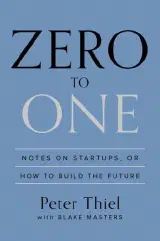
Zero to One: Notes on Startups, or How to Build the Future
The premise is almost embarrassingly simple: copying something that already exists — scaling it, globalizing it, iterating on it — is categorically different from creating something that didn't exist before. Thiel calls these two types of progress 1-to-n and 0-to-1, and his argument is that we've confused one for the other long enough that we've started calling the former "innovation." The word "disruptive" has eaten its own meaning.
The monopoly argument is where Thiel does his best work. The intuition that competition is healthy, that contested markets produce efficiency and consumer welfare, is correct in a static economy. But in a dynamic one — where the goal is to build something that generates cash flow for decades — competition is a tax on thinking. Airlines serve more passengers than Google but earn fractions of a percent in profit margins; Google has no real competitor in search and earns enough to fund moonshots. The lesson isn't that monopolies are morally good. It's that if you're competing in a crowded market, you're probably not building anything new.
What important truth do very few people agree with you on?
— Thiel, *Zero to One*, ch. 1
The section on "definite optimism" is underrated. Thiel sketches a 2×2: you can believe the future is better or worse than the present, and you can believe it is or isn't under your control. He argues that America moved in the 1970s from "definite optimism" — the mid-century mode where engineers built the interstate, cured polio, and planned to land on the moon — to "indefinite optimism," the mode that produces finance MBAs who diversify portfolios instead of building things. This isn't just nostalgia. It's an explanation of why smart people keep going to consulting and investment banking instead of founding companies, and why government policy has trended toward maintaining optionality instead of executing plans. Whether you agree with the diagnosis, it's more precise than most tech-culture takes on the same phenomenon.
Salespeople are actors: their first priority is persuasion, not sincerity. That's why the term 'salesperson' has a derogatory connotation, and why used car dealers are a proxy for unfair trade.
— Thiel, *Zero to One*, p. 175
Where the book falters is in the advice it can't quite give. Thiel is very good at explaining what distinguishes a category-creating company from an also-ran once both are visible in retrospect. He's less useful about how to find the "secret" — the important truth that others are too timid or too conformist to see — before you know whether you're right. The founder mythology chapters, where he discusses the eccentric psychology of successful founders, read more like pattern-matching on celebrity than theory. When his own Reddit AMA included the note that maybe you shouldn't become an entrepreneur, that was more honest than most of the book.
Doing what someone else already knows how to do takes the world from 1 to n, adding more of something familiar. But when you do something new, you go from 0 to 1.
— Thiel, *Zero to One*, ch. 1
For a developer who's watched AI companies emerge since 2022, the book's logic maps directly onto what's playing out: the companies that created genuinely new capabilities command extraordinary valuations and margins, while those building on top of others' APIs compete on cost. Thiel wrote all of this before the current wave, which makes the framework feel earned rather than convenient. The theory survived contact with a technology he couldn't have fully anticipated. That's a decent test.