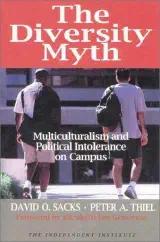
The Diversity Myth: Multiculturalism and Political Intolerance on Campus
multiculturalism and the politics of intolerance on Campus
Stanford in the late 1980s became the first major American university to formally replace its Western civilization requirement after students marched and chanted for its elimination, and the consequences Sacks and Thiel document in the years that followed are not pretty.
Written in 1995 and republished in 1998, the book was produced by two Stanford graduates who watched the transformation from inside. Its core claim is specific and falsifiable: multiculturalism as practiced at elite American universities is not about learning more, but about learning less, while substituting political conformity for genuine intellectual diversity. The authors make this case through primary sources -- syllabi, official university publications, the Stanford Daily, student government records -- documenting how Stanford's replacement curriculum traded rigorous engagement with great books for a therapeutic program organized around oppressor/victim frameworks. They trace how dormitory life became a vector for political indoctrination, how grade inflation hollowed out any pretense of academic standards, and how dissent from the new orthodoxy was punished through informal social mechanisms far more effective than any formal speech code. The book is most useful as documentary history: this happened, on these dates, as recorded in these sources.
campuses are full of people who look different but think alike. This is not real diversity, but pseudo-diversity.
— Sacks and Thiel, The Diversity Myth, Preface to the Second Edition
The strongest sections involve the actual evidence. When the authors reproduce course syllabi for classes organized around hair culture, or describe grading incentives that rewarded essays dismissing the Western tradition, they are not making abstract arguments -- they are describing the specific product parents were paying $100,000 for. The chapter on Stanford's financial scandal is the book's best: the university billed the federal government for a cedar-lined closet, antique lead urns, a yacht's depreciation, wedding reception expenses, and flower arrangements at a horse stable dedication. This ties the ideological and financial corruption together with genuine force. Institutions that place themselves above criticism will eventually abuse every power they hold. Stanford did.
When everything is educationally important—and even hairstyles are worthy of study—nothing is educationally important.
— Sacks and Thiel, The Diversity Myth, ch. 3
The book's weaknesses are real. The rhetorical framing occasionally runs ahead of the evidence -- describing Stanford as resembling a Third World country, or framing multiculturalism as an all-out assault on civilization, gives critics easy footholds without strengthening the empirical case. Sacks and Thiel are almost entirely focused on Stanford's humanities administration and say little about whether the formation of graduates suffered in measurable ways, or whether the hard sciences departments, which operated under different norms, should temper the conclusions. Some campus episodes are magnified beyond what the evidence demands.
Multicultural victimology is so powerful because it taps into two base emotions that are not often found together—self-pity and self-importance.
— Sacks and Thiel, The Diversity Myth, ch. 5
What survives scrutiny, thirty years later, is the structural argument: universities organized around group identity rather than individual intellectual inquiry will produce less learning and more politics. This is not a conservative claim so much as an institutional one. The specific abuses documented here have largely faded; the structural tendencies Sacks and Thiel identified have metastasized far beyond one campus. I find the empirical core more convincing than the rhetoric -- the syllabi speak for themselves. If you want to understand how American universities arrived where they are today, this remains one of the most detailed records of when and how the turn happened. It is a brief for the prosecution, written by witnesses; read it as such.
Read the longer summary
The argument
In 1987, Stanford students marched on a Faculty Senate meeting chanting “Hey hey, ho ho, Western Culture’s got to go!” Within a year, the required Western Culture course was gone, replaced by something called Cultures, Ideas, and Values, with mandatory attention to race, gender, and class. David Sacks and Peter Thiel were Stanford undergraduates during the years that followed. The Diversity Myth, first published in 1995 and reissued in 1998, is what they wrote about it.
The book has one thesis and it states it bluntly: “diversity” as practiced at Stanford produced its opposite. The faculty became overwhelmingly partisan. Required reading lists shrank to a narrow band. Students who deviated from orthodoxy got expelled from dorms, ostracized, or hounded out of school. The rhetoric of openness became cover for a closed, conformist, frequently vindictive culture that Sacks and Thiel call “the multiculture.”
This is a polemic. It is also unusually well-documented. Most of the book’s force comes from primary sources the authors collected over four years on campus — the Stanford Daily, official university publications, course syllabi, leaked emails, residence staff materials. When they describe a freshman English class that assigns students to write grant proposals for AIDS support groups instead of essays on literature, they cite the syllabus. When they describe a feminist studies professor expelling a male graduate student for the wrong ideological orientation, they have his paper.
What replaced Western Culture
Most of the book’s first half walks through CIV. The setup is actually clever. The original course required Plato, Augustine, Machiavelli, Rousseau, and Marx. The replacement required readings from generic categories like a Greek philosopher, a Renaissance dramatist, an Enlightenment figure, plus Marx (who was preserved by name). That subtle shift let any professor swap in whatever they wanted within each category.
So a track called “Europe and the Americas,” taught by anthropologist Renato Rosaldo, paired Augustine’s Confessions with discussions of identity in indigenous communities, replaced Plato’s Republic with materials on separatist political movements, and assigned a Marxist-feminist autobiography by Rigoberta Menchú (whose account later turned out to be partly fabricated, though the book was published before that came out).
The strongest literary moment in the book is the close reading of Aimé Césaire’s A Tempest, an explicitly anti-colonial rewrite of Shakespeare’s play that Stanford assigned alongside the original. Sacks and Thiel point out that Césaire’s Caliban — the noble revolutionary — gets the moralizing speech that Shakespeare’s Caliban never gets, because Shakespeare already did the work Césaire thinks he’s doing. In Shakespeare, Caliban is “liberated” by drunken Stephano, immediately worships him, attempts a doomed rebellion, and at the end says he was “thrice-double ass / Was I to take this drunkard for a god.” The point Shakespeare is making — that liberation requires more than chants and a new master — is the one Césaire’s reading missed. This is one of the few places where the authors stop documenting and start thinking, and they think well.
The rest of the curriculum chapter is more uneven. There’s a list of trendy classes, including a notorious history seminar on black hair, a Peace Studies course that defines its subject so broadly it covers everything except wars, and an Anthropology 1 where the authors quote a student’s drunkenly-written exam to show that high grades went to whoever told the TAs what they wanted to hear. The examples are real. The framing — that this is what most Stanford humanities education had become — is harder to verify, and the authors don’t try.
What multiculturalism actually was
The book’s most useful analytic move, in the middle chapters, is to argue that multiculturalism was never genuinely relativist. Relativism is what the rhetoric promised. What it actually installed was a specific hierarchy of victim groups (the standard 1990s set: racial minorities, women, gays, the poor) with a specific set of approved enemies (whites, men, heterosexuals, Christians, capitalists, the West). Within each victim group, “authentic” membership required ideological conformity. Black conservatives, pro-life women, gay Republicans got blacklisted — sometimes literally; the Black Student Union maintained a list.
The authors call this “interdividual” identity. Each multicultural identity was defined relationally, against an oppressor. Without the oppressor, the identity dissolved. This explains a pattern the authors document repeatedly: when actual oppression was hard to find, multicultural activists generated it. The book quotes a computer science lecturer named Stuart Reges, writing on a gay campus bulletin board, suggesting that homosexual students bring couples to fraternity parties to “see if some of them get angry” and provoke incidents at the gym so the area could be declared a disaster zone. This is one of the book’s most damning documents because it isn’t paraphrase. It’s the actual instructions for manufacturing the evidence.
The Ujamaa incident — the chapter is titled “Welcome to Salem” — is the book’s set-piece scapegoating story. Two white freshmen, after a black sophomore had insisted to them that Beethoven was black, defaced a Stanford Symphony poster of Beethoven with stereotypically African features and posted it near the sophomore’s door. The dorm’s reaction (a four-hour meeting in which residents wept and hyperventilated, the freshmen expelled from housing, the incident becoming a permanent reference for “campus racism”) is the book’s clearest example of what it’s arguing. Whether or not Beethoven was black — he wasn’t — the same claim made by a black student was a source of pride; made by white students with the wrong intent, it became a hate crime. Truth value did not enter the analysis.
The Girardian core
Thiel was René Girard’s student at Stanford. He hasn’t always been explicit about it, but the second half of The Diversity Myth is Girard with the serial numbers partly filed off. The argument: communities bind themselves by collectively expelling a victim. The expulsion can’t be acknowledged as such, or the binding doesn’t work. The community has to genuinely believe the victim deserved it.
The book’s central case study is the harassment of Keith Rabois, a Stanford law student (and later Thiel’s PayPal colleague) who shouted homophobic slurs at a resident fellow’s cottage as an explicit free-speech provocation. The university’s response was extraordinary: open letters in the Stanford Daily signed by 443 law students, faculty, and administrators; a letter-writing campaign to California law firms warning them not to hire him; bulletin boards papered with hundreds of personalized denunciations. Rabois transferred. The episode reads, in 2026, exactly like a social-media cancellation campaign two decades early.
Sacks and Thiel are clear-eyed about Rabois — they don’t pretend he didn’t say something rude — but their point is the disproportion between what he did and what was done to him. They are also clear-eyed (and this is harder to do) about the function of the disproportion. The point of the response wasn’t to punish Rabois. It was to give the community a ritual focal point through which it could reaffirm its values by collectively rejecting an oppressor. The actual offense barely mattered. What mattered was that everyone signed.
If you’ve read Girard, you’ve seen this analysis. If you haven’t, the book is a decent introduction to it, even though the authors don’t name him directly. This is the part of the book that has aged best. The Beethoven incident, the candlelight vigil that got reinterpreted as a Klan rally, the manufactured outrage at a sporting goods store boarding its windows during the Rodney King protests, the four-day MEChA hunger strike over a grape boycott — these patterns are now recognizable everywhere. The authors saw them in 1995.
Where the book stumbles
This is a partisan book and it shows. The chapter on the Allan Cox suicide is the worst part. Cox was a Stanford dean who killed himself in 1987 after being accused of molesting the mentally handicapped son of his graduate student. The authors use his memorial — at which Stanford’s leadership praised him — to score a hypocrisy point against the same leadership for being too harsh on a senior accused of date rape. The juxtaposition is rhetorically effective and substantively cheap. Cox is dead. The case for Stanford’s leadership being hypocrites about sexual misconduct didn’t need the suicide of a child molester to make it.
The “new Puritanism” chapter on date rape uses the same kind of selective statistics the authors elsewhere criticize. They are right that the Stanford Rape Education Project’s “one in three” number was an advocacy figure rather than a finding. They are wrong to slide from that into the implication that the underlying problem was largely manufactured. The chapter wants to have it three ways: the statistics are inflated by activists, and the cultural climate that produces those statistics is itself the real issue, and the actual incidents are mostly the result of student promiscuity that the authors disapprove of. Pick a lane.
The book also doesn’t engage with the strongest forms of its opponents’ arguments. There’s almost no consideration of why minorities at Stanford in the 1980s might have actually wanted ethnic centers, or why a student arriving at a campus that was overwhelmingly white in 1987 might find a Black Student Union useful for reasons that have nothing to do with manufactured grievance. The authors treat all such institutional accommodations as ideological capture. Some of them were. Some of them weren’t.
The book is dated in ways that are inevitable but worth noting. The “Generation X” diagnosis at the end — apathetic, post-multicultural, too disillusioned to embrace either the new orthodoxy or its alternative — turned out to be wrong about Generation X and very wrong about the cohorts that followed. The book underestimated how fully the next generation would embrace the framework it was documenting.
Why it matters now
Reading The Diversity Myth in 2026 is an odd experience. Most of what the authors predicted came true, then some. The patterns they documented as marginal Stanford practice — speech codes, ideological hiring, ritual scapegoatings, the corporate language of harmony and inclusion — became standard practice across American institutions. The “Stanford as bellwether” thesis was largely correct.
But the book also shows the limits of pure ideological diagnosis. Sacks and Thiel could see clearly what was wrong. They could not see how to reverse it. The final chapter, on the arrival of Stanford’s new president Gerhard Casper in 1992, reads as cautious optimism: maybe a calm administrator with no ideological investment can stop the slide. He didn’t. None of the structures the book describes were dismantled. Casper presided over the consolidation of the system the authors were diagnosing and went home.
This is worth sitting with. The book is a careful diagnosis of an institutional pathology by two people who later went on to build some of the most powerful companies in American history. They had documentation, money, networks, ideological clarity, and three decades to work with. The institution they were writing about is now more, not less, of what they criticized. Whatever lessons the book holds, “if you just expose what’s happening, the system will correct itself” is not one of them.
The other thing worth sitting with: the diagnostic framework in this book — Girardian scapegoating, manufactured grievance, the conversion of victim status into political power — has become a kind of folk theory among one part of the American right. It’s not wrong, but it’s not complete. It explains what happens at the level of community dynamics. It doesn’t explain why the framework took over institutions in the first place, or why it’s been so hard to dislodge, or why so many people who would have agreed with the authors in 1995 found themselves coopted by 2015. The book has a theory of how the multiculture maintains itself; it doesn’t have a theory of how it wins.
Who should read it
Anyone trying to understand how a small ideological vanguard captures a major institution. Anyone interested in Girard who wants to see his framework applied to a contemporary case. Anyone curious about the intellectual formation of Peter Thiel — this is, in many ways, the foundational document of a worldview that later shaped Palantir, Founders Fund, and a substantial slice of Silicon Valley politics.
Don’t read it as a balanced account. It isn’t trying to be one, and it shows. Read it alongside something more empirically rigorous (Heterodox Academy’s work on viewpoint diversity in the academy is a good complement) and something with deeper social theory (Christopher Lasch’s Culture of Narcissism makes some of the same observations with less polemic and more historical reach). Sacks was 25 and Thiel 27 when they wrote the first edition. It reads like that, in both the good ways and the bad.
The best thing about the book is that it took the trouble to write down what was actually happening, with sources, while it was happening. The Stanford alumni who would later wonder how their alma mater became what it became can read, in this book, the actual receipts. That’s worth something. It’s worth more than the polemic surrounding it.