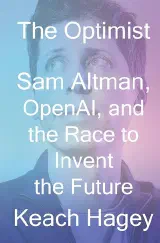
The Optimist: Sam Altman, OpenAI, and the Race to Invent the Future
Sam Altman, OpenAI, and the Race to Invent the Future
WSJ reporter's biography of Sam Altman with extensive coverage of Greg Brockman's role at OpenAI.
Sam Altman didn't build ChatGPT. He built the conditions under which ChatGPT could exist — and Keach Hagey's biography makes a compelling case that this distinction matters more than most people realize.
*The Optimist* traces Altman from his childhood in St. Louis through his first startup failure, his years running Y Combinator, and finally his unlikely position as the face of the AI era. The through-line isn't technical genius. It's something closer to a political talent: an ability to read a room, align interests, and keep everyone at the table long enough for something consequential to happen. At nineteen, he convinced Sequoia Capital partners that his location-sharing app Loopt was the future. It wasn't. At twenty-eight, he convinced Elon Musk that the world would end if Google won the AI race. Musk wrote the checks. What Hagey surfaces is a man whose primary skill is making other people feel that his vision is also their vision — and that the alternative is catastrophe.
Altman is a figure out of Isaac Asimov or Neal Stephenson. Or he is the author himself: if it feels as though we have all collectively stepped into a science fiction short story, it is Altman who is writing it.
— Hagey, The Optimist, Epilogue
The book's most revealing section covers OpenAI's peculiar structure: a nonprofit board controlling a for-profit subsidiary with capped investor returns. It was sold as a compromise between idealism and commerce, but it was really an unstable compromise, and the November 2023 board revolt made that instability visible. Hagey gives us the best reported account of those five days to date — the conspiracy, the counterattack, the reinstatement. What emerges isn't a story about AI governance. It's a story about relationships. The board members who tried to fire Altman had watched him make promises to multiple people simultaneously, tell different versions of the same story, and advance products while telling safety-concerned employees their concerns were being heard. They had reason to act. They also had no plan, no public rationale that could stick, and no leverage once his employees and investors mobilized. The relationships won.
Where *The Optimist* disappoints is where most first biographies disappoint: it takes too long to get moving. The early chapters on Altman's father's fair-housing work, his childhood prodigy status, and the Loopt years — while occasionally illuminating — read like obligation rather than argument. Hagey wants to show us the roots of Altman's institution-bending instincts, and the parallels are there, but they don't earn the space. By the time we reach OpenAI, readers who came for the AI story will have waited longer than necessary.
Still, this is the first serious biography of the most powerful person in AI, and Hagey is a careful reporter who doesn't mistake access for advocacy. The portrait that emerges is neither the messianic figure Altman performs publicly nor the cynical operator his critics imagine — it's something more interesting: a true believer in technological progress who has internalized, perhaps too completely, that belief alone changes nothing and power changes everything. For anyone trying to understand how the AI era got the leadership it has, this is where you start.
Read the longer summary
The argument, in one paragraph
Hagey’s central claim is that Sam Altman is not what Silicon Valley’s mythology makes him out to be. He is not a brilliant engineer, not a product visionary in the Steve Jobs mold, not even really an entrepreneur in the build-something-from-nothing sense. What he is, and what makes him the most influential figure in AI today, is a once-in-a-generation political operator. He reads rooms, aligns interests, recruits ferociously, and bends institutions into shapes that suit his ambitions. The book argues that this skill, more than any technical insight, is what landed OpenAI at the front of the AGI race and what kept Altman in charge of it even when the board he reported to tried to throw him out.
That’s a worthwhile argument, and one I think Hagey mostly substantiates. It’s also a corrective to the way Altman is usually written about, which is either as the priest of the intelligence age or the smiling face of an apocalyptic gamble. Hagey’s Altman is messier and more interesting than either: a person whose comfort with ambiguity and contradiction is itself the engine of his success.
The kid from St. Louis who figured out how to sell
The first third of the book is the part most reviewers complain about, and they’re not wrong. Hagey spends a lot of pages on Altman’s childhood in Clayton, Missouri, his family’s dynamics, his father Jerry’s work designing unconventional fair-housing structures, his teenage coding, and his early gay activism in a Midwestern high school. Some of this is filler. But one strand pays off later. Jerry Altman built a career writing legal and financial structures that bent existing institutions into new shapes to get capital flowing into housing that wouldn’t otherwise have been built. Twenty years later, Sam would do the same thing on a larger canvas, with OpenAI’s nonprofit-controlling-a-capped-profit structure. Hagey doesn’t bludgeon the connection, but it’s there, and it’s one of the more original things in the book.
The Stanford-dropout-into-Loopt sequence is more familiar Silicon Valley material. Loopt was a location-sharing app that joined Y Combinator’s first batch in 2005, raised significant venture money, and never really worked. It eventually sold to Green Dot for around $43 million in 2012, which sounds fine until you do the math on the dilution. Loopt failed, but it gave Altman two things that would matter much more than any equity check: a relationship with Paul Graham, and a reputation as someone who could walk into a meeting with Sequoia Capital at twenty-one and walk out with a yes.
This is where Hagey is at her sharpest. She quotes people who watched Altman pitch and couldn’t quite explain what they were seeing. He sat with his legs crossed, said outlandish things with calm conviction, and made everyone in the room want to be part of his version of the future. It’s the same skill Peter Thiel later described, in Hagey’s reporting, as putting Altman “just at the absolute epicenter” of “the Silicon Valley zeitgeist.” The book’s title is doing a lot of work here. Altman’s optimism isn’t quite a philosophy. It’s a sales technique that happens to also be sincere.
Y Combinator and the apprenticeship in power
The YC section is, for me, the most interesting part of the book, and the one that reframed how I think about Altman. Most accounts treat YC as the launchpad. Hagey treats it as the formation. Altman entered YC’s first cohort in 2005, became a part-time partner, and then, in 2014, took over from Graham as president. He proceeded to scale YC from a tightly held mentorship operation into a multi-stage capital and influence machine, with research arms, growth funds, and political reach of its own. He hosted policy salons. He flirted with running for governor of California. He used YC as a perch to invest personally in nuclear fusion (Helion), longevity (Retro), and universal basic income pilots.
What Hagey makes clear, and what’s easy to miss, is that this period was Altman’s real apprenticeship in everything OpenAI later required. Running YC taught him how to spot people, recruit them, and weave them into a network that owed him favors. It taught him how to manage a brand that was, on paper, about helping founders, but was in practice about being at the center of every important conversation in the Valley. By the time he started OpenAI, he had a Rolodex no one else in AI could match, and a reputation for seeing around corners that wasn’t entirely earned but was very useful.
The book is honest that not everyone at YC loved this. When Altman pivoted his attention to OpenAI, the YC partnership felt blindsided. He left under conditions Hagey describes carefully, in language I won’t paraphrase too closely, but which sound less like a graceful handoff and more like a slow firing. Founders he’d recruited felt used. Some of the people who watched him operate at YC could already see the playbook that Mira Murati, much later, would describe to OpenAI’s board.
OpenAI: a wild structure, a worried billionaire, and a recruiting masterclass
OpenAI is where the book’s reporting becomes essential. Hagey walks through the 2015 founding with the kind of detail that makes you realize how contingent the whole thing was. Altman convinced Elon Musk that Google, which had just bought DeepMind, was on a glide path to controlling AGI, and that the only counterweight was a nonprofit safety-focused lab. Musk wrote the early checks. Altman recruited Greg Brockman, Ilya Sutskever, and a small core of researchers, often by appealing to a sense of mission that was simultaneously real, vague, and flattering. He paid below market rates and convinced people they were getting a deal because they were saving humanity.
The genius and the fragility of OpenAI was the structure. A nonprofit board controlled a for-profit subsidiary with a cap on investor returns. This was, on paper, a way to attract capital without losing the moral posture. In practice it was also a recruiting tool. Engineers could tell themselves they were not joining another Google. Investors could tell themselves they were taking a bet on AGI without having to defend the optics. The board, meanwhile, had real power, including the power to fire the CEO, which would matter later. Hagey does well to draw the line from Jerry Altman’s housing structures to this one. Both bend the rules of institutional capital to make something happen that wouldn’t otherwise. The downside, of course, is that you’re playing a game whose rules nobody fully understands, including you.
By 2018, Musk had left the board after losing an internal fight to take over the company. The relationship soured into the public feud it remains today. Altman, now without his deepest-pocketed patron, did the thing he is best at. He found Microsoft. The 2019 Microsoft deal, which gave Microsoft a multi-billion-dollar stake in OpenAI’s commercial arm in exchange for compute on Azure, was the moment OpenAI stopped being a research nonprofit in any meaningful sense. Hagey traces this transition with care. The official story is that the nonprofit still controls everything. The actual story is that the company needs ten figures of compute per year to compete, and that money comes from somewhere with expectations attached.
This section is also where Hagey introduces the recurring tension that drives the rest of the book: between the people inside OpenAI who believed the original safety mission, and the people who believed the only way to do safety was to ship the most capable models first. Dario Amodei, who had run OpenAI’s research, left in 2021 with several colleagues to found Anthropic. Hagey is judicious about why. Some of it was genuine alignment concern. Some of it was a personality clash with Altman. Some of it was a sense, articulated more carefully in the Murati sections later, that Altman was telling different people different things about the same decisions.
The Blip, and what the board actually meant
For most readers, this is the chapter they’re paying for. The November 2023 firing, the five days of chaos, the reinstatement, the new board. Hagey delivers. She has done what nobody else managed at the time, which is to nail down what the board meant when it issued its only public statement, the one about Altman not being “consistently candid” with directors.
The picture that emerges is uglier and pettier than the high-stakes safety thriller everyone wanted at the time. Altman had told different board members different things about Helen Toner’s published research, about a planned governance overhaul, and about whether the safety review process for new model releases was actually happening. Mira Murati, who briefly served as interim CEO during the Blip and is one of Hagey’s most important sources, described to the board a pattern she had watched for years. Altman would say what you wanted to hear. If that didn’t work, he would chip away at your credibility until your influence was gone. He promised the same role or resource to two different people and let them fight it out. None of these things rise to the level of fraud. Cumulatively, they make running a company impossible if the people around the CEO can’t trust what he tells them.
Hagey also makes clear why the firing collapsed. The board had legal authority but no political base. Almost the entire OpenAI staff signed a letter threatening to follow Altman to Microsoft. The directors had no plan, no spokesperson, and no rebuttal beyond “we can’t tell you the specifics.” Altman ran the public narrative from a hotel room with a borrowed laptop. By the following Wednesday morning the board members who voted to remove him were themselves removed. It was a complete inversion of formal corporate authority, and the lesson Silicon Valley took away was the one Altman had already proven at Y Combinator: governance is downstream of narrative, and Altman is the best narrative operator in the industry.
I think the book’s strongest single insight comes here. The board was right about the candor problem. They also could not survive being right, because OpenAI’s value was almost entirely tied up in Altman’s personal credibility with employees, customers, and investors. The structure that had been designed to keep one person from running away with the mission turned out to depend, at the moment of crisis, on that one person.
What the book gets right and where it stalls
The book has real flaws. The early chapters are overwritten. Hagey is a magazine and newspaper writer adjusting to a 384-page format, and you can feel her including material because she has it rather than because the argument needs it. The technical sections are thin. If you want to understand transformer architecture or RLHF or why GPT-4 was a step change, this is not your book. Hagey gestures at the science and moves on.
She also goes light on a few things I expected her to press harder. The Microsoft deal gets less scrutiny than it deserves, given that it is the deal that made the rest of the story possible. The Saudi PIF and Gulf money flowing into Altman’s chip ambitions is mentioned but not interrogated. The book’s title promises a race to invent the future, and there are moments, especially toward the end, when the actual race, the technical and commercial competition with Anthropic, Google DeepMind, and the Chinese labs, fades into the background while the boardroom story grinds on.
But where Hagey is strong, she is very strong. The Blip chapter is now the canonical account. The Y Combinator material reframes Altman in a useful way. The Jerry Altman thread is original. And the overall portrait, of an unusually gifted political operator who genuinely believes in technological progress and is willing to bend almost anything to make it happen faster, feels true to the public Altman we can all observe.
This is also a quietly pro-progress book, which I appreciate. Hagey doesn’t do the doomer routine. She takes the safety questions seriously without making them the whole frame. She lets Altman’s optimism stand as a coherent worldview rather than a marketing line, even as she shows where it slides into self-interest. That’s harder to pull off than it looks, and it is the main reason the book holds up.
Who should read it
If you are interested in AI but not especially in the personalities behind it, skip this one and pick up Karen Hao’s Empire of AI instead. Hao does more on the labor and infrastructure of the field. If you want to understand the technology, read Cade Metz or Stephen Witt.
But if you want to understand how OpenAI specifically came to occupy the position it does, and why it keeps surviving crises that should kill it, this is the book to read. It’s also the best account I have seen of how Silicon Valley’s power actually works in 2025: not through technical brilliance, not through capital, but through the ability to be the person everyone in the room is paying attention to. Altman didn’t win because he was the smartest. He won because he was the most patient, the best at building obligation, and the most willing to keep moving when the ground was shifting underneath him.
That’s a less flattering story than the one Altman would tell about himself. It is also more useful, because it is actually transferable. You cannot copy Altman’s IQ. You can study how he did the thing he actually did.