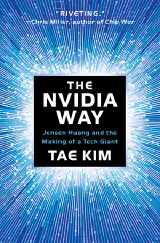
Nvidia Way
Jensen Huang and the Making of a Tech Giant
Tae Kim's business history of Nvidia's 30-year rise from startup to world's dominant AI hardware platform under CEO Jensen Huang.
Nvidia's ascent from a gaming chip startup to the world's most valuable company is usually explained as being in the right place at the right time. Kim's book argues that explanation is lazy — what actually happened is that one person built a culture deliberately designed to be in the right place thirty years before the right time arrived.
The Nvidia Way, as Kim describes it, is a specific set of organizational choices that most companies would find uncomfortable: 60-plus direct reports for the CEO, public dressing-downs instead of private feedback, no five-year plans, no organizational charts, projects assigned to anyone with the right skills regardless of official role. The result, as told through the stories of early employees and still-serving executives, is a company that moves at a pace its competitors can't match and surfaces problems before they become catastrophes. The flat structure isn't an accident or a quirk — it's a calculated attack on the bureaucratic complacency that Jensen Huang, who has absorbed *The Innovator's Dilemma* more seriously than most CEOs, believed would eventually kill Nvidia if left unchecked.
Second place is the first loser.
— Huang, The Nvidia Way, ch. 6 (p. 85)
The more interesting story, though, is CUDA. In 2006, Nvidia invested $475 million — a third of its R&D budget over four years — in a programming platform that had essentially no customers. Gross margins cratered. Wall Street was unhappy. Huang kept investing. What CUDA did was take Nvidia's parallel-processing hardware and make it accessible to scientists and engineers working in standard programming languages, rather than graphics specialists who could translate their problems into rendering pipelines. The 2012 AlexNet result — a GPU-trained neural network that demolished image recognition benchmarks — was the moment that vindicated the bet publicly, though the moat had been under construction for six years before anyone outside a few university labs noticed. That CUDA ecosystem, built over nearly two decades, is what explains why AMD and Intel, despite billions in declared AI investment, remain years behind. They can copy the hardware roadmap. They cannot easily replicate the developer gravity.
I wish ample doses of pain and suffering upon you
— Huang, The Nvidia Way, ch. 2 (p. 18)
Where the book falls short is proportionality. The first half spends considerable time on the 1990s graphics wars — the NV1 failure, the RIVA 128 near-miracle, the rivalry with 3dfx — in more detail than most readers will need or remember. The AI era gets less than a quarter of the pages. The attempted ARM acquisition goes unexamined. The crypto period is absent entirely. And the question of what happens to a company this tightly organized around one person's judgment, when that person eventually leaves, gets a paragraph and a shrug. Kim is clearly admiring of Huang, and the book reads like it — which means the harder questions about organizational fragility get less scrutiny than they deserve.
I'd rather torture you into greatness because I believe in you
— Huang, The Nvidia Way
For anyone trying to understand how Nvidia got here, this is still the right book. The early history is thorough, the CUDA narrative is clearly enough told, and the management principles are illustrated with specific anecdotes rather than vague platitudes. Just don't expect it to tell you whether the Nvidia Way survives its founder. That book hasn't been written yet.
Read the longer summary
The thesis: a paranoid 30-year build, not an AI gold rush
Tae Kim’s argument cuts cleanly through the easy reading of Nvidia’s moment: the company didn’t stumble into the AI era. It spent three decades building an organisation designed to be impossible to catch, and then the world arrived at the door it had already framed. The Nvidia Way is a corporate biography organised around one person — Jensen Huang, who has run the company since he co-founded it at a Denny’s in San Jose in 1993, making him the longest-serving CEO of any major technology company.
The book’s load-bearing claim, made early and re-stated throughout, is that Nvidia’s moat is not the silicon. It’s a culture engineered to be incompatible with normal corporate physics: flat, fast, openly allergic to comfort, and willing to spend a third of four years of R&D budget on a single bet (CUDA) that Wall Street openly mocked at the time. The thirty years of compounding work — and roughly a 33% compound annual return on the stock since the 1999 IPO, turning $10,000 at IPO into $13.2 million by the end of 2023 — is the dividend on a long-held position, not a discovery of a new asset class.
Kim wrote the first comprehensive history of Nvidia, drawing on more than a hundred interviews including Huang and his two co-founders. That access is the book’s primary asset. Where the book gets uneven (and it does, badly in places — more on that), the reporting is still the most detailed first-pass record of how Nvidia actually operates day-to-day that exists between two covers.
Huang as protagonist, for better and worse
Kim’s portrait of Huang is the book’s spine, and it’s where the book is at its strongest and its most uncomfortable. The sketch: Taiwan-born, sent to a Kentucky boarding school as a child that turned out to be a reform institution, waited tables at Denny’s as a teenager, was an obsessive table-tennis competitor, took eight years to finish a master’s in electrical engineering. The man Kim describes does not exhale.
As CEO, Huang runs about sixty direct reports — a span of control most management literature would call impossible. He won’t tolerate PowerPoint and works exclusively on whiteboards, on the theory that slides hide what people don’t actually understand. He gives feedback in front of the room rather than in private one-on-ones, on the explicit principle that everyone should learn from one person’s mistake. Each project gets a “Pilot in Command” — a single named person, reporting to Jensen, who owns the deliverable end-to-end. Every employee can send a weekly “top 5” email straight to him, bypassing the layers. There is no five-year plan, because Huang’s view is that the world moves too fast for one to be useful, so the company plans continuously instead.
The Huang-isms come thick. He tells Caltech graduates: “I wish ample doses of pain and suffering upon you,” because he thinks character — not intelligence — is the input that makes greatness, and character is forged through struggle. He looks back on Nvidia’s near-death years and tells an audience: “we sucked at a lot of things.” Both lines are characteristic. The first is the worldview, the second is the diagnostic posture that comes with it.
This is the part where you have to decide what kind of reader you are. If you find midnight-emails-on-Sunday romantic, the book is a manual. If you don’t, Kim’s account is also the evidence against: the system selects hard for people willing to live this way, and chews up everyone who can’t or won’t. Kim doesn’t wrestle with that tradeoff. He reports the wins and lets the casualties stay anonymous. We’d push back here. A culture that produces $3 trillion of market value and a culture that’s healthy for most humans are not the same culture, and the book’s polite silence on that gap is the one place where Kim feels like a fan rather than a journalist.
That said: the structural mechanics — PIC accountability, the top-5 emails, the no-slides rule, the public feedback — are the most copy-able lessons in the book, and they don’t require you to also adopt the 80-hour weeks. They explain Nvidia’s velocity better than any chip diagram does.
CUDA: the bet that bought the AI decade
The strongest single thread in the book, for our money, is the CUDA story. In 2006, Nvidia spent roughly $475 million — about a third of four years of R&D budget — to build a software layer that turned graphics processors into general-purpose parallel compute engines. For years it had almost no customers. Gross margin fell from 45.6% to 35.4% as the 2008 financial crisis crushed demand for the workstations CUDA was supposed to power. Wall Street wanted Huang to abandon it.
He didn’t. The bet was that the world would eventually need to break problems across thousands of cores instead of running them serially on CPUs, and that whoever owned the developer ecosystem when that day came would own the era. Six years later, in 2012, AlexNet won the ImageNet competition on two CUDA-trained GPUs and the door cracked open. Six years after that, transformer-based language models walked through it. By 2026 CUDA has on the order of five million developers, and the libraries that have accreted on top of it across HPC, biology, finance, and machine learning are the kind of thing competitors cannot meaningfully replicate by writing a cheque.
Kim tells this story well, but stops one beat short of the deeper point. The interesting variable isn’t that Huang was prescient — plenty of people saw parallel compute coming. The interesting variable is that almost no other public-company CEO would have eaten that margin compression, that long, against that much skepticism. Most CEOs answer to a clock that doesn’t allow ten-year bets where the first eight years look like waste. Huang has built — over decades — a board, a balance sheet, and a personal authority within the company that lets him hold a position the market hates until it’s right. That governance result is the real innovation. Kim half-names it but doesn’t drive it home.
The corollary, which is also under-developed in the book, is what this implies for AMD, Intel, and the trillion or so dollars currently being mobilised to dethrone Nvidia. The chips are catchable. The decade-old developer ecosystem is not, until or unless someone builds an abstraction layer that makes CUDA-locked code portable, and even then the libraries take years to fully mirror. This is the bit you’ll keep noticing once Kim plants the seed.
Speed of light, the six-month cadence, and the killing of SGI
The operational chapter — how Nvidia outran the graphics incumbents in the 1990s — is genuine fun and lands a real lesson, even if it’s where Kim spends too much page count. The industry standard for a new chip was eighteen months. Nvidia compressed that to six. They got there with three things working together: a software-emulation rig that let them validate a design without paying for multiple silicon respins; Curtis Priem’s “resource manager” architecture, which let them emulate hardware features in software when the silicon wasn’t ready; and a culture Huang labelled “speed of light,” meaning the only acceptable constraint on a project is physics, not bureaucracy or politics.
The competitors couldn’t copy this because they couldn’t survive it. Silicon Graphics, dominant when Nvidia was a startup, simply could not fund a new chip on Nvidia’s tempo and watched its lead evaporate. 3dfx — briefly the king of consumer 3D — sued Nvidia, lost the development race anyway, and went bankrupt; Nvidia bought the patents and hired a hundred of its engineers. The earlier RIVA 128 chip, taped out in nine months instead of two years, was the bet that saved the company when it was nine months from running out of cash.
The lesson Kim draws — fewer big bets, executed faster, beats more bets executed at industry pace — is the right one, and it ports to fields well outside chip design. The bit Kim doesn’t quite say but is sitting in the reporting: speed at this level is itself a moat, because it sets a tempo that competitors with normal corporate metabolisms cannot match without breaking themselves. That’s why a company 860 times larger (Intel) eventually lost to a 1990s startup. Goliath had the resources; he didn’t have the clock speed.
The book’s weakest seam: where the AI era actually lives
Now the honest part. The Nvidia Way is two books bolted together, and the join is rough. The first half is a chronological grind through the 1990s — DOOM, Quake, the failed Sega NV2 deal, every minor episode of the early ATI rivalry — and Kim writes it the way someone writes about their own teenage years. He sort of is. There’s far too much of it. The whole post-2013 stretch, where Nvidia becomes a 3-trillion-dollar company powering the AI revolution, is rushed by comparison and gets less than a quarter of the book.
The transformer architecture barely appears. Why CUDA’s lock-in has held against tens of billions of competitor capital is asserted rather than argued. The 2019 Mellanox acquisition — the move that connected Nvidia’s GPUs into the data-centre fabric AI training actually runs on — gets a few pages when it deserves a chapter. The failed $40 billion ARM deal gets a sentence. The crypto-mining boom that ran the stock up and down through the late 2010s is essentially absent. So is the geopolitics: Nvidia in 2026 is arguably an instrument of US industrial policy, with chip-export blocks against China, datacentre deals in the Gulf, and a CEO who has effectively become a head-of-state-level figure. None of that is in the book in any serious form.
The most damaging gap is succession. Huang is 61 and visibly the irreplaceable variable in everything Kim documents. The flat structure, the public feedback, the long-horizon bets, the personal calls on every key product — all of it is Huang-shaped. Kim never asks the question seriously, and the politeness of the silence is the book’s loudest tell. Morris Chang ran TSMC until 86; maybe Huang has another two decades. But “we’ll figure it out later” is not an answer for a company at this scale, and a serious book about Nvidia in 2026 has to engage with it.
We’d cut a third of the 1990s gaming nostalgia and spend the saved pages on three things: how Nvidia is navigating the export-controls war with China and what happens to its margins if scaling laws bend; what the actual structure of the AI customer base looks like (hyperscalers, sovereigns, labs) and how concentrated the demand is; and what Nvidia looks like without Huang.
What’s actually missing, and where to read next
If you’re using this book to think about Nvidia rather than just to enjoy it, a few specific gaps to flag. There’s almost nothing on the architecture of AI demand — the hyperscaler concentration, the rise of sovereign-AI buyers, the cyclicality risk in a customer base where five companies are most of the order book. There’s almost nothing on the rest of the AI hardware stack — networking beyond Mellanox, packaging, HBM memory, the TSMC dependency. And there’s a near-total absence of the geopolitical layer, even though by the time Kim was finishing the book, Huang had become a recurring guest of presidents and prime ministers.
For backfill, three pointers. Acquired’s three-part Nvidia podcast covers the same ground with more balance on the CUDA-to-AI transition; Kim’s interview with their hosts is in the book’s own marketing materials and is itself worth listening to. Chris Miller’s Chip War is the right companion volume for the geopolitics that The Nvidia Way leaves out. For the rival biography, Stephen Witt’s The Thinking Machine is the other Nvidia book on the market — Nvidia’s own first chief scientist, David Rosenthal, has publicly said Kim’s account is more accurate, but Witt is reportedly more readable on the recent decade. We haven’t read Witt yet, so take that secondhand.
If you want one book on Huang as a manager, this is it. If you want one book on Nvidia as a company in 2026, this isn’t quite enough on its own.
Who should read it
Founders — especially first-time founders trying to figure out what kind of company to build. Kim’s accidental contribution is to show that the standard playbook (comfortable culture, layered hierarchy, predictable releases, polite feedback, multi-year strategic plans) produced Intel. A different playbook produced Nvidia. Whether you can stomach the second is the whole question, and the book is unflinching about the cost even when it’s not fully honest about it.
Operators and managers — read for the structural details. The Pilot-in-Command system, the top-5 weekly emails, the public-feedback policy, the no-PowerPoint rule, the project-based fluid resourcing instead of fiefdom-based functional teams. These are unglamorous, copy-able mechanisms. You don’t need to also adopt the 80-hour weeks to steal them.
Investors and analysts — useful as background, but pair it with something current. The book stops short of where the interesting questions now live.
Anyone curious about how an actual $3 trillion company gets built — yes, with some patience for the 1990s detour, this is the right book. The author talked to a hundred-plus people who were there. Whatever you think of Kim’s editorial distance, the reporting is real, and the texture of how Nvidia operates internally is something you won’t find compiled anywhere else. We’d rather have an imperfect first book on Nvidia than wait for the perfect one. This is the imperfect first book, and it’s worth your time.