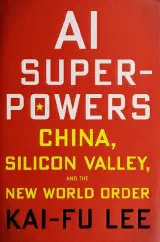
AI Superpowers: China, Silicon Valley, and the New World Order
China, Silicon Valley, and the new world order
The central bet in Kai-Fu Lee's 2018 book is that the AI race is no longer about who can make the next breakthrough. It's about who can deploy the existing one fastest, and that distinction changes everything about who's winning.
The book's sharpest contribution is what Lee calls the age of implementation. Deep learning's foundational advance came in the early 2010s. Since then, the constant flow of AI headlines has given the impression of perpetual discovery, but Lee argues we've been applying one powerful technique to an expanding range of problems, not finding new ones. This matters because once the competition shifts from invention to rollout, the advantage goes to whoever has the most data and the most aggressive engineers. The US edge in elite researchers matters less when adding more data dwarfs adding more genius. China, with a vastly larger internet user base and a digital ecosystem embedded deeply in physical-world commerce, holds that data advantage by a widening margin. Lee makes the technical logic of this compelling.
If data is the new oil, then China is the new Saudi Arabia.
— Kai-Fu Lee, AI Superpowers, ch. 1
He is particularly sharp on the entrepreneurial culture question, which most Western analysis gets wrong. The standard dismissal of Chinese tech companies as copycats misses what actually happened in markets where five thousand companies attempted the same concept simultaneously. Groupon entered China and lost. Meituan started from a similar group-buying idea and became a $130 billion company by out-iterating every competitor it faced. What looks like imitation at founding looks like genuine innovation after five survival rounds in the world's most cutthroat market. Lee's case here is not theoretical — it's a description of how companies actually behaved, and it shifts the burden of proof onto the skeptics.
I can tell you that Silicon Valley looks downright sluggish compared to its competitor across the Pacific.
— Kai-Fu Lee, AI Superpowers, ch. 4
The book's second half is weaker. Lee's analysis of AI-driven job displacement is solid at the level of which work is automatable (structured, optimization-based, asocial) versus which is durable (creative, high-dexterity in unpredictable settings, fundamentally human in contact). But the solutions he offers don't match the scale of his own diagnosis. His proposal for a social investment stipend that rewards care work and education reads as hopeful rather than rigorous, and critics who wanted more economic rigor were right to say so. There's also an honesty gap: Lee lives and invests in China, and his portrait of Chinese state capacity as a clean competitive advantage says nothing about what surveillance infrastructure and absent data rights actually look like for the people inside it. The book's rosy read of Chinese governance is its most conspicuous omission.
I predict that within fifteen years, artificial intelligence will technically be able to replace around 40 to 50 percent of jobs in the United States.
— Kai-Fu Lee, AI Superpowers, ch. 6
The first two-thirds are worth the time for anyone trying to think clearly about where AI value will concentrate and why the question of who's ahead is more complicated than the standard US-centric framing suggests. Just read the prescription chapters with more skepticism than the diagnosis ones.
Read the longer summary
The Phase Shift That Changes Everything
Kai-Fu Lee’s central argument isn’t about who has better researchers. It’s about what phase AI development has entered — and that distinction changes almost everything about who leads.
The discovery era effectively closed around 2012, when Geoffrey Hinton’s team ran a deep-learning system through the ImageNet image-recognition contest and beat the nearest competitor by a margin that genuinely shocked the field. That result confirmed deep learning as a real paradigm shift. It also largely ended the era when novel fundamental breakthroughs determined the pecking order. The core technique now existed; what remained was figuring out what to build with it.
In an implementation era, the factors that matter are structurally different. Elite researchers with novel theoretical contributions matter less. Training data at scale, execution speed, and deployment breadth matter more. A model trained on ten times more labeled data will routinely outperform a more elegant model with less — this isn’t a fringe position in machine learning. Lee’s contribution is tracing out what this means geopolitically: if we’ve shifted from discovery to deployment, then the country with the largest data pools, the most ferociously competitive entrepreneurs, and the most committed government support has a structural advantage. None of those attributes favor the United States. All of them favor China.
Why the Copycat Framing Is Wrong
The standard Western framing of Chinese tech — imitators sheltered by regulatory walls who succeed only because Google and Facebook can’t compete on their home turf — isn’t quite false, but it’s a useless predictor of what these companies actually became.
Lee’s cleanest example is Meituan. When Groupon’s group-buying model arrived in China, more than 5,000 companies launched to replicate it — including Groupon itself, which entered the Chinese market directly. Meituan survived that arena not because it had the best copy of the original idea, but because it out-executed thousands of competitors, then iterated far past the founding concept into food delivery, hotel booking, restaurant data, and commercial infrastructure spanning hundreds of cities. At the time Lee was writing, Meituan carried a valuation around $130 billion. Groupon, which had the “original” idea, was valued at roughly half a billion.
WeChat tells the same story at higher stakes. Starting it as a WhatsApp comparison misses the substance entirely: WeChat became a payment rail, a commerce platform, an identity layer, and something close to an operating system for daily economic life. Lee argues that the “coliseum” is the real Chinese innovation engine — you enter by copying a concept, but the only exit that isn’t failure is continuous product improvement faster than thousands of competitors can match.
Beneath the entrepreneurial culture is a data advantage that compounds over time. China’s internet ecosystem embedded itself into physical-world transactions earlier and more thoroughly than its American equivalent — mobile payments displaced cash at a pace that still seems implausible to American observers, and the behavioral data generated by this is richer and more predictive than search histories or social engagement metrics. Lee’s formulation — “if data is the new oil, then China is the new Saudi Arabia” — is a slogan, but what it points to is real: the raw material for training the next generation of AI systems is unevenly distributed, and China holds more of it.
Four Waves as Competitive Map
The most analytically durable section of the book is Lee’s framework dividing AI’s economic impact into four sequential waves, each drawing on different data types and hitting different sectors with different national competitive dynamics.
Internet AI is already mature: the recommendation engines, personalization systems, and ad-targeting infrastructure that determines what reaches which eyes. Business AI mines enterprise databases for correlations too subtle for human analysis — predictive patterns across millions of loan applications, clinical records, or customer transactions that no expert could notice but that optimization algorithms surface reliably. Perception AI converts the physical world into processable inputs: face recognition at scale, voice interfaces, machine vision in manufacturing and retail. Autonomous AI — self-driving vehicles, robotic logistics, agricultural machinery — arrives last and cuts deepest into physical labor markets.
Lee’s mapping of national advantage across waves is specific where most analysts hand-wave. American leadership in business AI is real, grounded in decades of enterprise data and institutional expertise in financial and medical decision systems. But Lee argues it’s the most temporary of US advantages — China is building the labeled datasets and engineering capacity to compete here, and government funding is explicitly accelerating the catch-up. In perception AI, the advantage is already tilting, because deploying at scale generates the data needed to improve at scale, and Chinese cities have rolled out face recognition and voice interfaces at volumes that generate training data American deployments can’t match. Autonomous AI is still genuinely contested.
The framework earns its place as an organizing tool precisely because it’s specific about where advantages sit rather than treating “AI” as a single race with a single finish line. Most coverage of the US-China dynamic treats it as a horse race. Lee’s structure, even where it’s wrong about timing, is right that different application domains have different competitive dynamics — and that fact alone cuts through most of the noise.
The Job Threat Is Structurally Different
The standard reassurance about automation — that new jobs will emerge as old ones disappear, as they did after earlier industrial transitions — rests on an analogy that Lee argues doesn’t hold. The Industrial Revolution eliminated physical labor jobs and simultaneously created demand for white-collar workers to manage the new industrial economy. AI hits both simultaneously, and along a different axis than previous technology waves.
The axis that actually determines exposure is not whether a job is physical or cognitive. It’s whether the job requires genuine social judgment and creative improvisation in high-variance situations. A radiologist reading scans is more exposed than a criminal defense attorney, even though both are highly educated knowledge workers. Radiology is pattern recognition on labeled images — structurally identical to what deep learning already handles well. Criminal defense requires navigating human relationships, constructing narratives under uncertainty, and exercising judgment in situations that never quite resemble previous ones.
Physical work breaks the same way. Elder caregiving is resistant — it’s socially intensive, physically unstructured, and contextually variable in ways that make robotic substitution genuinely hard. Assembly-line inspection is not; it’s exactly the kind of structured visual pattern-matching that computer vision handles at scale. Lee estimates that between 40 and 50 percent of American jobs could be technically replaceable over the next fifteen years — a figure some reviewers found alarmist and others found conservative. What it captures correctly is the inequality dimension: when AI naturally generates monopolies through self-reinforcing data feedback loops, the concentration of wealth from displacement isn’t normal capitalist churn. It’s closer to a permanent restructuring.
For developing economies, the implication is starker than for America. The proven route out of poverty for the past century was cheap manufacturing labor — a starting point that let South Korea, Taiwan, and China itself begin accumulating industrial capacity before moving up the value chain. When intelligent robotics can undercut labor costs in Cambodia or Nigeria, that first rung disappears. Lee’s forecast of a bifurcated global economy — AI-rich nations compounding wealth while developing nations lose their only competitive lever — is among the better-argued passages in the book, and it’s aged more durably than some of his geopolitical forecasts.
The Strongest Parts
Lee’s combination of credentials is genuinely rare for a book operating in this space. He built the first continuous speech recognition system for his Carnegie Mellon PhD thesis — two decades before Siri — then led AI research at Apple, ran Microsoft Research in China, and opened and led Google China. He subsequently built Sinovation Ventures from scratch and has invested in hundreds of Chinese technology companies. The resulting portrait of Chinese startup culture is more accurate than most Western analyses, because Lee isn’t reporting from outside. He’s been operating inside both ecosystems at levels where strategic decisions actually get made.
The most clarifying material is his analysis of why the “copycat” label, applied casually, is a competitive liability for anyone who believes it. The argument is grounded in specific company histories rather than cultural generalization, and it’s convincing on its own terms. Reviewers who dismissed his pro-China framing often did so without engaging the actual examples, which hold up to scrutiny.
Where It Falls Apart
The book’s structural problem is that its two halves are pursuing different projects, and the connective tissue between them is thin.
Chapter 7 describes Lee’s 2013 lymphoma diagnosis and the change in values that followed. The writing is honest. But its function in the argument is to motivate his prescription — a “social investment stipend” that compensates people for caregiving, teaching, and community work rather than standard employment — and the logical bridge between “I faced death and valued family more” and “therefore here is how to restructure labor markets” is genuinely shaky. Lee is not an economist. The prescription gets roughly twenty pages. An economist tackling the same problem would need to address funding mechanisms, labor market transitions, political economy, and second-order effects. None of that appears. Several reviewers noted that the second half reads like a separate, less rigorous book, and they’re right.
More consequentially, the book declines to look directly at the political conditions enabling China’s position. Lee notes the central government’s ability to mobilize resources at scale, and moves on. What he skips is the question his critics kept raising: how much of China’s data advantage depends on surveillance infrastructure that lacks meaningful consent mechanisms? What does an AI ecosystem built on government favor look like when that favor shifts? Foreign Affairs criticized the book for zero-sum framing; others noted that Chinese data sets are less universally useful than Lee implies — a massive pool of Mandarin-language behavioral data doesn’t transfer cleanly to medical AI trained on Western clinical records. Both critiques have substance. Lee’s Sinovation portfolio depends on Chinese market access, and his silence on political fragility is understandable as a matter of self-interest. It still weakens the book as analysis.
Worth noting in 2025: the decoupling Lee saw coming has accelerated in ways he didn’t anticipate. US export controls on advanced semiconductors have constrained Chinese access to the compute that frontier AI at scale requires, which complicates his thesis about data abundance translating directly to capability. China’s development of frontier models has proceeded more slowly than the 2018 projections would imply; its advantages in perception AI and industrial deployment remain real. The book’s frame — who has better data and more aggressive builders — turns out to be only part of the constraint. Chip access and architecture research matter more than Lee’s argument allowed.
Who Should Read This
If you have a clear picture of how transformer architectures work and you’re following the current literature on capabilities, this book won’t teach you much about the technology. Its value is the competitive and cultural analysis: what Chinese tech companies actually built, how data asymmetries play out across different application domains, and what the geopolitical distribution of AI capability means for economies that are neither China nor the US.
The first two-thirds are worth reading carefully. The final quarter is worth reading with active skepticism about anything prescriptive. For a more updated view of Lee’s thinking, AI 2041 — written with novelist Chen Qiufan and published in 2023 — makes concrete near-term predictions through fiction rather than geopolitical forecasts, and holds up better precisely because it stopped trying to call who wins the arms race. AI Superpowers is most useful now as a corrective to casual dismissals of Chinese AI capability and as a historical document of where the US-China dynamic stood in 2018, before the technology decoupling accelerated in earnest. On those two narrower purposes, it still delivers.