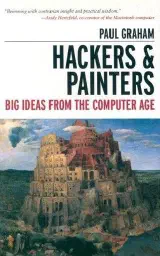
Hackers & Painters: Big Ideas from the Computer Age
Big Ideas from the Computer Age
The thesis is simple and somewhat outrageous: hackers are more like painters than like scientists, and treating programming as an art form rather than an engineering discipline explains why some programmers are so much better than others. Graham doesn't hedge this. He argues it, illustrates it, and then spends the rest of the book following where it leads.
The title essay is the best thing here. Graham draws the analogy carefully: both hackers and painters work by building things. They iterate, often not knowing what the final product will look like until it emerges. The best way to learn is to make. Style matters because style is how you encode ideas. This isn't decorative — it has practical consequences. If you believe programming is a creative act, you choose your tools differently, you tolerate iteration differently, and you hire differently. We find this argument genuinely persuasive, and it holds up better than you'd expect for a book written in 2004.
The computer world is like an intellectual Wild West, in which you can shoot anyone you wish with your ideas, if you're willing to risk the consequences.
— Graham, Hackers & Painters, Preface
Where it gets messier is the economics chapters — "How to Make Wealth" and "Mind the Gap." These made Graham famous in startup circles, and they contain real insight. Wealth is created, not redistributed; measurement plus leverage equals the startup advantage. But they're also where his worldview is most visible, and not always in useful ways. The argument that income inequality is mostly a proxy for technological innovation is partially true and conveniently incomplete. He's not wrong, but he's working with a narrower lens than he acknowledges. The reader who already buys the premise will find confirmation; the reader who doesn't will find the evidence thin.
The programming language essays are the sleeper chapters. They're ostensibly about Lisp, which limits the audience, but they're actually about language expressiveness and the competitive advantages that come from using better tools. The Blub paradox — the idea that programmers using a less powerful language can't appreciate what they're missing because their tools shape their perception — is one of the more genuinely useful ideas in technical literature. Twenty years later, with functional programming mainstream and type inference everywhere, the Lisp advocacy feels quietly vindicated without requiring you to actually use Lisp.
This is worth reading if you program professionally and haven't yet, less because it will change how you code and more because it articulates a way of thinking about craft that most technical education skips entirely. The economics chapters are the weakest part; the language and design essays are the most durable. What you take from it depends on where you start — a twenty-two-year-old with startup ambitions reads a different book than a senior engineer wondering why their codebase feels brittle. Both reads are valid.