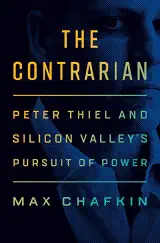
The Contrarian
Peter Thiel and Silicon Valley's Pursuit of Power
Max Chafkin's biography of Thiel — his philosophy, influence, and power in Silicon Valley.
Peter Thiel built a fortune betting against consensus. The central argument of Max Chafkin's biography is that this habit of mind — being contrarian — never evolved into something more. Where Thiel claims to stand for freedom, progress, privacy, and human flourishing, Chafkin finds instance after instance of him doing the opposite when power or spite demanded it. The private man who founded Palantir, a surveillance company whose clients include the CIA and the Army. The champion of free expression who secretly funded a $10 million legal campaign to destroy Gawker. The immigrant who advocates closing borders. Chafkin's thesis: the contradictions aren't accidents, they are the man.
The biographical territory is rich. Thiel emerges from Stanford as an aggrieved conservative in a liberal institution, co-authoring a broadside against multiculturalism before anyone in Silicon Valley was doing that kind of thing publicly. He builds PayPal through a mixture of genuine vision and ruthless internal politics, then makes early bets on Facebook and other companies that generate billions. He's willing to try almost anything to accumulate influence — publishing a NASCAR magazine, co-hosting a public access TV show, funding libertarian seasteading experiments — and eventually he lands on Trump, who turns out to be his most consequential bet. Chafkin is good on all of this. The reporting is deep: over 150 sources, many anonymous because they fear Thiel's retribution, which itself tells you something about the man.
My goal, in the pages that follow, is to try to understand a man who has made billions of dollars in part by being inscrutable.
— Chafkin, *The Contrarian*, Introduction
Where the book earns its criticism is in the analysis. Chafkin is a Bloomberg tech reporter, not a philosopher, and it shows when he tries to explain why Thiel matters ideologically. He's too quick to flatten Thiel's reading of Girard and Strauss into political shorthand, and too eager to trace lines of causation from Thiel's dinner parties to January 6th. The critical reader notices the technique: chapters filled with stories of chaos and improvisation, ending with authorial summaries implying mastermind-level scheming. The gap between those two things is where the book's credibility leaks.
Whereas Jobs viewed business as a form of cultural expression, even art, for Thiel and his peers it was a mode of transgression, even activism—a version of what he'd been trying to do at the Stanford Review.
— Chafkin, *The Contrarian*
Still, the most important contribution holds up: Chafkin documents how Thiel exported an ideology — monopolies are good, founders are gods, technology must be pursued regardless of cost — into the mainstream of American business thinking. That's not nothing. Thiel didn't just make money; he made a worldview, and that worldview now shapes how a generation of founders think about power, government, and their own self-image. Whether Thiel himself believes it coherently or has simply found it profitable to perform belief is exactly what the book struggles to resolve.
Founders who followed the Thiel model weren't just allowed to bend the normal rules of decency to protect their creations—they were expected to do so.
— Chafkin, *The Contrarian*
The uncomfortable honest answer is that Chafkin doesn't solve the riddle. The book concludes that Thiel is a contrarian who stands for nothing but opposition, which is probably the correct call — but it's also slightly boring. A man of genuine conviction, even repellent conviction, would make for a more instructive read. What we get instead is a profile of motivated inconstancy: a man who has leveraged ambiguity and disruption so effectively that even his biographer can't quite say what he actually wants. For anyone trying to understand how Silicon Valley acquired its current politics, this book is essential. Just read the chapters, not the conclusions.
Read the longer summary
The thesis: Thiel as the ideology factory
Chafkin’s core argument is simple, and he’s not subtle about it. Thiel, more than any other figure, created what Chafkin calls the governing worldview of Silicon Valley — a conviction that technology should progress “relentlessly—with little, if any, regard for potential costs or dangers to society,” and that founders who do the pursuing deserve near-monarchical authority inside their own companies. Everything else in the book — PayPal, Palantir, Facebook, Gawker, Trump, JD Vance — flows from this frame.
It’s a useful frame. It’s also a limiting one. Chafkin treats the Valley’s “break things” culture as if Thiel invented it, which overstates one person’s causal role. The spirit was already there in the DNA of the place long before Thiel showed up at Stanford. What Thiel did was articulate it with unusual clarity and put money behind founders who embodied it. That matters. But the framing shades into the book’s larger problem: Chafkin keeps reaching for grand unified theories when the man in front of him is more contradictory and more interesting than any theory can hold.
Origins: a weird kid, Stanford, and the making of a contrarian
Thiel was born in Germany in 1967, raised in Foster City, and showed up at Stanford as a high-achieving chess player with a Randian streak. Chafkin is good on the Stanford years. The campus’s mix of identity politics and hookup culture alienated Thiel, and he responded by co-founding The Stanford Review, a combative conservative paper that became the seedbed for his later network. He wrote The Diversity Myth with David Sacks in 1995, Chafkin’s first instance of Thiel positioning himself as a public intellectual. The circle that formed around the Review would reappear for decades: Sacks, Keith Rabois, and others who later became PayPal Mafia members and Founders Fund partners.
Three influences shaped him more than anything on the syllabus. Ayn Rand gave him a vocabulary for individualism. René Girard gave him a framework for why competition is usually a trap — why copying what everyone else is copying destroys value. And Leo Strauss taught him that serious thinkers hide their real views behind acceptable public ones. Chafkin handles all three of these as faintly sinister — Girard’s Christianity, Strauss’s esotericism, Rand’s anti-altruism — rather than as the intellectual materials Thiel actually uses. Girard in particular is the key to Thiel’s entire investment thesis: monopoly is better than competition precisely because competition is mimetic, and mimesis is the enemy of original thought. You don’t need to agree with Thiel to notice that the book refuses to meet him on this ground.
The money: PayPal, Facebook, Palantir
The business chapters are where Chafkin’s reporting is strongest. He interviewed more than 150 people, many on condition of anonymity because, as he notes, they feared retaliation. The portrait is detailed and frequently unflattering.
PayPal is an office-politics thriller. Thiel’s Confinity merged with Elon Musk’s X.com in 2000; Musk was briefly CEO; a quiet boardroom coup installed Thiel while Musk was on his honeymoon. The company survived, went public, and sold to eBay for $1.5 billion. The people who left with money became the PayPal Mafia: Musk, Reid Hoffman, Max Levchin, Chad Hurley, Jeremy Stoppelman, Dave McClure, Keith Rabois, Roelof Botha, David Sacks. No other alumni network in tech history has produced that kind of downstream concentration. Chafkin is skeptical Thiel’s leadership was the cause. A fairer reading is that Thiel built a culture where intense, disagreeable, high-agency people wanted to work together, then didn’t get in their way when they left to start things.
The Facebook story is the one everyone knows the punchline to. Thiel put in $500,000 in 2004, took a board seat, and eventually walked away with more than a billion dollars. Chafkin emphasizes the moments Thiel got it wrong — urging Zuckerberg to sell to Yahoo for a billion, selling too early, missing the full run. This is the book’s recurring rhetorical move. Thiel wins, but Chafkin finds a way to frame each win as either luck or someone else’s judgment. A track record that includes PayPal, Facebook, Palantir, SpaceX, and Stripe is hard to explain by luck, but Chafkin doesn’t try.
Palantir is where the politics and the business fuse. Founded in 2003 with seed money from In-Q-Tel, the CIA’s venture arm, Palantir built data-fusion software that the Army, Navy, ICE, and intelligence agencies now pay heavily for. Thiel’s libertarianism meets government contracting here, and Chafkin is right that the contradiction deserves attention. If you want the state out of your life, you probably shouldn’t build the machine the state uses to see into other people’s lives. Thiel’s answer, roughly, is that a better-run surveillance apparatus is preferable to the sprawling, incompetent one we’d otherwise have. You can accept or reject that answer. What you can’t do is pretend it isn’t an argument.
The other investments get less attention than they deserve. Founders Fund backed SpaceX when it was still unfashionable to back a rocket company. It backed Stripe. It backed Anduril, the defense-tech company Palmer Luckey started after Facebook fired him for a political donation. A book that takes Thiel’s influence seriously needs to take these bets seriously, because they are the receipts. Chafkin mostly doesn’t.
The Gawker reckoning
The Gawker saga is the book’s most dramatic set piece, and it’s the one where Chafkin’s framing most obviously bends the facts. In 2007, Gawker’s Silicon Valley site Valleywag outed Thiel as gay. In 2012, Gawker published Hulk Hogan’s sex tape. Thiel secretly funded Hogan’s lawsuit; Hogan won a $140 million judgment; Gawker filed for bankruptcy. Chafkin treats this as a shocking assault on press freedom by a vengeful billionaire.
The version that involves an adult male wrestler’s stolen sex tape, published without consent, and a jury that agreed the publication was illegal — that version is harder to squeeze into a First Amendment martyrdom story. Gawker’s own editor testified under oath that he would have considered publishing a celebrity sex tape involving a child over the age of five. A courtroom heard that. A jury heard it. Ryan Holiday’s Conspiracy, told from Thiel’s side, comes out somewhere more honest: Gawker was not a noble institution of the press, and funding a lawsuit by a plaintiff with a real legal grievance against a tabloid that trafficked in stolen recordings is not obviously a crime against democracy.
This isn’t a small thing. The Gawker chapters are where Chafkin most clearly chooses the narrative he wants over the facts he has. For readers who want to understand Thiel, it’s also the place where his own logic is most coherent. He took years, he used the courts, he funded a plaintiff with a real grievance. Whatever you think of the motive, the method is the opposite of reckless.
Trump, Vance, and the shadow presidency
Thiel’s endorsement of Trump at the 2016 Republican National Convention broke a taboo. Silicon Valley had been reliably Democratic; no one in his tier had crossed the line. Thiel donated $1.25 million, spoke on the convention floor, joined the transition team, and installed allies in posts across the incoming administration. Chafkin calls this “the shadow presidency,” and the reporting on specific picks — Michael Kratsios as CTO, Kevin Harrington and others on the National Security Council — is genuinely useful.
The weaker part is the causal claim. Chafkin writes as if Thiel were pulling strings. The transcripts and interviews in his own book don’t support that. Trump’s White House had too many factions, too much chaos, and too much Trump for any one donor to orchestrate. Thiel placed people. Some got confirmed, most didn’t. Most of his political picks lost their primaries. Blake Masters, whom Thiel spent millions on, lost his Arizona Senate race badly. The one political return on investment was JD Vance, whose 2022 Ohio Senate win came after roughly $15 million in Thiel money — and whose 2024 elevation to the vice presidency happened after this book went to press.
This is where an honest biographer slows down and asks: so what actually is the return on this political spending? For a man Chafkin casts as a master strategist, the record through 2021 looks more like a fund manager making ten bets knowing most will lose. Some did lose. Vance paid off. The book reads all of it as one cold, long-running plan, which gives Thiel too much credit and too little.
The limits of Chafkin’s frame
The honest criticism of The Contrarian — and it’s the criticism several Goodreads reviewers have made well, from both the left and the right — is that the author’s contempt for Thiel limits what he can see. Chafkin quotes someone at Thiel’s 2016 election-night party describing the mood: “The big attitude was, ‘I’m so happy everyone in Silicon Valley is unhappy about this.’” Chafkin treats that as damning. It is also, plainly, accurate about a certain kind of Valley-insider pleasure in breaking consensus. The book keeps catching Thiel being exactly what he says he is and treating it as unmasking.
The bigger missing piece is Thiel as a thinker. Zero to One, published in 2014, is a widely read book among founders for a reason. Its argument — that the best companies build monopolies, that competition is for losers, that the future belongs to “definite optimists” with a plan rather than “indefinite optimists” who spray money everywhere — is a framework people actually use. You can disagree with it. You can find it cold. But a biography that treats the author of Zero to One as mostly a reactionary grievance peddler has omitted the load-bearing intellectual structure of its own subject. Paul Graham, who dislikes Thiel’s politics, has made much the same point about the book.
There’s also the question of ageing and death. Thiel funds life-extension research. Chafkin treats this as vanity or hubris. An honest engagement would admit that if you don’t think death is a fixed moral good, you have no principled reason to oppose research into extending healthy lifespans. You can argue Thiel’s specific bets are bad science. You can’t argue the goal itself is contemptible without doing the actual philosophy, and the book doesn’t.
Here is how to read The Contrarian without being flattened by it. Treat the reporting as real and the editorial as a bias to subtract. The interviews are extensive. The timelines are accurate. The details on boardroom politics, funding rounds, and political hires — those are the parts worth reading. The constant adjectival pressure — “reactionary,” “authoritarian,” “neo-reactionary,” “oligarch” — is the part you have to step around. Several reviewers, including some sympathetic to Chafkin’s politics, have flagged specific factual stretches: the treatment of a Honduran charter city project as dead when it was alive and growing; the suggestion that Thiel orchestrated Facebook’s content moderation decisions, which Zuckerberg’s own record makes implausible; the repeated move of treating “associated with people who said ugly things” as equivalent to endorsing the ugly things.
The 2025 re-issue, retitled The Contrarian: Peter Thiel and the Rise of the Silicon Valley Oligarchs, adds a new framing for a post-2024 world in which Thiel’s protégé is the sitting Vice President. The subtitle change tells you where Chafkin wants to take the story: from “pursuit of power” to “the oligarchs have arrived.” Readers coming to the book now should know that the updated edition leans harder on this argument without substantially reopening the reporting.
Who should read it
Read this if you want to understand how Silicon Valley got political, who the people around Thiel are, and why the PayPal Mafia keeps mattering. Read it if you want a detailed account of the Gawker suit, the Facebook board years, or the 2016 transition team — the facts are here even when the framing isn’t. Read it alongside Zero to One if you want both sides: Thiel’s own account of his method, and a hostile outsider’s reconstruction of his life. Skip it if you’re looking for a fair-minded engagement with Thiel’s actual arguments — Chafkin is not the writer for that job, and probably was never going to be. The book Thiel deserves has not been written. This is the book we have.