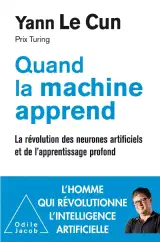
Quand la machine apprend
La révolution des neurones artificiels et de l'apprentissage profond
Deep learning is not intelligence. That's the admission buried in the first pages of Yann Le Cun's book, and it's a braver claim than most AI books dare to make. Le Cun — Turing Prize winner, co-inventor of convolutional neural networks, and the person most responsible for the architecture that powers half the AI systems you interact with today — spends 400 pages explaining what his invention actually does, and what it can't do. The gap between those two things is where the book lives.
The technical argument at the book's core is worth taking seriously precisely because Le Cun knows the machine's limits better than anyone. A deep learning system, no matter how many layers, is optimizing a cost function over labeled examples. Feed it millions of images, it learns to classify. Build it big enough with enough text, it generates plausible sentences. But ask it to resolve an ambiguity that requires knowing physics — whether "it" in a sentence refers to the box or the sculpture — and it has no way to answer. Le Cun calls this the absence of a "world model": the background knowledge every eight-year-old uses when catching a ball, anticipating its arc from understanding that objects fall predictably. Machines don't have that. The book is unusually honest about how fundamental that gap is, and how little progress the field has made closing it. That honesty is worth more than the cheerful consensus that AGI is three years away.
Aujourd'hui, un système de deep learning n'est pas capable de raisonnement logique. [La machine] exécute sans avoir la moindre idée de ce qu'elle fait, et possède moins de sens commun qu'un chat de gouttière.
— Le Cun, Quand la machine apprend
The second register of the book is memoir, and it's genuinely good. Le Cun traces the decades when neural networks were academic heresy — the "AI winters" when funding dried up and researchers working on learning systems were viewed as cranks. The community that kept the work alive was small enough that everyone knew each other: Hinton in Toronto, Bengio in Montreal, Le Cun bouncing between French institutions that couldn't quite find room for him and American labs that understood exactly what he was doing. That story — of a minority research tradition surviving the consensus, then watching the consensus flip overnight in 2012 — is both history and a practical lesson. Good ideas don't always find their moment on schedule.
La crainte que nous avons d'un robot voulant prendre le pouvoir est une projection sur les machines des particularités de la nature humaine.
— Le Cun, Quand la machine apprend
Where the book loses credibility is in its treatment of Facebook and Mark Zuckerberg. Le Cun works for Meta and knows it, and the sections on Facebook's AI ethics read like press releases. The hard questions — what it means that recommendation algorithms are optimizing engagement rather than anything resembling truth, what a company committed to "world representation" might do about that — go unasked. A book willing to call ChatGPT "good engineering, not revolutionary" should be willing to apply the same honest eye to its author's employer. It doesn't, and the omission is noticeable.
Nous sommes incapables de concevoir et de construire des machines qui approchent la puissance du cerveau humain, avec ses 86 milliards de neurones et sa puissance consommée d'environ 25 watts.
— Le Cun, Quand la machine apprend
That said, this is one of the few AI books written by someone who actually built the thing. Le Cun knows how backpropagation works because he helped prove it works. If you want to understand deep learning from the inside — its genuine achievements, its real limits, and the human story of how it got built — this is where to start. The French-only publication is a genuine obstacle for most readers. Wait for the translation; it'll be worth it.