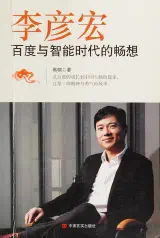
Li Yanhong
Chinese biography chronicling Robin Li's creation of the Baidu legend in vivid, humorous narrative style.
Robin Li built China's dominant search engine not by copying Google but by betting that relevance — genuine algorithmic relevance — would win a market that everyone else was treating as a directory business. *Li Yanhong*, Han Xiao's 2015 biography, is less a life story than an argument: that the man who understood search earlier than his competitors in China also saw, earlier than most, that search and artificial intelligence are the same problem dressed in different clothes.
The book's most useful contribution is a three-era model of the internet that Li uses to frame his own career. The PC era rewarded iteration speed — companies that could update software in hours rather than six months outcompeted the packaged-software incumbents. The mobile era shifted the advantage to ecosystem builders; the companies that could integrate purchasing, maps, and services into a single experience locked users in. Li argues that Baidu won the PC era and struggled in mobile precisely because mobile changed the rules: a search bar is enough for text queries, but a user who wants to book a hotel, call a car, and pay for lunch needs something closer to a vertically integrated platform. The "third stage" — the AI era — is where Li sees Baidu recovering the structural advantage it lost to WeChat and Alibaba. Voice and image as interfaces favor companies with massive data reserves and deep learning infrastructure. That, he argues, is Baidu.
There is something both compelling and convenient about this framing, and we think Han doesn't press on the tension hard enough. The three-era argument is unusually honest about where Baidu underperformed in mobile. But it is also a retroactive justification for a pivot that hadn't been proven when the book was written. The concrete examples Han provides — AI-coached telephone sales, student loan verification by face recognition, a film marketing campaign that delivered 200% above projections through user profiling — are genuine demonstrations of capability rather than empty promises. What makes them interesting is the economics: collapsing the cost of understanding user behavior from expensive and slow into something near-real-time. That is the real argument for AI as a platform, not the generic claim that "the future is intelligent."
The book struggles where most Chinese tech biographies struggle: the hagiographic pull is strong, and Han never really asks whether Baidu's AI ambitions were driven by conviction or by the need for a new story after losing the mobile wars. Reading it now, after DeepSeek upended the assumption that Baidu had an unassailable lead in Chinese AI, that question feels more pressing than the book allowed itself to pursue. Even so, as a document of how one engineer's intuitions about relevance became a company — and how that company tried to translate those intuitions into the next technological era — *Li Yanhong* repays the time, especially for anyone trying to understand why China's internet industry took AI seriously before Silicon Valley did.