
Hugging Face AI and Climate researcher
Sasha Luccioni
Profile
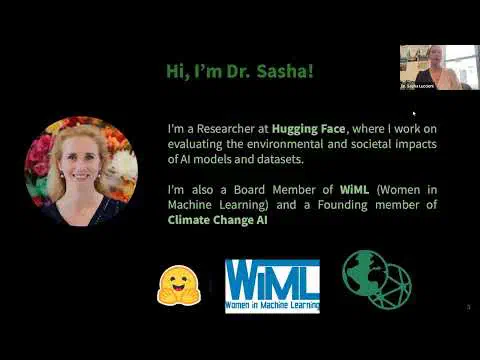
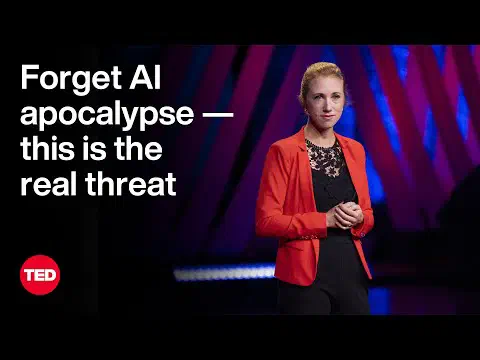
Sasha Luccioni is the researcher who put a number on what everyone in AI would rather not talk about: the electricity bill and the carbon cost of building and running these models. As AI & Climate Lead at Hugging Face — and now Co-Founder and Chief Scientific Officer of the Sustainable AI Group — she has spent the better part of a decade turning “AI has an environmental footprint” from a hand-wavy talking point into measurable, reproducible science. If you have ever wondered how many grams of CO₂ your inference call actually costs, you are asking a question that Luccioni’s work largely made answerable. She was named to TIME’s 100 Most Influential People in AI in 2024 and featured on the BBC’s 100 Women list the same year.
Born in Ukraine and raised in Canada, she came into the field sideways — starting in the humanities before moving into computer science, earning a PhD in AI, and doing a stint in applied finance research before deciding she wanted to do socially useful work. She spent time working alongside Yoshua Bengio on AI-for-good and AI-for-climate projects, and is a founding member of Climate Change AI and a board member of Women in Machine Learning. She is also an Adjunct Professor at McGill University’s School of Computer Science.
What makes her matter to developers is that she builds tools, not just papers. She helped create CodeCarbon, a Python package that estimates the emissions of your training and inference runs, and it has become one of the most widely adopted sustainability instruments in the ML ecosystem — a few lines of code that turn an abstract concern into a dashboard number. More recently she launched the AI Energy Score, a standardized benchmark and public leaderboard (unveiled at the Paris AI Action Summit in February 2025) that rates models 1-to-5 stars on their energy efficiency across ten tasks, the way an appliance gets an Energy Star label.
Her central argument is uncomfortable and increasingly hard to dismiss: reaching for a giant, general-purpose generative model when a small task-specific one would do is often orders of magnitude more wasteful, and the industry’s default of scaling everything hides real physical costs. She is not a doomer and not an accelerationist — she is an empiricist who thinks the field should measure what it’s spending before it decides whether the spending is worth it. For anyone building with AI today, that framing is a useful counterweight to the “just use the biggest model” reflex.
Key Articles & Papers
Estimating the Carbon Footprint of BLOOM, a 176B Parameter Language Model Power Hungry Processing: Watts Driving the Cost of AI Deployment? Counting Carbon: A Survey of Factors Influencing the Emissions of Machine Learning Stable Bias: Analyzing Societal Representations in Diffusion Models Announcing AI Energy Score Ratings The Environmental Impacts of AI — Policy PrimerVideos

Spotify Podcasts









YouTube