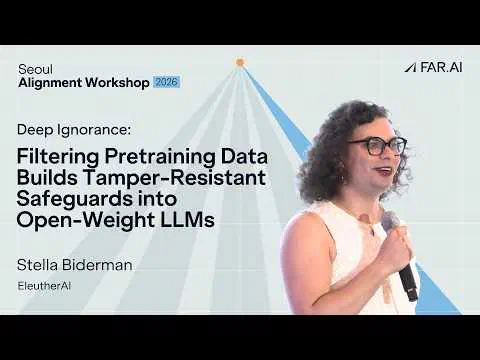

EleutherAI Executive Director, open-source AI researcher
Stella Biderman
Profile
Stella Biderman is the Executive Director of EleutherAI, and more than almost anyone else, she is the reason open-weight large language models exist as a serious field rather than a corporate courtesy. EleutherAI began in 2020 as a Discord server of volunteers who wanted to replicate GPT-3 — a grassroots effort co-founded by Connor Leahy, Sid Black, and Leo Gao — and Biderman is the person who turned that scrappy collective into a genuine non-profit research institute whose artifacts now underpin thousands of academic papers. A mathematician by training (B.S. in mathematics from the University of Chicago, M.S. in computer science from Georgia Tech), she works at the intersection of NLP, training-data curation, and interpretability, and she has an unusually clear thesis: that auditors, academics, and independent researchers should be able to study frontier AI without having to sign an NDA with the company selling it.
The receipts are substantial. Biderman was a driving force behind The Pile, the 800GB dataset that trained a generation of open models; GPT-NeoX-20B, which was for a time the largest openly available language model in the world; and Pythia, a suite of 16 models trained on identical data in identical order with 154 checkpoints apiece — a research instrument, not a product, purpose-built so that scientists can actually study how model behavior emerges over training. She also contributed to BLOOM via the BigScience collaboration, to VQGAN-CLIP (one of the early text-to-image pipelines), and to OpenFold. If you have ever run lm-evaluation-harness to benchmark a model, you have used software her team built and maintains — it became the de facto standard, the harness behind Hugging Face’s Open LLM Leaderboard.
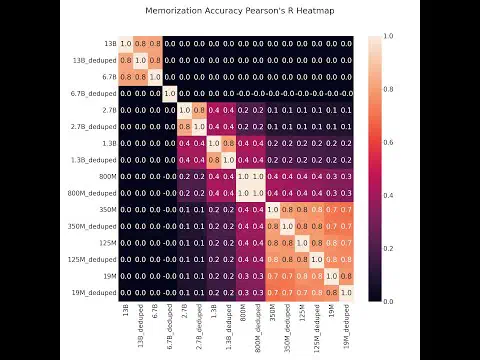
What sets Biderman apart from the “release the weights and move on” crowd is that she treats openness as a research methodology, not a marketing posture. Pythia exists because reproducibility requires controlled conditions; her work on memorization (“Emergent and Predictable Memorization in Large Language Models”) and on the consistency of interpretability circuits across training runs reflects a scientist trying to make LLMs legible rather than merely available. More recently she co-led The Common Pile v0.1, an 8TB corpus of public-domain and openly licensed text, and the accompanying Comma 7B models — a direct attempt to prove you can train competitive LLMs without scraping copyrighted work you have no permission to use. That is a pointed answer to one of the field’s biggest open legal questions.
Today Biderman splits her energy between running EleutherAI and research work at FAR.AI, and she has become one of the most articulate voices in AI policy — testifying and writing on how regulation (the EU AI Act especially) too often fails to distinguish open scientific research from commercial deployment. For a developer learning AI, she matters because the tools you reach for to study, evaluate, and reproduce models — the datasets, the checkpoints, the eval harness — largely trace back to her insistence that this stuff be public. She is proof that open science can set the transparency bar that the labs then have to answer to.
Key Articles & Papers
The Pile: An 800GB Dataset of Diverse Text for Language Modeling GPT-NeoX-20B: An Open-Source Autoregressive Language Model Pythia: A Suite for Analyzing Large Language Models Across Training and Scaling The Common Pile v0.1: An 8TB Dataset of Public Domain and Openly Licensed Text Emergent and Predictable Memorization in Large Language Models VQGAN-CLIP: Open Domain Image Generation and Editing with Natural Language Guidance Emergent Abilities of Large Language Models Are Emergent Abilities in LLMs Just In-Context Learning?Videos
Controversies
Biderman is a combative and prolific presence in AI’s public debates rather than the subject of scandal, but a few genuine tensions are worth naming. EleutherAI’s decision to build and release The Pile — which included copyrighted material such as the Books3 corpus — later made it a reference point in copyright lawsuits and criticism over training data; Books3 was eventually pulled from distribution. Biderman has argued forcefully that transparency about training data is being chilled by litigation risk, and that the safest legal path (say nothing about your data) is the worst outcome for science — a position her Common Pile work is meant to make moot. She has also been openly critical of “open-washing,” pointing out that many models marketed as open ship weights without the data or code needed to actually reproduce them. On safety, she takes a nuanced line that irritates both camps: she has argued that CSAM prevention is close to the only clear case where a closed model is genuinely safer than an open one, while otherwise defending openness against blanket restriction. Her sharp-elbowed style on X/Twitter has drawn its share of feuds, but the underlying disagreements are substantive ones about how open AI research should be.
Spotify Podcasts

YouTube