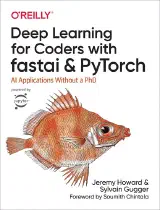
Deep Learning for Coders with fastai and PyTorch
AI Applications Without a PhD
The central claim of *Deep Learning for Coders with fastai and PyTorch* is that a PhD was never the price of admission — Python fluency and a few GPU hours are enough to get state-of-the-art results, and most of what the field calls "prerequisites" are mythology.
Howard and Gugger make this case by showing before explaining. Chapter one drops you into a working image classifier — four lines of code, one training epoch, sub-1% error rate — before spending a single paragraph on what a neural network actually is. This top-down pedagogy runs through the whole book: practical result first, theoretical scaffolding second. It is more honest about learning than most technical texts. The real demotivator in picking up deep learning is not the math; it is the gap between "I understand backpropagation" and "my model actually works." Howard and Gugger compress that gap to nearly zero.
A lot of people assume that you need all kinds of hard-to-find stuff to get great results with deep learning, but as you'll see in this book, those people are wrong.
— Howard and Gugger, Deep Learning for Coders with fastai and PyTorch, ch. 1
The book covers serious ground. Computer vision, NLP, tabular data, and collaborative filtering each get their own chapters, with code that runs end-to-end in Jupyter notebooks. The transfer learning material is especially good — the authors argue, correctly, that using pretrained weights is the single most underrated technique in practical deep learning, and they give it the emphasis it deserves rather than relegating it to a footnote. There is also a thorough section on training tricks: 1cycle scheduling, mixup, label smoothing. That material turns out to be more valuable than the architecture chapters, because it captures accumulated practitioner knowledge that does not appear cleanly in any single paper. The data ethics chapter is thoughtful without being preachy, and the feedback loop examples are concrete enough to stick.
The key is to just code and try to solve problems: the theory can come later, when you have context and motivation.
— Howard and Gugger, Deep Learning for Coders with fastai and PyTorch, ch. 1
The weaknesses are real. The top-down structure, for all its virtues, produces repetition: the same cat-vs-dog dataset gets revisited at multiple levels of abstraction, and by the fourth time you are watching the model train on it, you may wonder whether the pedagogy is serving you or just itself. The fastai library's abbreviation-heavy coding style — `ni` for `num_inputs`, `tfm` for `transform` — is a genuine irritant that works against the book's own stated goal of reducing jargon. Howard and Gugger are aware that the library will eventually be superseded, but they are less candid about the fact that their idiosyncratic style creates a small but real onboarding tax every time you move to a standard codebase.
Overfitting is the single most important and challenging issue when training for all machine learning practitioners, and all algorithms.
— Howard and Gugger, Deep Learning for Coders with fastai and PyTorch, ch. 1
None of this undermines the book's core value. If you are a programmer who has been told that deep learning requires a mathematics PhD, *Deep Learning for Coders* is the most direct rebuttal available. If you already know the basics and want to understand what training practitioners actually do to get models to work — not just what architecture researchers publish about — the middle section is worth the cover price on its own. It will not take you to the research frontier, but for a practitioner who wants to ship something, it is close to the best single starting point in print.