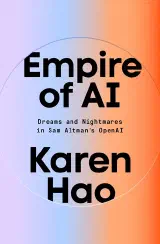
Empire of AI: Dreams and Nightmares in Sam Altman's OpenAI
Dreams and Nightmares in Sam Altman's OpenAI
Investigative journalist Karen Hao's critical examination of OpenAI's evolution, with extensive Brockman coverage.
OpenAI started as a nonprofit meant to save humanity from dangerous AI; Karen Hao's argument is that it became exactly what it was supposed to prevent.
*Empire of AI* is Hao's seven-year investigation into OpenAI, built on interviews with more than 250 people who watched the company transform from an idealistic research lab into what she calls a corporate empire — extracting cheap labor from data annotators in Kenya, competing for water from Chilean aquifers, and concentrating the most consequential research talent in the world under a single corporate structure. The empire analogy isn't decoration. Hao uses it seriously: OpenAI fits a recognizable pattern in which a universalist mission — "AGI for all of humanity" — serves as ideological cover for accumulation, performing the same function that "civilizing missions" served in the 19th century. The parallel is uncomfortable enough to be worth sitting with.
Most consequentially, the mission remains so vague that it can be interpreted and reinterpreted—just as Napoleon did to the French Revolution's motto—to direct the centralization of talent, capital, and resources however the centralizer wants.
— Hao, Empire of AI, ch. “A Formula for Empire”, p. 400
Where the book earns its reputation is in the reporting. The behind-the-scenes account of Sam Altman's November 2023 firing and five-day reinstatement is told here with more texture than anywhere else, and it's revealing not just as corporate drama but as a character study. Hao depicts Altman as someone who mirrors back what his audience wants to hear — a psychological agility that lets him credibly perform both the safety advocate and the growth-at-all-costs operator depending on who's in the room. The Doomer/Boomer fracture inside OpenAI — between researchers who feared rapid deployment and those who wanted to accelerate — explains why a company full of brilliant people kept making decisions that alarmed them. Musk's departure, Amodei founding Anthropic over GPT-3's commercialization, Sutskever leaving over safety: these aren't coincidences, and Hao connects the dots.
What I reject is the dangerous notion that broad benefit from AI can only be derived from—indeed, will ever emerge from—a vision for the technology that requires the complete capitulation of our privacy, our agency, and our worth
— Hao, Empire of AI, Epilogue, p. 413
The weaknesses are real and worth naming. Hao never takes AGI seriously as an actual possibility, which distorts her account. If machine superintelligence is genuinely coming, the moral calculus of racing to control its development looks different than if AGI is a convenient fiction used to raise money. By treating the mission as pure manipulation rather than a contested empirical question, she makes the book's critics easier to dismiss than they deserve. The alternative she sketches in the final chapter — small, community-centered AI projects like a Māori speech recognition tool — is affecting, but she never honestly reckons with why OpenAI's original altruism collapsed. The answer involves compute costs and competitive dynamics that would crush her preferred alternatives just as thoroughly.
There's also a factual problem. A significant figure about water consumption at a Chilean data center turned out to be inflated by a factor of 1,000 due to a unit conversion error. Hao acknowledged it publicly after publication. One error doesn't undermine a book, but it gives critics a handhold they use to dismiss the whole, and it suggests the extraction narrative received less scrutiny than the corporate intrigue sections.
Still, the book delivered something that didn't exist before: a reported account of how the most consequential AI company in the world actually operates, from the inside. Whether or not you accept the empire frame, the underlying journalism stands. For anyone trying to understand where AI governance went wrong — and why it will probably keep going wrong — this is the place to start.
Read the longer summary
The book’s central claim
Karen Hao spent seven years reporting on OpenAI and came out convinced the company is not a startup but something closer to an imperial power. Not as metaphor, as structure. Hao argues that OpenAI and the handful of firms that can still afford to compete operate by the same logic as the great nineteenth-century trading companies: they claim other people’s resources (data, water, electricity), extract cheap labor at the periphery (annotators in Nairobi, communities near Chilean data centers), consolidate scarce research talent inside a few firms, and justify all of it with a civilizing mission. In this case, the mission is building artificial general intelligence to help humanity.
That is the book’s spine. If you accept the empire frame, everything else flows from it. Sam Altman is not a founder but a sovereign. The governance blow-up of November 2023 was a succession crisis. The Microsoft deal was a colonial charter. A data center’s water bill becomes the new cotton trade. If you don’t accept the frame, much of the book’s rhetorical weight shifts.
Hao interviewed more than 260 people. She worked internal documents, Slack messages, memos. Her book sits alongside Keach Hagey’s The Optimist as the two serious tellings of the OpenAI story, and it is the sharper and angrier of the two. It won the 2025 National Book Critics Circle Award for nonfiction. That reporting pedigree is real, and we want it on the table before we say what we think the book gets wrong.
Altman’s portrait is the strongest thing in here
The best chapters are about Altman. Hao did what reporters on a beat this size can rarely pull off: she got enough people to talk on or close to the record that a pattern emerges. The pattern is that Altman is an unusually skilled mirror. He listens. He catches what the other person in the room wants to hear. He agrees, and then he agrees with someone who wants the opposite, and both people walk out thinking he is on their side. Over years, this compounds.
Hao lines up the receipts. The 2015 mission was open and nonprofit. By 2016 Ilya Sutskever was writing internally that being “open” did not actually mean sharing the science. The capped-profit structure arrived in 2019. By 2022 the strategy was ship ChatGPT fast and iterate in public. By 2024 the mission had quietly become putting capable tools cheaply in as many hands as possible.
You could read that sequence as pragmatism. A nonprofit cannot buy H100s at the scale the frontier demands. A lab that refuses to commercialize cannot pay the people doing the research. A company that will not ship gets overtaken by one that does. Hao reads it as mission creep, and at minimum she is right that “benefit humanity” has done a remarkable amount of rhetorical work for a phrase nobody inside OpenAI can actually define. The board that briefly fired Altman said he had not been “consistently candid.” Hao gives that sentence body.
This part of the book holds up even if you are bullish on AI. Altman is a genuinely interesting character and Hao’s is the most detailed account of him in print. Where she overshoots — and we think she does, slightly — it is because she treats shape-shifting under pressure as a moral indictment rather than the generic condition of any CEO trying to hold together 700 researchers, a trillion-dollar partner, and a terrified board.
The empire frame is thinner than the title suggests
Here is where we push back. The empire analogy is the book’s whole organizing idea, and Hao commits to it less than you would expect. The one sustained parallel is with the British East India Company, a charter company that slowly accreted sovereign powers over Bengal. Fine. But outside that one comparison, there is almost nothing about how actual empires worked. Not Rome. Not the Mongols. Not the Ottomans. Not even a serious look at how the East India Company’s extractive machinery differed structurally from, say, training a transformer on scraped web text.
Tom Johnson, reviewing the book in his AI book club, made this point cleanly: the empire reference is broad strokes only. We agree. “AI colonialism” has been a fashionable phrase in certain academic circles for years — Zuboff, Couldry, the Springer review that cites Mehta and Chakrabarty does a better job with the political theory than Hao does herself. The book often reads like it is importing that vocabulary rather than testing it.
Empires, historically, held territory with armies. They taxed. They passed laws in conquered places. They owed allegiance to no superior sovereign. OpenAI does none of these things. It obeys US law, pays US taxes, operates at the sufferance of regulators who could break it up tomorrow, and sells to customers who can swap its API for Anthropic’s or Google’s with a single line change. Calling that structure an empire stretches the word until it mostly means “large company the author dislikes.”
A more honest framing — which Hao circles but never quite embraces — is that frontier AI is concentrating inside a few firms the way chipmaking concentrated inside TSMC and Samsung, or search inside Google. That is a serious and worrying problem. It just isn’t empire.
Labor and resources: where she’s right, and where the reporting broke
The Kenyan chapters are hard reading, and they should be. OpenAI and its contractors paid annotators roughly a dollar or two an hour to review traumatic content so that ChatGPT would refuse to produce it. That happened. The workers Hao profiles are real. The harm is real. Anyone who wants to argue AI is a clean industry has to answer for this, and most industry defenders have not.
But we have to flag something, because our rule is to never flatter. The resource-extraction arc of the book hit a serious factual problem after publication. In November 2025, Hao acknowledged on X that the book overstated the water consumption of a specific Chilean data center by a factor of one thousand. A unit conversion mistake. Wired covered the retraction. The underlying point — that compute scales with water and power, and that communities living next to data centers have real complaints — survives. The specific arithmetic meant to make the point vivid does not.
This matters because the water story is one of the book’s emotional engines. Hao opens those sections with Chilean activists precisely because the numbers, as originally printed, were shocking. When the shock turns out to have been three orders of magnitude off, the shock was carrying weight the evidence could not support. Good journalists make errors; honest ones correct them, and Hao did. But the book had already shaped a year of discourse before the correction landed. Anyone picking it up now should know the correction exists.
Boomers, Doomers, and the flattening of AGI
Hao organizes the internal politics of OpenAI around two factions: accelerationists who want to ship, and safety people who want to slow down. Boomers and Doomers. The shorthand tracks real splits — Dario and Daniela Amodei leaving for Anthropic, Sutskever leaving for Safe Superintelligence, Mira Murati leaving for Thinking Machines Lab. We didn’t realize, before Hao, how many of the current AI labs are splinters of one original OpenAI disagreement.
Where the book gets worse is on AGI itself. Hao’s implicit line, which she is careful never quite to state outright, is that AGI is vaporware — a rhetorical instrument Altman uses to concentrate power, not a technology worth taking seriously on its own terms. She says late in the book that her critique is not of AI as a technology but of one extractive model for developing it. The texture of the book pushes the other way. Whenever she writes about safety, it is almost always through the lens of who is using safety language as a weapon in corporate politics.
This is where we disagree most sharply. If capability trajectories even roughly hold, the engineers inside these companies who worry about alignment are not propagandists. They are people making technical bets with incomplete information. Kurzweil’s 2029 date is probably early; the “bigger than the internet” framing Steven Levy uses is probably closer. You can disagree with any specific timeline and still think alignment is a live technical question rather than a public-relations costume.
Flattening AGI into pure rhetoric lets Hao sidestep the hardest question in her own book. What if the mission, while obviously exploited by its stewards, is also pointing at something real? What if the best ML researchers on earth voluntarily clustered inside OpenAI (and then Anthropic, and then xAI) not because they were duped by an empire-branding exercise, but because they think the technology is plausibly as consequential as electricity and they want to be in the room where it gets built? Hao never quite entertains this. She treats the belief itself as evidence of capture.
What the book won’t tell you
A reader who finishes Empire of AI will know a great deal about what went wrong at one company. They will know much less about why the technology that company built is useful enough that hundreds of millions of people now use it every week. The productivity stories — the doctor writing notes in half the time, the small-business owner with a legal assistant she could not previously afford, the blind student whose phone can describe the world — are not in this book. The book is not interested in them.
That absence is a choice, and we are sympathetic to the defense that the pro-AI story is already told everywhere else. Fair enough. But the reader who wants a complete picture should understand that Hao has selected her material to prosecute a case. Good investigative journalism often does this. The narrative fallacy Johnson names is real: once you have the empire thesis, the details you notice are the ones that fit it.
There is also almost no engagement with the counterfactual. Suppose OpenAI had stayed a pure nonprofit in 2019. What happens? In the most honest reading, Google DeepMind ships the first transformer-based consumer product, Microsoft never partners with a safety-focused lab, the frontier sits inside the same small group of firms it sits in now — minus Anthropic, which was itself a defection from OpenAI. The argument that a more public-minded path was genuinely available requires showing that path was feasible at frontier scale. Hao does not show this. Her final chapter sketches an alternative — smaller models, community ownership, a Māori-language project — but even she seems to know the sketch is aspirational rather than argued.
Who should read it
Read Empire of AI if you want the most detailed public account of how OpenAI became what it is, told at full strength by a reporter with the access to make the case. Read it for the Altman character study, which is going to outlast every other book written about him this year. Read the Kenyan chapters, which are morally serious. Read it as one half of a conversation — Hagey’s The Optimist is the other half, softer in prose but more willing to let its subjects remain ambiguous.
Skip it, or read it skeptically, if you want to understand the technology itself, or an even-handed assessment of whether AI concentration is worse than semiconductor or cloud concentration, or a policy roadmap. The optimism of the closing chapter is hope rather than analysis.
Our honest verdict: a valuable book and an over-reaching one. The reporting is first-rate. The Altman portrait will define how the next decade of journalists write about him. The labor reporting is necessary. The empire frame is a marketing choice dressed as a thesis, and the water arithmetic was off by a factor that should have embarrassed the book’s fact-checkers. Read it with the framing discounted by roughly a third and the water correction in mind, and you will come out better informed. Just not quite in the direction Hao intended.