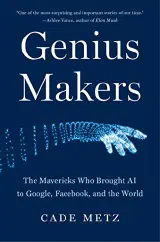
Genius Makers: The Mavericks Who Brought A.I. to Google, Facebook, and the World
Journalist Cade Metz's history of AI pioneers — Goodfellow's GAN breakthrough at Montreal bar to Google.
The story of modern AI isn't really about algorithms — it's about a handful of true believers who kept a discredited idea alive long enough for compute and data to prove them right. Cade Metz's *Genius Makers* tells that story through the people at its center: Geoffrey Hinton, who spent forty years on neural networks when the field had written them off; Yann LeCun, who made the same bet and landed at Facebook; and the two students who built AlexNet in a Toronto bedroom using consumer GPUs and sparked one of the most consequential bidding wars in tech history.
The access Metz had is remarkable — over 400 interviews across eight years on the AI beat at the *New York Times* — and it shows. The book moves fast, from academic labs operating on shoestring budgets in the 1980s, through Google's $44 million acquisition of Hinton's tiny startup, to the escalating arms race between the tech giants. What it does best is demonstrate that the modern AI revolution wasn't a bolt from the blue. It was a delayed vindication. The researchers who built it had been right for decades; they just needed the hardware to catch up. That framing — true believers versus the consensus — gives the book its narrative pull, and Metz earns it through detail: the personalities are vivid, the anecdotes specific, the corporate drama genuinely tense.
Where the book falters is proportion. Ethics and bias get roughly ten pages out of three hundred. The portrayal of women is similarly thin — most of the eight named appear in that ethics chapter, as though their primary contribution to the field is pointing out what the men got wrong. *Genius Makers* is organized around a tight orbit of mostly male researchers, and anything outside that orbit becomes a footnote. Rich Sutton's reinforcement learning work, crucial to the DeepMind story, barely registers. The AGI debate — the anxiety that drives enormous fear and funding across the industry — gets raised without being seriously pressure-tested. These aren't neutral omissions. They shape what the book tells you deep learning *was*, and who the field says got to build it.
I came away thinking *Genius Makers* is the best single-volume account of how neural networks went from fringe research to trillion-dollar arms race. Metz writes like the reporter he is: fast, character-driven, clear without dumbing things down. If you want to understand who built this technology and how the money followed the ideas, read this first. If you want to understand what it means or where it leads, you'll need something else when you're done. The *who* is handled with real skill. The *so what* is left almost entirely to you.
Read the longer summary
The central argument: performance beat understanding
Genius Makers is not really an AI book. It’s a book about people — a small, obsessive, academically marginal group who bet their careers on an approach everyone else had written off, and turned out to be right at exactly the right moment. Cade Metz, the New York Times reporter who covered Silicon Valley for years, sat in those rooms and talked to those people. That access is the book’s main asset.
The argument, if there is one, is implied rather than stated: modern AI was not inevitable. It was the product of a handful of specific individuals — Geoffrey Hinton above all, but also Yann LeCun, Ilya Sutskever, Demis Hassabis, Andrew Ng — who kept neural networks alive through years of academic contempt and funding drought, and then watched as compute and data finally made their approach unbeatable. The result was an arms race that pulled these researchers out of universities and into the biggest tech companies on earth.
Metz doesn’t argue that this was good or bad. He documents it. That restraint is partly a strength and partly a problem, which I’ll get to.
2012: the hinge moment
The book earns its first hundred pages with the scene everyone in AI already knows but few have seen rendered properly: the ImageNet competition in Florence, 2012.
Alex Krizhevsky, a quiet Ukrainian-born grad student in Geoffrey Hinton’s Toronto lab, had spent months training a neural network on two gaming GPUs in his bedroom. The architecture — now called AlexNet — was not exotic. Convolutions, backpropagation, ideas that had been circulating since the 1980s. What changed was scale: more data (Fei-Fei Li’s ImageNet dataset, years in the making) and more raw compute than anyone had previously thrown at the problem.
The result was a 10-percentage-point improvement over the previous best system. That doesn’t sound dramatic until you understand that the field had been grinding out fractions of a percent for years. LeCun stood up in the conference room and declared it an unequivocal turning point. The skeptics argued from the floor. By the end of the session, what had shifted wasn’t consensus — it was something quieter. Resignation.
Metz captures this scene well, and the phrase that hangs over the whole moment is this: performance had become persuasive enough to replace understanding. The machines couldn’t explain themselves. Nobody fully understood why the architecture worked at the scale it did. But it worked, and that was enough to move on.
Sutskever — the other key figure in that Toronto lab, now better known as a co-founder of OpenAI — is a fascinating foil to Krizhevsky. Where Krizhevsky was laconic, patient, uninterested in theory for its own sake, Sutskever was relentlessly intense. He had walked into Hinton’s office as an undergrad, without an appointment, and immediately started critiquing the backpropagation paper Hinton handed him. The lab that built AlexNet was not a team of peers. It was a strange collision of personalities that happened to fit together. Krizhevsky’s own attitude toward the whole thing — he never really thought of it as “AI,” just pattern recognition and applied math — is one of the more interesting notes in the book and one Metz doesn’t dwell on enough.
Six degrees of Geoffrey Hinton
The book’s organizing principle is what one reviewer aptly called “six degrees of Geoffrey Hinton.” Hinton is the gravity well through which almost every major figure in the modern AI story has passed: LeCun, Sutskever, Krizhevsky, a generation of researchers who went from his lab to Google, Facebook, DeepMind, OpenAI.
Metz follows that network. The book opens with what should be an absurd scene: an auction run from a hotel room in Lake Tahoe. Hinton has incorporated a tiny company called DNNResearch, ostensibly just to give his students a future outside academia. Google, Microsoft, Baidu, and DeepMind all bid. The final price — $44 million, paid by Google, largely for Hinton himself and his students — is both extraordinary and completely reasonable given what the technology went on to do.
Hinton’s personal story adds texture the tech narrative doesn’t usually have. Both of his wives died of cancer at relatively young ages. His first wife’s politics brought him to Canada when AI funding elsewhere had dried up; his second wife gave up her own academic career in art history to support his work — a fact he acknowledged during his 2018 Turing Award acceptance speech. Metz handles this with enough care that it doesn’t feel like a device, but it does land: the man who more than anyone else kept neural networks alive was also navigating a life of personal loss and a conviction that he was right about something everyone else had moved on from.
What comes through clearly is that Hinton’s most important contribution was not a single paper or breakthrough but sustained belief. He kept the research going during the years when nobody funded it and most of the field thought connectionism was a dead end. That kind of stubbornness — which looked eccentric for decades and then looked like genius — is the actual subject of the book.
The arms race
Once Google bought Hinton’s lab in 2012, the race began in earnest. Metz tracks how each major player — Google, Facebook, DeepMind, and eventually OpenAI — built its AI capabilities, mostly by acquiring academic researchers at prices that made no sense until they did.
Andrew Ng had already been at Google, running the “Google Brain” project alongside Jeff Dean. He understood what scale meant: intelligence grew with data, and Google had more data than anyone. When Hinton arrived, Ng was already heading out the door, eventually to Baidu and then to found Coursera — which is its own kind of story about what happened when the techniques that scaled AI started scaling education.
At Facebook, LeCun built the AI Research lab (FAIR) on similar principles: hire academics, give them freedom, publish openly. The tension between publishing research (which recruits talent and builds reputation) and hoarding it (which protects competitive advantage) runs through the book. LeCun’s team published. So did DeepMind, initially. Then the publications slowed as the commercial stakes rose.
DeepMind — the London lab founded by Demis Hassabis, described as a neuroscientist and chess prodigy who wanted to build a machine that could do anything the human brain could do — gets substantial attention. Hassabis’s claim to have built the best game-playing system in history (AlphaGo, which beat the world champion Lee Sedol in 2016) is told with appropriate drama. DeepMind was acquired by Google in 2014 before it had shipped a single commercial product.
OpenAI appears later in the story, founded in 2015 by Elon Musk, Sam Altman, and a group of researchers as a nonprofit safety organization. Metz covers the internal tensions — Musk leaving the board, disputes about mission versus commercial necessity, the drift from nonprofit to “capped-profit” — with enough detail that you get a sense of how fragile the early OpenAI story was. The full GPT story extends beyond this book’s timeline, but Metz sets up the conditions.
The best parts
The book is at its best when it’s scenes, not summaries. The Lake Tahoe auction. The Florence conference room. Hinton’s eventual departure from Google citing safety concerns. Ian Goodfellow inventing generative adversarial networks in a single all-night coding session after getting drunk at a Montreal bar and making a claim he felt obligated to test — if it hadn’t worked that night, he says, he probably would have given up on the idea entirely.
The character work is strongest for the central figures. Metz conducted over 400 interviews across eight years, and it shows. The portrait of Sutskever is particularly sharp: a person so intellectually fast he often seems to exist slightly ahead of whatever conversation he’s in, doing handstand push-ups in his apartment when an idea clicked, declaring “success is guaranteed” before the results were in. The portrait of Hinton is generous but not hagiographic.
The pacing is also good. For a book covering thirty years of technical history, it moves. Metz earns the comparisons to Steven Levy and Brad Stone — he knows how to build a scene and how to find the telling detail that makes an abstract concept stick.
The weak parts and blind spots
There are real gaps.
The ethics chapter — covering bias, facial recognition failures, and the concerns raised by researchers like Timnit Gebru and Joy Buolamwini — runs roughly 10 pages in a 371-page book. A reviewer at Ethically Aligned AI noted it feels “begrudgingly included,” and that’s fair. The problems Metz touches on — a Google image classifier tagging Black people as gorillas, facial recognition systems with dramatically higher error rates for darker skin tones — deserve more than a detour. These aren’t footnotes. They’re direct consequences of the exact decisions Metz is celebrating in the preceding 300 pages. The women doing this work are concentrated in a single chapter titled Bigotry and not integrated into the main narrative. That structural choice matters.
The Financial Times review made a related point: Metz doesn’t push hard on the limitations of the models themselves, their energy consumption, or the stated goal of AGI. The researchers talk about building machines that surpass human intelligence across every domain; Metz reports what they say without doing much to interrogate it. The book’s final third, which is largely about AGI debates, floats as a result — you’re watching people argue about something enormous without the tools to evaluate their positions.
There’s also a significant temporal gap. Genius Makers was published in March 2021 — before ChatGPT, before GPT-4, before the current generation of large language models entered public consciousness. The book traces the roots of what’s happening now but ends before the thing it was building toward. If you want to understand why Hinton is warning about AI safety, or what OpenAI actually became, or how the race Metz describes turned into the present moment, you’ll need to read something else afterward. Parmy Olson’s Supremacy picks up where this book leaves off.
The book is also thin on China. The country appears as a competitive threat — some researchers worried China would win the AI race — but the specific story of Baidu’s push, the broader Chinese ecosystem, and what the race looks like from that side gets relatively little space. Given how central that dynamic has since become, it’s a real absence.
Who should read it
If you’re building with AI tools and want to know how we got here — who the people are, what they actually believed, how the technology moved from academic obscurity to the center of every tech company on earth — this is the book. It will fill in names, faces, and motivations for figures who previously may have just been affiliations on papers. The architecture debates and training techniques stay in the background; the people come forward. For anyone who wants the origin story told by someone with real access, it’s worth the time.
If you already know the outlines — Hinton, LeCun, Sutskever, the AlexNet moment — you’ll still find texture and anecdote you didn’t have before. The Goodfellow GAN story alone is worth something.
If you’re hoping for a critical examination of AI’s social impact, this isn’t that book. Read it alongside Timnit Gebru’s own writing or Karen Hao’s reporting if that’s what you’re after. Metz is admiring of his subjects in a way that has both charm and cost.
The one thing I’ll say in its favor without qualification: Metz can write. The book is better constructed than most tech narratives. The characters are vivid, the pacing holds, and the central figure — a 64-year-old professor who couldn’t sit down for medical reasons and still traveled across North America for the moment that would define his field — is genuinely compelling. The story is worth telling, and this is a good telling of it. Just go in knowing what it doesn’t cover.