
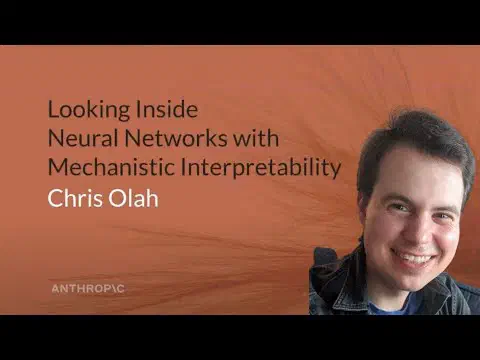
Co-founder leading Anthropic's mechanistic interpretability research
Chris Olah
Profile
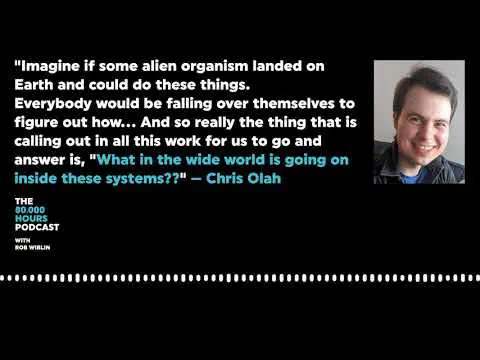
Chris Olah is the closest thing modern AI has to a great scientific illustrator — someone whose entire career is a bet that neural networks are not inscrutable black boxes but objects that can be understood, feature by feature and circuit by circuit, if you look hard enough. As a co-founder of Anthropic and the leader of its interpretability team, he has turned that bet into the field now called mechanistic interpretability: the effort to reverse-engineer the actual algorithms a trained model runs, the way you’d disassemble a compiled binary you didn’t write. For developers, this is the most concrete answer anyone has to the uncomfortable question, “what is my model actually doing in there?”
His path is famously unconventional, and it’s worth knowing because it tells you something about how the field really works. Olah dropped out of the University of Toronto after a year, won a Thiel Fellowship instead of finishing a degree, and worked his way up from intern to research scientist at Google Brain, where he contributed to early neural-network visualization work (including DeepDream). In 2017 he co-founded Distill, an interactive, web-native journal that raised the bar for how machine learning ideas could be explained — full of live diagrams you could poke at. He then led interpretability at OpenAI before departing in 2020 and co-founding Anthropic in 2021 alongside Dario Amodei and the group that walked out of OpenAI with him.
The substance of his work is a decade-long argument built one artifact at a time. If you’re learning AI today, you’ve almost certainly already read him without knowing it — his 2015 blog post “Understanding LSTM Networks” is still the canonical explainer, cited hundreds of times and read by millions. From there the through-line runs through feature visualization, the Circuits thread on vision models, and then — at Anthropic — the transformer circuits program: “A Mathematical Framework for Transformer Circuits,” “Toy Models of Superposition,” and the sparse-autoencoder work (“Towards Monosemanticity,” “Scaling Monosemanticity”) that culminated in the delightfully weird “Golden Gate Claude” demo, a version of Claude with a single internal feature cranked so high it steered every conversation toward the bridge.
Where he sits now is at the center of Anthropic’s safety thesis: that you cannot trust what you cannot inspect, and that interpretability is the discipline that makes inspection possible. He is candid that the work is unfinished and that AI systems are “grown” more than engineered — a framing he brought all the way to a 2026 appearance at the Vatican. Skeptics fairly note that interpretability has yet to prevent a real-world failure, and that features-and-circuits insight still lags model capability by a wide margin. But for anyone building on top of frontier models, Olah’s output is the best available toolkit for turning “the model just does that” into an actual explanation.
Key Articles & Papers
Understanding LSTM Networks Neural Networks, Manifolds, and Topology Feature Visualization The Building Blocks of Interpretability Zoom In: An Introduction to Circuits A Mathematical Framework for Transformer Circuits Toy Models of Superposition Towards Monosemanticity Scaling Monosemanticity: Extracting Interpretable Features from Claude 3 SonnetVideos
Spotify Podcasts




YouTube